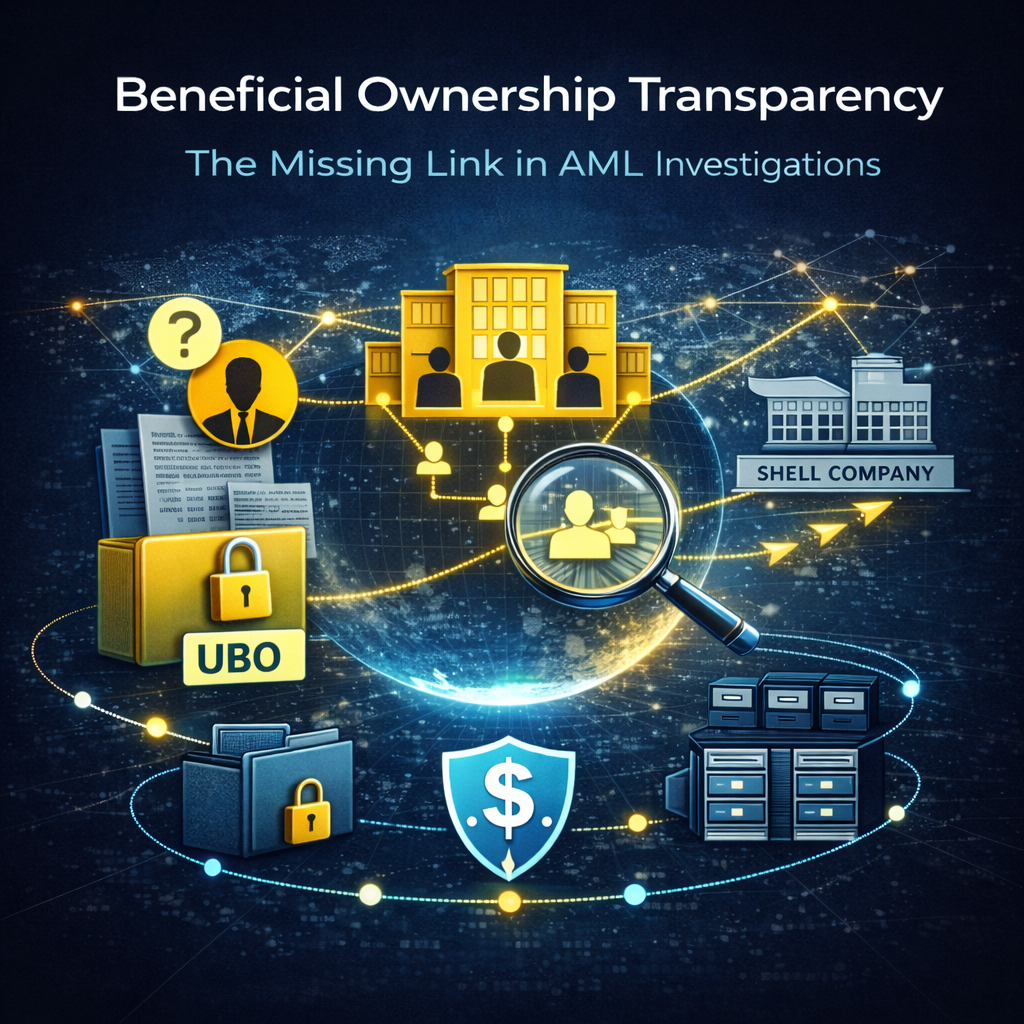
Modern financial crime rarely operates under a criminal’s real name. Instead, illicit funds move through layers of corporate entities, nominee directors, trusts, and offshore structures designed to conceal the true owner of assets. These arrangements are not always illegal; however, when exploited by criminals, they become powerful tools for laundering money and evading law enforcement. For Financial Intelligence Units (FIUs), banks, and regulators, identifying the ultimate beneficial owner (UBO) behind financial transactions is often the key to understanding a financial crime network. Without reliable beneficial ownership information, AML investigations face three fundamental limitations: Investigators cannot identify the real controlling individual Financial institutions struggle to perform effective customer due diligence Authorities cannot link assets to criminal activity Recognizing these challenges, global standards such as FATF Recommendation 24 emphasize the need for accurate, up-to-date beneficial ownership information accessible to competent authorities. This article explores how beneficial ownership transparency strengthens AML frameworks, supports FIU intelligence analysis, and improves asset tracing and recovery across jurisdictions.
Beneficial ownership refers to the natural person who ultimately owns or controls a legal entity or arrangement, even if ownership is exercised indirectly through multiple layers of companies.
In legitimate business operations, corporate structures may exist for taxation, investment management, or legal liability reasons. However, criminals frequently exploit these structures to obscure illicit activities.
Typical concealment strategies include:
Criminals create chains of companies across multiple jurisdictions.
Example structure:
Individual → Company A (Country 1) → Company B (Country 2) → Bank Account (Country 3)
Each additional layer complicates investigations and delays asset tracing.
Nominees are individuals listed as company officers but act on behalf of the true owner.
This practice can obscure control and create the illusion of legitimate governance.
Trust structures may separate ownership from control through trustees, protectors, and beneficiaries.
While legitimate, these arrangements can hide the identity of individuals benefiting from criminal proceeds.
Jurisdictions with historically limited transparency have often been used to register shell companies.
Although regulatory reforms have improved transparency, criminals continue to exploit regulatory gaps.
Financial Intelligence Units rely on accurate ownership data to perform effective financial analysis.
When analysts review Suspicious Transaction Reports (STRs), they attempt to answer key questions:
Who ultimately controls the entity conducting the transactions?
Are multiple companies controlled by the same individual?
Are there links to previously known criminal actors?
Beneficial ownership data helps analysts connect seemingly unrelated financial activities.
For example:
A suspicious payment may involve:
Company A in one country
Company B in another jurisdiction
Multiple bank accounts and intermediaries
Without UBO data, these entities may appear unrelated.
With ownership transparency, analysts may discover that the same individual controls all entities involved in the transaction chain.
This transforms fragmented data into a coherent financial crime network.
The Financial Action Task Force (FATF) has identified beneficial ownership transparency as one of the most critical elements of effective AML systems.
FATF Recommendation 24 requires countries to ensure that competent authorities can access accurate and up-to-date beneficial ownership information.
Key expectations include:
Many jurisdictions now require companies to report their beneficial owners to centralized registries.
These registries provide authorities with a single source of ownership information.
FIUs and investigators must be able to access registry data quickly during financial investigations.
Delayed access can allow criminals to transfer assets before authorities act.
Self-declared ownership information must be verified through:
corporate filings
financial institution due diligence
cross-checking with tax or regulatory data
Without verification, registries risk becoming repositories of inaccurate information.
Cross-border investigations require the ability to share beneficial ownership information between jurisdictions.
The absence of cooperation mechanisms can allow criminals to hide behind international legal barriers.
Despite significant global progress, several challenges remain in implementing effective ownership transparency frameworks.
Some corporate structures involve dozens of entities across several jurisdictions.
Tracing ownership through these structures requires advanced analytical capabilities.
Beneficial ownership registries rely on companies providing accurate information.
If reporting requirements are weak or enforcement is limited, registries may contain incomplete or misleading data.
Countries maintain different thresholds for determining beneficial ownership.
Common thresholds include 25% ownership or control, but criminals can structure holdings to remain below these limits.
Some jurisdictions restrict access to ownership information due to privacy considerations.
While privacy protections are important, excessive restrictions can hinder financial crime investigations.
Modern AML investigations increasingly rely on technology to analyze beneficial ownership data at scale.
Graph databases allow investigators to visualize relationships between individuals, companies, and assets.
These tools can reveal hidden ownership networks and identify central actors.
Entity resolution algorithms identify when different records refer to the same individual or company.
For example:
“John A. Smith”
“J. Smith Ltd Owner”
“Jonathan Smith”
These variations may represent the same beneficial owner.
Platforms used by FIUs increasingly combine:
STR data
corporate registry information
sanctions lists
asset registries
international intelligence requests
Integrated systems allow analysts to build comprehensive ownership profiles quickly.
This dramatically improves investigative efficiency.
Financial institutions play a frontline role in identifying beneficial owners during Customer Due Diligence (CDD) and Enhanced Due Diligence (EDD) processes.
Banks are required to:
identify beneficial owners when opening accounts
verify ownership structures
monitor transactions for suspicious activity
High-quality due diligence improves the quality of STRs submitted to FIUs.
Strong cooperation between financial institutions and FIUs also helps identify emerging risks such as:
professional money laundering networks
misuse of corporate service providers
complex offshore structures used for fraud
Beneficial ownership transparency is one of the most powerful tools available to combat financial crime. Without it, investigators face an opaque financial system where criminals can hide behind layers of legal entities.
When ownership information is accurate, accessible, and integrated into financial intelligence systems, FIUs can transform fragmented transaction data into actionable investigative insights.
Global initiatives such as FATF Recommendation 24 and expanding beneficial ownership registries represent significant progress toward greater transparency. However, achieving meaningful results requires more than regulatory requirements.
Authorities must ensure that ownership information is accurate, verified, accessible, and integrated with financial intelligence analysis tools.
For FIUs, regulators, and financial institutions, strengthening beneficial ownership frameworks will remain a critical priority in the ongoing effort to disrupt financial crime networks and recover illicit assets.