Financial crime is evolving at a pace that challenges traditional investigative structures. Criminal networks increasingly exploit digital financial services, instant payment systems, cross-border transfers, and complex corporate structures to move illicit funds rapidly across the global financial system. For Financial Intelligence Units (FIUs), this transformation creates both operational challenges and opportunities. Historically, many FIUs relied on manual analysis processes, fragmented databases, and limited technological infrastructure. Analysts reviewed suspicious transaction reports (STRs) manually, often working across disconnected systems that slowed investigations and limited the ability to detect complex financial crime patterns.
Financial crime has become increasingly complex due to the expansion of digital financial services and global financial connectivity.
Criminal organizations now use a range of sophisticated techniques to obscure the origin of illicit funds.
Common laundering methods include:
rapid cross-border transfers through correspondent banking networks
shell companies registered in multiple jurisdictions
trade-based money laundering schemes
use of digital assets and cryptocurrency exchanges
layering through multiple financial intermediaries
These methods generate enormous volumes of financial data that must be analyzed to identify suspicious patterns.
For FIUs, the challenge is not simply collecting information but transforming large datasets into actionable financial intelligence.
Without advanced analytical tools, identifying connections between transactions, entities, and criminal networks becomes extremely difficult.
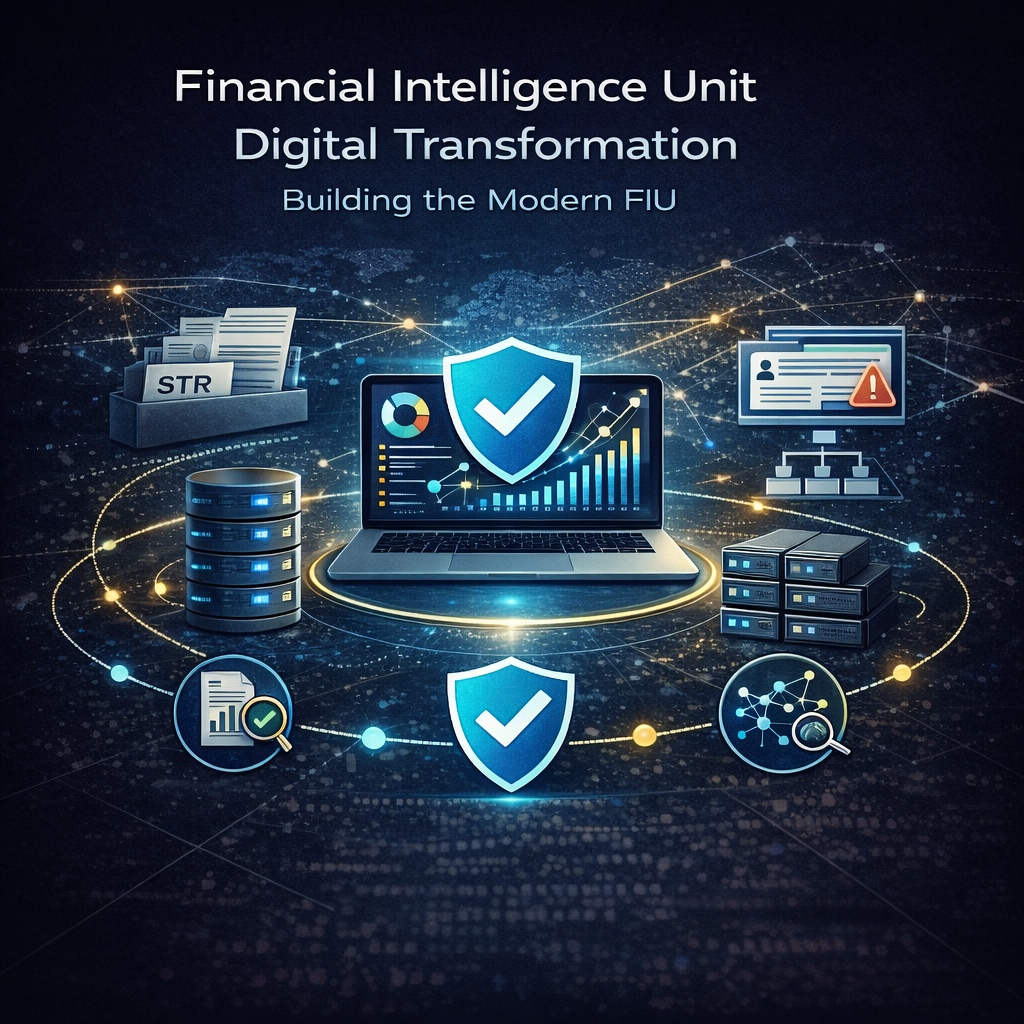
A digitally transformed FIU relies on a technological architecture that integrates multiple intelligence sources into a unified analysis platform.
Key components include:
Platforms such as goAML or FIU360 enable financial institutions to submit STRs electronically. These systems standardize reporting formats and ensure secure transmission of financial intelligence.
Automated ingestion allows FIUs to process thousands of reports efficiently.
Modern FIUs integrate multiple data sources into a centralized intelligence environment, including:
banking transaction reports
beneficial ownership registries
company registries
sanctions lists
law enforcement intelligence databases
Integration allows analysts to access comprehensive datasets during investigations.
Digital case management tools organize investigation workflows and track case progress from initial report to intelligence dissemination.
These systems improve coordination between analysts and ensure proper documentation for legal and regulatory purposes.
Graph analysis and visualization platforms enable analysts to explore complex financial networks.
These tools can reveal relationships between individuals, companies, and accounts that might otherwise remain hidden.
Automation and artificial intelligence are transforming the way FIUs analyze financial data.
Traditional investigative approaches required analysts to manually review large numbers of reports. Today, AI technologies can assist analysts by identifying high-risk patterns within massive datasets.
AI systems can rank suspicious reports according to risk levels, allowing analysts to focus on cases that present the greatest potential threat.
Machine learning algorithms can identify transaction patterns associated with money laundering, fraud, or terrorist financing.
These systems analyze historical cases to detect similarities in new reports.
AI tools can map relationships across thousands of entities simultaneously, identifying key nodes within criminal networks.
This capability dramatically improves investigative efficiency.
Natural language processing technologies allow FIUs to analyze narrative information contained in suspicious transaction reports.
This enables automated extraction of key entities, locations, and financial indicators.
Because FIUs manage highly sensitive financial intelligence, strong governance and security frameworks are essential.
Digital transformation must incorporate strict controls over data access, storage, and sharing.
Key governance components include:
Only authorized personnel should be able to access specific datasets.
Role-based access controls ensure that analysts view only the information required for their investigations.
Financial intelligence systems must comply with national data protection laws and international information-sharing standards.
Secure encryption and monitoring systems protect sensitive intelligence.
Comprehensive audit trails track how data is accessed and used within FIU systems.
This ensures transparency and accountability in intelligence operations.
Financial crime investigations frequently involve multiple jurisdictions. Digital transformation enables FIUs to cooperate more effectively with international partners.
Technological capabilities that support cross-border cooperation include:
The Egmont Secure Web enables FIUs to exchange financial intelligence confidentially with partner jurisdictions.
Secure communication ensures that sensitive investigative information remains protected.
Using standardized reporting formats allows intelligence to be shared quickly between FIUs and law enforcement agencies.
Standardization improves interoperability between systems.
Digital platforms enable investigators in different jurisdictions to coordinate investigations more efficiently, particularly in cases involving complex financial networks.
The modernization of FIU technology infrastructure provides several strategic advantages for financial crime investigations.
Automation significantly reduces the time required to analyze suspicious reports.
Advanced analytics reveal connections between entities that traditional investigative methods may overlook.
Integrated platforms facilitate faster information exchange between FIUs, regulators, and law enforcement agencies.
By prioritizing high-risk cases, FIUs can deploy investigative resources more effectively.
Financial Intelligence Units play a critical role in detecting and disrupting financial crime. However, the scale and complexity of modern financial systems require investigative capabilities that extend beyond traditional manual analysis.
Digital transformation provides FIUs with the tools necessary to process large volumes of financial intelligence, uncover hidden criminal networks, and collaborate more effectively with domestic and international partners.
By investing in integrated intelligence platforms, advanced analytics, and secure information-sharing systems, FIUs can significantly strengthen their ability to combat money laundering, terrorist financing, and other forms of financial crime.
For governments and regulatory authorities, modernizing FIU technology infrastructure is not simply an IT upgrade—it is a strategic investment in national and global financial security.