
Financial Intelligence Units operate in an environment where financial crime is increasingly complex, cross-border, and digitally enabled. Suspicious transaction reports, case files, registry data, sanctions lists, and law enforcement information remain essential, but they rarely provide the full intelligence picture on their own. OSINT for Financial Intelligence Units helps analysts enrich internal data with publicly available information that can reveal additional context, hidden relationships, reputational risks, geographic exposure, corporate links, and behavioral indicators. When used correctly, OSINT becomes a valuable layer in AML/CFT analysis and financial crime investigations.
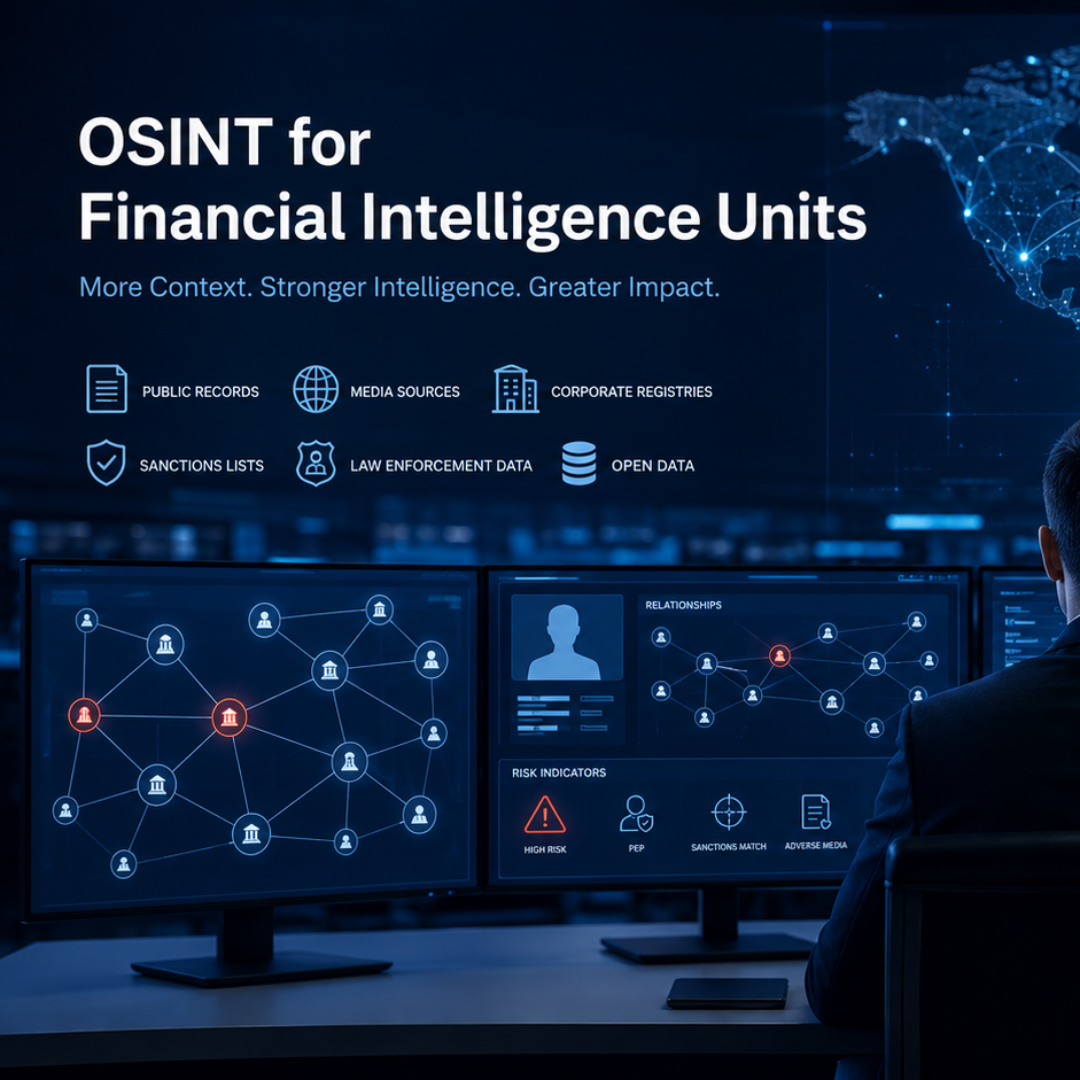
Financial crime actors often leave traces across public and semi-public sources. These traces may appear in company registries, websites, media reports, procurement records, court documents, social platforms, leaked datasets, professional profiles, trade data, shipping references, public sanctions notices, and other accessible sources.
For an FIU analyst, this information can provide important context. A suspicious transaction report may identify a company and several counterparties, but OSINT can help determine whether those entities are linked to adverse media, politically exposed persons, high-risk jurisdictions, shell company networks, or suspicious commercial activity.
OSINT is not a replacement for protected intelligence, official records, or regulated reporting. It is an enrichment layer that supports better questioning, stronger prioritization, and more informed analytical judgment.
Open-source data is valuable, but it is also noisy. Analysts may spend significant time searching, verifying, organizing, and documenting public information. Without a structured process, OSINT work can become inconsistent, difficult to audit, and hard to reproduce.
Public data can also be misleading. Different entities may share similar names, online information may be outdated, and sources may vary in reliability. Analysts need a disciplined approach that separates useful intelligence leads from unsupported assumptions.
For FIUs, the challenge is not simply finding more information. The challenge is turning public data into reliable, explainable, and case-relevant intelligence.
OSINT for Financial Intelligence Units is the structured collection, assessment, and use of publicly available information to support AML/CFT analysis, strategic intelligence, operational intelligence, and investigative referrals.
In practice, OSINT can help analysts answer questions such as:
Who controls or influences an entity?
Does the business activity match the transaction behavior?
Are there links to adverse media or corruption allegations?
Do public records show related companies, addresses, or directors?
Is there evidence of commercial activity consistent with the declared purpose?
Are there public signs of sanctions exposure or evasion risk?
The value of OSINT lies in context. It helps analysts test whether the information inside a report aligns with what can be observed externally.
FIUs frequently analyze companies that appear in suspicious transaction reports, cross-border transfers, procurement activity, trade documents, or beneficial ownership structures.
OSINT can help analysts understand whether a company appears operationally active, where it is registered, who is publicly associated with it, whether it has a visible business presence, and whether its declared activities match observed behavior.
For example, a company receiving high-value international transfers may claim to be engaged in consulting services. Public records may show no website, no staff profiles, no visible customers, and a registered address shared by hundreds of unrelated entities. This does not prove criminal activity, but it may support further analysis.
Adverse media research is one of the most common OSINT activities in AML/CFT work. Analysts may review reputable media sources, public legal records, regulatory notices, and official announcements to identify allegations or findings linked to corruption, fraud, sanctions violations, organized crime, trafficking, or terrorism financing.
The key requirement is careful source evaluation. A reliable official notice carries different weight from an unverified online post. OSINT findings should be documented with source quality, date, relevance, and analytical limitations.
Criminal networks often operate through relationships between people, companies, addresses, intermediaries, websites, phone numbers, email domains, and digital identifiers.
OSINT can reveal connections that are not immediately visible in transaction data. Shared addresses, repeated directors, common web infrastructure, linked phone numbers, similar business descriptions, and overlapping public profiles can all help analysts identify possible relationships.
When combined with internal FIU data, these public indicators can strengthen network analysis and support more targeted investigation.
OSINT is also useful for strategic analysis. FIUs can monitor public trends, enforcement actions, sanctions updates, fraud patterns, emerging payment methods, virtual asset risks, and sector-specific vulnerabilities.
This supports typology development and red flag identification. For example, recurring public cases involving trade-based money laundering, procurement fraud, online investment scams, or sanctions evasion can help FIUs update their analytical indicators and reporting guidance.
When FIUs prepare intelligence packages for law enforcement or other competent authorities, OSINT findings can help provide additional context. Publicly available information may clarify business activity, ownership links, geographic exposure, or reputational concerns.
However, OSINT must be used carefully. Intelligence products should clearly separate verified facts, public-source findings, analytical assessments, and recommendations.
A mature OSINT workflow should be consistent, documented, and auditable. Analysts should not rely on random searches or undocumented browsing.
A practical workflow usually starts with the intelligence question. The analyst defines what needs to be clarified, such as ownership, business activity, location, adverse media, or network links. The next step is source selection, where analysts choose relevant public sources based on reliability and relevance.
Findings are then captured, assessed, and linked to the case record. Analysts should record source URLs, access dates, screenshots where appropriate, reliability notes, and analytical conclusions. The final step is integration into the broader case analysis, where OSINT is compared with internal data, reporting information, and other intelligence sources.
This structure improves consistency and helps supervisors review how conclusions were reached.
OSINT can only support decision-making when it is evaluated properly. Public information must be checked for reliability, relevance, and timeliness.
A source may be official, commercial, journalistic, user-generated, archived, or anonymous. Each type has different evidential value. An official company registry is generally stronger for registration details, while reputable investigative journalism may be useful for allegations but still requires careful treatment.
Analysts should also be cautious with name matching. Similar names can create false associations, especially across different languages or jurisdictions. Entity resolution should consider identifiers such as registration numbers, dates of birth, addresses, directors, domains, and other corroborating details.
Good OSINT practice reduces the risk of false positives and unsupported conclusions.
OSINT becomes more powerful when it is connected to a financial intelligence platform rather than handled only through separate manual research.
A modern platform can help analysts store OSINT findings inside the case record, link findings to entities, attach supporting documents, record source references, and maintain audit history. It can also support data enrichment from approved external sources and present results alongside suspicious transaction reports, internal records, and case history.
This improves analytical efficiency because analysts do not need to switch constantly between disconnected tools. It also improves governance because OSINT findings become part of the controlled case environment.
In platforms such as FIU360 and related enrichment modules, this kind of connected approach can support stronger data quality, faster analysis, and more complete intelligence products. IntelliSYS describes FIU360 Connect as an enrichment add-on that gathers information from financial sources, government databases, and open-source platforms for direct integration into AML analysis workflows.
OSINT must be conducted within clear legal and ethical boundaries. Publicly available does not automatically mean unrestricted use. FIUs need policies that define what sources may be used, how information should be collected, how records should be stored, and how findings should be referenced in intelligence products.
Security is also important. Analysts should avoid exposing operational interest while conducting research. Depending on the jurisdiction and case sensitivity, agencies may need controlled browsing environments, approved tools, access logging, and clear procedures for handling sensitive findings.
A disciplined OSINT program protects both the analyst and the institution.
OSINT is a skill, not just a tool. Analysts need training in source evaluation, search methodology, entity resolution, documentation, verification, bias control, and integration with AML/CFT analysis.
Training should also cover how to avoid overreliance on public data. OSINT findings should support analytical reasoning, not replace it. The strongest intelligence products combine public-source research with regulated reporting, internal records, strategic priorities, and expert judgment.
IntelliSYS project experience includes operational intelligence training, strategic intelligence training, OSINT training, data intake review, and FIU process engineering, which reflects the importance of combining technology modernization with analyst capability development.
When implemented correctly, OSINT improves both operational and strategic intelligence outcomes.
It helps analysts enrich suspicious transaction reports, validate business activity, identify public risk indicators, discover potential links between entities, and support more focused investigations. It also supports strategic analysis by helping FIUs monitor emerging financial crime trends, typologies, and sector-specific vulnerabilities.
For management, structured OSINT creates a more consistent and auditable analytical process. Findings can be reviewed, reused, and connected to case records rather than remaining in informal notes or individual analyst files.
The result is stronger intelligence, better prioritization, and improved support for law enforcement and other competent authorities.
Many organizations approach OSINT informally. Analysts are asked to “search online” without standardized procedures, approved source lists, documentation rules, or quality controls.
This creates inconsistency. One analyst may document findings thoroughly, while another may only summarize them. Some findings may be stored in case files, while others remain in personal notes. Source reliability may not be assessed consistently.
Another mistake is over-automation. Automated tools can accelerate discovery, but they can also produce irrelevant or misleading results if not reviewed carefully. Human judgment remains essential.
A mature OSINT function requires the right balance of technology, methodology, governance, and training.
IntelliSYS specializes in financial intelligence, AML/CFT operations, anti-corruption, criminal intelligence, workflow automation, and secure technology implementation for government and regulated environments. Its public positioning emphasizes the ability to bridge business operations and IT solutions in AML, CTF, anti-corruption, and law enforcement domains.
For OSINT-enabled FIU modernization, IntelliSYS can support authorities with operational assessments, analyst training, data intake improvement, workflow design, secure platform implementation, integration of enrichment sources, and controlled case management.
Through FIU360 and related modules, IntelliSYS helps FIUs connect internal reports, external enrichment, analytics, case workflows, and intelligence outputs into a more effective operating environment.
The objective is not simply to collect more public data. The objective is to turn relevant open-source information into structured, reviewable, and actionable financial intelligence.
Financial Intelligence Units need reliable context to understand suspicious activity, identify hidden relationships, and support stronger investigations. OSINT provides an important enrichment layer when it is collected, assessed, documented, and integrated properly.
OSINT for Financial Intelligence Units helps analysts move beyond isolated reports and build a clearer view of entities, networks, risks, and emerging typologies. When combined with secure platforms, strong governance, and trained analysts, OSINT becomes a practical capability for modern AML/CFT intelligence work.
If your organization is planning to strengthen OSINT capabilities, modernize FIU analysis workflows, or integrate enrichment sources into a financial intelligence platform, IntelliSYS can help design and implement a secure, operationally aligned solution.
Contact IntelliSYS to discuss your OSINT-enabled FIU modernization project or request a consultation.