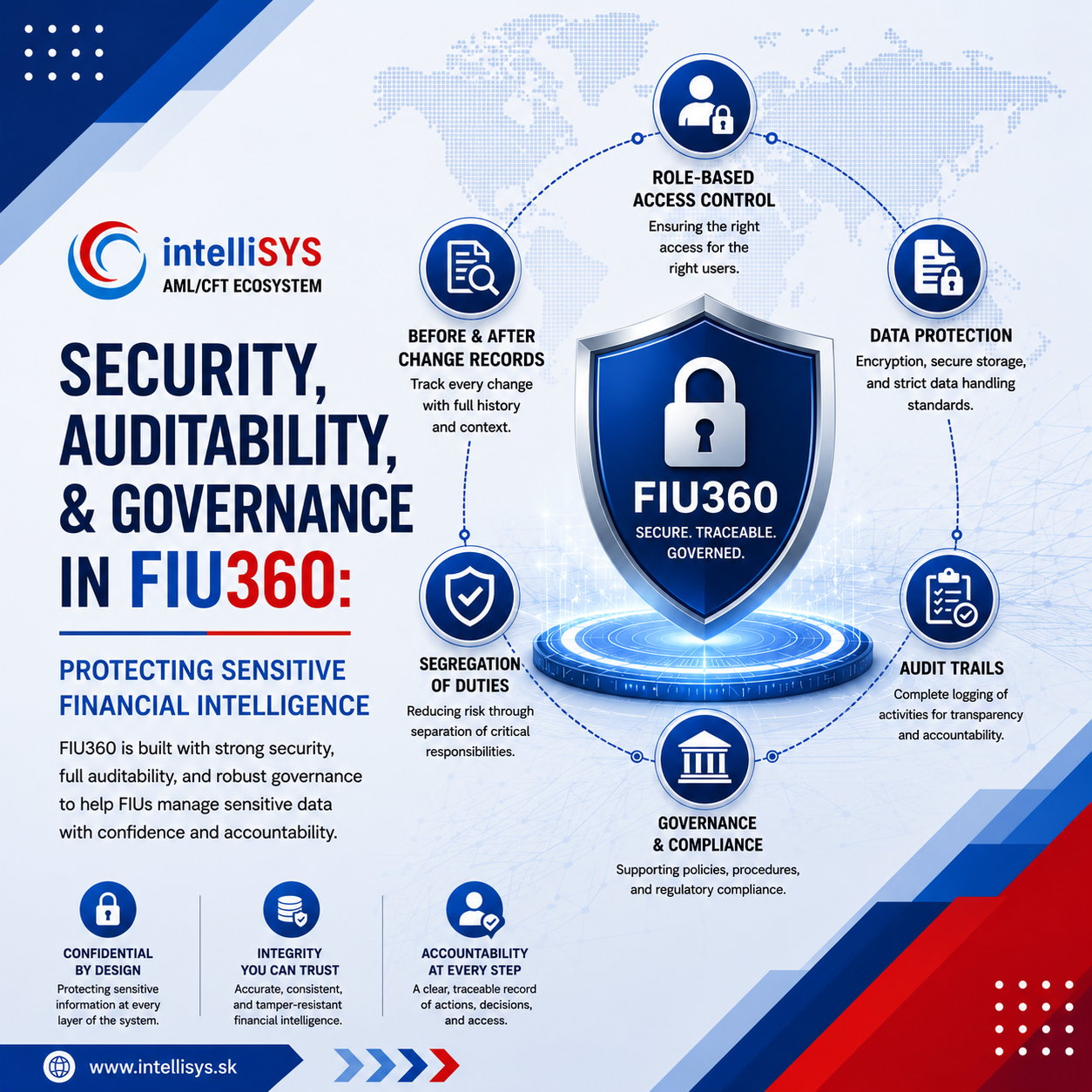
Financial Intelligence Units handle some of the most sensitive information in the national AML/CFT ecosystem. Suspicious transaction reports, intelligence assessments, subject profiles, case files, supporting documents, sanctions alerts, and dissemination records must all be protected with strict security and governance controls. For this reason, a modern FIU does not only need a platform that can collect and analyze data. It needs a secure financial intelligence platform that protects confidentiality, controls access, records every critical action, and supports institutional accountability. FIU360 is designed with security, auditability, and governance as core principles. It helps Financial Intelligence Units manage sensitive financial intelligence in a controlled, traceable, and operationally secure environment.
FIUs operate at the intersection of reporting entities, regulators, law enforcement agencies, government bodies, and international counterparts. The information they receive and produce can include personal data, financial records, suspicious activity reports, criminal intelligence indicators, beneficial ownership data, and sensitive investigation referrals.
If this information is exposed, altered, misused, or accessed by unauthorized users, the consequences can be serious. It may compromise investigations, damage institutional trust, expose confidential reporting, or weaken national financial crime prevention efforts.
This is why FIU technology must be designed around security from the beginning.
Security should not be an add-on. It must be built into user access, data storage, workflow design, document handling, case management, reporting, and intelligence dissemination.
Not every user inside an FIU should see the same information. Analysts, supervisors, administrators, compliance officers, reporting entities, law enforcement recipients, and external stakeholders may all need different levels of access.
FIU360 supports role-based access control, allowing the FIU to define who can access specific modules, screens, records, functions, and workflows.
This helps ensure that users only interact with the information and actions required for their role.
For example, a reporting entity user may be allowed to submit reports and receive FIU communication, but not access internal analytical case files. An analyst may be able to review reports and create cases, while a supervisor may have additional approval or oversight permissions. A system administrator may manage technical settings without accessing sensitive intelligence content where restrictions apply.
This separation is essential for secure FIU operations.
FIUs are not simple organizations. They may include intake teams, analysis teams, compliance units, strategic intelligence teams, operational intelligence teams, IT administrators, supervisors, and management.
Each group may require different access rights.
FIU360’s security model supports granular authorization, which allows access to be configured at a detailed level. This is important because FIU work often involves different report types, case types, security classifications, and sensitivity levels.
For example, a corruption-related case may require tighter access than a routine compliance case. A terrorism financing case may require restricted visibility. A case involving a politically exposed person may need additional control and supervisory oversight.
A secure FIU platform must support these operational realities.
Segregation of duties is a key governance principle in sensitive systems. It helps reduce the risk of unauthorized decisions, conflicts of interest, and uncontrolled changes.
In an FIU environment, the same user should not always be able to perform every action without review. Different tasks may require separate roles for submission, validation, analysis, review, approval, dissemination, and administration.
FIU360 supports this by allowing permissions and workflows to be structured according to institutional policies.
This strengthens internal control and helps the FIU demonstrate that sensitive decisions followed approved procedures.
A secure FIU system must provide a clear record of activity. When sensitive data is accessed, changed, reviewed, escalated, disseminated, or deleted, the institution should be able to reconstruct what happened.
FIU360 includes detailed auditing and logging capabilities.
The system can record user activity from login to logout, including access events, data manipulation, system actions, workflow updates, and changes to records. This creates a traceable history of how information was handled across the platform.
Audit trails are critical for internal governance, supervisory review, incident investigation, and institutional accountability.
They also help protect the FIU by providing evidence that information was handled according to defined procedures.
One of the most important parts of auditability is understanding how data changed over time.
FIU360 can maintain before-and-after images for data changes. This means that when a record is modified, the system can preserve the previous state and the new state of the data.
This is highly valuable in financial intelligence work.
If a subject profile, case field, report detail, or workflow status is updated, supervisors can understand what changed, who changed it, when the change occurred, and from which machine or environment the change was made.
This reduces ambiguity and strengthens trust in the system record.
Encryption is a core requirement for protecting sensitive FIU information.
FIU360 supports encryption for critical data and communication between solution components. It also supports database encryption options to protect sensitive data from unauthorized access.
This is especially important because FIU systems may contain highly confidential information that should not be exposed even to users who manage infrastructure but are not authorized to view intelligence content.
A secure design should protect data both while it is being transmitted and while it is stored.
Encryption helps reduce the risk of unauthorized disclosure, supports data protection requirements, and strengthens the overall security posture of the FIU.
Sensitive information moves through the FIU lifecycle. Reports are submitted by accountable institutions, data is validated, additional sources are connected, analysts review cases, documents are uploaded, and intelligence packages are disseminated to competent authorities.
Each stage involves risk.
FIU360 is designed to support secure communication and encrypted handling of critical information. This helps protect data in transit between users, systems, and platform components.
It also supports the protection of data at rest, which is essential for sensitive records stored inside FIU databases, case files, document repositories, and intelligence archives.
This combination helps ensure that financial intelligence remains protected throughout the operational lifecycle.
Not all FIU data carries the same level of sensitivity.
Some reports may be routine. Others may involve active investigations, politically exposed persons, sanctions exposure, terrorism financing indicators, corruption, organized crime, or sensitive law enforcement cooperation.
FIU360 supports configurable security classifications for cases and intelligence products. This allows the FIU to classify information according to sensitivity and operational need.
Security classifications help determine how records are accessed, who can review them, and what restrictions apply.
This is particularly important for FIUs that need to protect high-risk or high-sensitivity intelligence while still allowing authorized analysis and review.
Case management is one of the most sensitive areas inside an FIU system.
A case may contain linked subjects, transaction details, documents, analyst notes, intelligence hypotheses, attachments, visualizations, decisions, and dissemination records.
FIU360’s case management module allows cases to be created with specific security settings. Access can be limited to authorized staff, and case officers can restrict sensitive files where required.
This means that even if a user has general access to the case management module, they may not automatically have access to every case.
This level of control is essential for protecting highly confidential intelligence assets.
FIUs handle large volumes of documents. These may include scanned records, correspondence, Excel files, Word documents, PowerPoint files, identity documents, legal material, supporting evidence, and intelligence reports.
FIU360 includes document management capabilities that support secure attachment, search, meta-tagging, versioning, and collaborative editing.
Versioning is important because analysts and supervisors need to know which document version was used, who changed it, and when the change happened.
In sensitive environments, document control is not only an efficiency feature. It is part of the institution’s governance and evidence integrity framework.
The final product of an FIU is often an intelligence package disseminated to law enforcement, a counterpart FIU, a regulator, or another competent authority.
This dissemination must be secure, controlled, and auditable.
FIU360 supports secure generation and dissemination of intelligence packages. These packages may include a narrative intelligence report, diagrams, charts, subject profiles, attachments, and structured case data.
A secure dissemination process helps the FIU control who receives intelligence, what was shared, when it was shared, and whether feedback was provided.
This is especially important where intelligence may support investigations, prosecutions, asset recovery, sanctions action, or international cooperation.
Security is not only about access permissions. It is also about process control.
FIU360 includes workflow and process management capabilities that allow FIUs to define how reports, cases, approvals, reviews, escalations, and disseminations should move through the organization.
This supports governance because it reduces informal decision-making and ensures that work follows defined procedures.
For example, a high-risk report may require supervisory review before dissemination. A sensitive case may require restricted access and additional approval. A correction request to a reporting entity may need to be recorded inside the system.
Workflow control helps ensure that these steps are followed consistently.
FIU leadership needs visibility into operational activity. They need to understand workloads, report volumes, case status, analyst performance, workflow delays, dissemination outcomes, and risk trends.
FIU360 supports dashboards, reporting services, statistics, and management oversight capabilities.
From a governance perspective, this is important because management cannot control what it cannot see.
Dashboards and reports help leadership identify operational bottlenecks, monitor performance, assess workloads, and support strategic planning.
Audit trails and workflow records also help management review whether processes are being followed properly.
FIUs operate under national laws and international expectations. They must protect sensitive data, cooperate with competent authorities, maintain confidentiality, and demonstrate effectiveness.
FIU360 is designed to support compliance with international standards and domestic regulatory requirements, including FATF-related expectations, Egmont Group principles, and national data protection requirements.
This does not mean technology alone guarantees compliance. Policies, procedures, training, and governance remain essential.
However, a platform with strong security, auditability, workflow control, and access management gives the FIU a stronger foundation for meeting its obligations.
Consider a sensitive FIU case involving suspected corruption, high-value transfers, multiple legal entities, and possible links to politically exposed persons.
In a weak system, documents may be stored in shared folders, comments may be exchanged by email, and access may be difficult to verify. If management later needs to review who accessed the case or how a decision was made, the record may be incomplete.
With FIU360, the FIU can manage the case inside a controlled platform.
Access can be restricted to authorized staff. Documents can be attached and versioned. Workflow steps can be assigned and tracked. User activity can be logged. Changes can be recorded. Dissemination can be controlled. Management can review the case history when needed.
This creates a stronger, more secure, and more accountable operating environment.
Security planning often focuses on external threats, but insider and operational risks are also important.
A user may accidentally access information they should not see. A document may be sent through the wrong channel. A case may be modified without proper review. A sensitive record may be downloaded without a clear business reason.
FIU360’s access control, auditing, workflow restrictions, and document management functions help reduce these risks.
The goal is not to block legitimate work. The goal is to ensure that legitimate work happens inside a controlled and traceable environment.
Security planning often focuses on external threats, but insider and operational risks are also important.
A user may accidentally access information they should not see. A document may be sent through the wrong channel. A case may be modified without proper review. A sensitive record may be downloaded without a clear business reason.
FIU360’s access control, auditing, workflow restrictions, and document management functions help reduce these risks.
The goal is not to block legitimate work. The goal is to ensure that legitimate work happens inside a controlled and traceable environment.
Security controls must be strong, but they should not make daily work unnecessarily difficult.
FIU analysts need to search, review, link, enrich, and analyze information efficiently. Supervisors need to monitor progress. Managers need performance visibility. Reporting entities and law enforcement partners need secure interaction with the FIU.
FIU360 supports this balance by combining security controls with operational functionality.
Analysts can work inside the platform while access, activity, documents, workflows, and dissemination remain governed by system controls.
This balance is essential for practical FIU modernization.
FIU360 security is powerful because it is connected to the full intelligence lifecycle.
It does not only protect login access. It supports secure registration, controlled data collection, encrypted communication, role-based permissions, case restrictions, document versioning, audit logging, workflow governance, dissemination control, and management oversight.
This integrated security model is important because FIU work is sensitive at every stage.
From the moment a report is submitted to the moment intelligence is disseminated, the FIU must protect confidentiality, integrity, and accountability.
FIU360 is designed to support that requirement.
Security depends not only on software features, but also on correct implementation.
An FIU may need to define user roles, access rights, case classifications, workflow approvals, document rules, audit review procedures, dissemination controls, and data retention policies.
IntelliSYS supports FIUs through platform implementation, configuration, integration, training, consulting, data migration, and operational support.
This helps ensure that FIU360 security features are aligned with the FIU’s internal policies, legal requirements, and operational structure.
The result is a platform that is not only technically secure, but operationally usable and institutionally governed.
Financial intelligence is only valuable when it is protected, trusted, and handled correctly.
FIUs need platforms that do more than process reports. They need secure environments where sensitive data is controlled, user actions are audited, documents are protected, cases are governed, and intelligence dissemination is traceable.
FIU360 provides a secure financial intelligence platform designed around the realities of FIU work. Through role-based access control, audit trails, encryption, workflow governance, case security, document management, and secure dissemination, it helps FIUs protect sensitive intelligence while supporting effective analysis and operations.
If your organization is planning to modernize FIU systems, strengthen AML/CFT data protection, or improve governance over financial intelligence workflows, IntelliSYS can help design and implement a secure FIU360 environment tailored to your requirements.
Contact IntelliSYS to discuss FIU360 security, governance, and implementation options or request a tailored demonstration.