Financial Intelligence Units are expected to process growing volumes of reports, detect complex financial crime patterns, protect sensitive information, and disseminate actionable intelligence to competent authorities. Many FIUs are still trying to meet these expectations with legacy systems, disconnected tools, manual workflows, spreadsheets, email-based communication, and fragmented data sources. This creates a serious operational challenge. A modern FIU does not only need a digital reporting channel. It needs an integrated financial intelligence platform that supports the full lifecycle of FIU work: collection, validation, enrichment, analysis, case management, dissemination, feedback, statistics, security, and governance. This is where FIU360 provides a clear modernization path.
Legacy FIU systems often reflect the needs of an earlier operational environment. They may have been designed primarily to collect reports, store records, or manage basic workflows.
However, financial crime has evolved.
Modern FIUs now face higher reporting volumes, more complex transaction patterns, cross-border risks, digital channels, shell company structures, sanctions exposure, terrorist financing indicators, trade-based money laundering risks, and growing expectations from national and international stakeholders.
Legacy systems often struggle because they are not built for this level of complexity.
They may support report collection, but not advanced enrichment. They may store cases, but not link subjects effectively. They may provide data, but not visualization. They may record activity, but not provide strong dashboards, workflow analytics, or integrated intelligence production.
Legacy FIU systems often reflect the needs of an earlier operational environment. They may have been designed primarily to collect reports, store records, or manage basic workflows.
However, financial crime has evolved.
Modern FIUs now face higher reporting volumes, more complex transaction patterns, cross-border risks, digital channels, shell company structures, sanctions exposure, terrorist financing indicators, trade-based money laundering risks, and growing expectations from national and international stakeholders.
Legacy systems often struggle because they are not built for this level of complexity.
They may support report collection, but not advanced enrichment. They may store cases, but not link subjects effectively. They may provide data, but not visualization. They may record activity, but not provide strong dashboards, workflow analytics, or integrated intelligence production.
In many FIUs, the real problem is not one single system. It is fragmentation.
Reports may be submitted through one channel. Analyst notes may be stored in documents. Case tracking may happen in spreadsheets. Additional information may be requested by email or letters. Documents may be stored in shared folders. Statistics may be prepared manually. Dissemination may happen through separate communication channels.
Each tool may perform a function, but the overall process becomes inefficient.
Fragmented workflows create several risks:
Data may be duplicated.
Important relationships may remain hidden.
Analysts may spend time searching instead of analyzing.
Management may lack real-time visibility.
Audit trails may be incomplete.
Sensitive information may move through uncontrolled channels.
For FIUs, fragmentation is not only an efficiency problem. It is an intelligence risk.
Financial intelligence depends on speed and context.
When analysts need to manually move information between systems, request data from external stakeholders, copy details into case files, build charts separately, and prepare reports from disconnected sources, the intelligence process slows down.
This delay can matter.
Funds may move quickly. Companies may change ownership. Accounts may close. Suspects may adapt their behavior. Law enforcement may need timely intelligence to support an investigation.
Manual handoffs also increase the risk of human error.
A modern FIU platform should reduce unnecessary manual transfer of data and bring key workflows into one controlled environment.
Financial intelligence depends on speed and context.
When analysts need to manually move information between systems, request data from external stakeholders, copy details into case files, build charts separately, and prepare reports from disconnected sources, the intelligence process slows down.
This delay can matter.
Funds may move quickly. Companies may change ownership. Accounts may close. Suspects may adapt their behavior. Law enforcement may need timely intelligence to support an investigation.
Manual handoffs also increase the risk of human error.
A modern FIU platform should reduce unnecessary manual transfer of data and bring key workflows into one controlled environment.
Some FIU systems focus mainly on receiving suspicious transaction reports or other regulatory disclosures.
This is important, but it is not enough.
The real value of an FIU is not in receiving reports. It is in transforming those reports into financial intelligence.
That requires validation, enrichment, analysis, subject linking, risk prioritization, case management, visualization, statistics, dissemination, and feedback.
A system that only collects reports leaves analysts with too much manual work after submission.
FIU360 is designed to support the full FIU operating model, not only the intake stage.
FIU360 provides a more complete approach to FIU modernization.
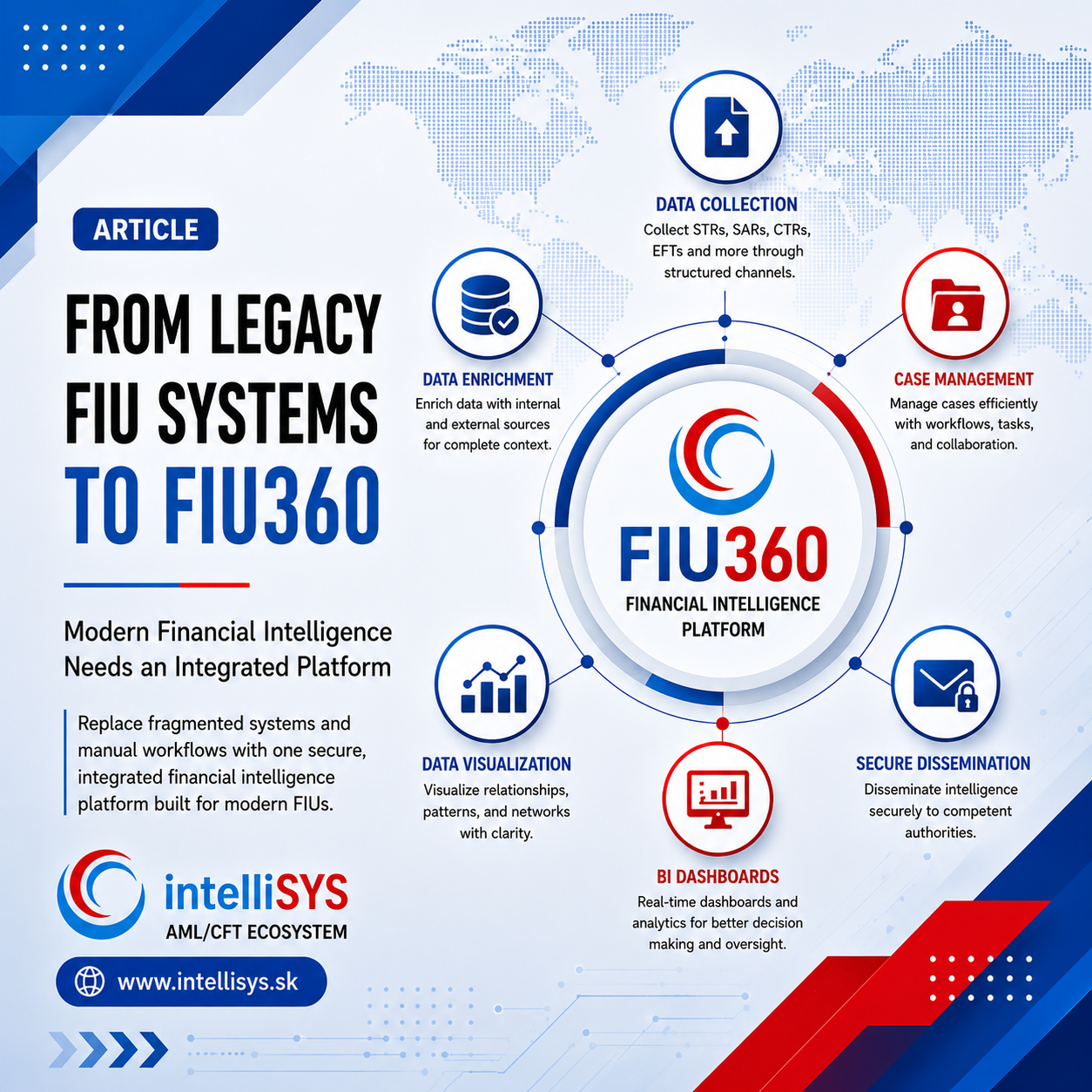
It is designed as an integrated financial intelligence platform that supports the full lifecycle of FIU operations. The platform connects reporting, data validation, enrichment, subject management, structured analysis, visualization, workflow management, case management, document management, statistics, BI dashboards, dissemination, feedback, security, and audit logging.
This integrated design helps FIUs move away from disconnected processes.
Instead of analysts working across separate systems and manual files, FIU360 provides a centralized environment where financial intelligence work can be performed, monitored, secured, and governed.
Legacy systems often suffer from inconsistent or incomplete data intake. If reports are submitted in poor structure or with weak validation, analysts inherit those problems later.
FIU360 supports structured data collection through configurable schemas, XML submissions, web forms, validation rules, and business rules.
This helps ensure that incoming reports meet defined requirements before they move deeper into the FIU workflow.
Better data at intake improves every later stage of analysis.
When reports are complete, standardized, and validated, analysts can spend less time correcting errors and more time identifying risk.
Legacy FIU environments often require analysts to manually request additional information from national databases, government agencies, registries, or law enforcement bodies.
This can take days or weeks.
FIU360 supports data enrichment by connecting financial reports to relevant external and internal sources. This may include company registries, population records, tax data, customs data, immigration records, vehicle registries, criminal intelligence systems, sanctions lists, open sources, and other authorized databases.
This helps analysts see more than the report itself.
They can understand ownership, relationships, historical activity, related subjects, and possible links to broader financial crime networks.
Legacy systems may store records, but they often do not help analysts connect subjects efficiently.
Financial crime analysis depends on relationships. A person may be linked to multiple accounts. A company may share directors with other entities. A phone number may appear across several reports. An address may connect unrelated-looking subjects.
FIU360 supports subject data management for persons, entities, accounts, transactions, phones, addresses, and other identifiers.
This allows analysts to search, view, update, and connect subjects inside the intelligence database.
The result is stronger relationship discovery and more complete intelligence profiles.
Legacy FIU environments often rely heavily on tables, documents, and manual diagrams.
These formats can make complex networks difficult to understand.
FIU360 includes data visualization capabilities that help analysts represent money flows, commodity flows, entity networks, and social relationships visually.
This matters because financial crime networks are often complex.
A visual network can help analysts identify hidden relationships, central actors, suspicious structures, and links between separate reports or cases.
Visualization also improves communication with law enforcement agencies that may need to understand a complex intelligence hypothesis quickly.
Legacy processes are often dependent on individual habits. One analyst may handle a report one way, while another follows a different process.
This makes performance difficult to measure and quality difficult to standardize.
FIU360 includes workflow and process management capabilities that allow FIUs to define standardized procedures for different report types, case types, reviews, approvals, escalations, and disseminations.
When a report or case enters the system, the workflow can assign tasks, track progress, measure completion times, trigger notifications, and support supervisory oversight.
This helps FIUs create more consistent and measurable operations.
Financial intelligence cases often contain sensitive data, linked subjects, documents, analyst notes, hypotheses, visualizations, and dissemination records.
In legacy environments, these assets may be stored across folders, emails, spreadsheets, and isolated systems.
This weakens security and makes case history difficult to reconstruct.
FIU360 includes case management capabilities that help FIUs organize and protect intelligence assets inside a controlled environment.
Cases can be assigned to officers, linked to subjects, classified by security level, restricted to authorized users, and managed through defined workflows.
This strengthens both operational efficiency and confidentiality.
FIUs handle many types of unstructured information. These may include scanned documents, correspondence, spreadsheets, reports, PowerPoint files, identity documents, and supporting attachments.
In legacy environments, these files are often stored outside the main intelligence system.
This creates search, access, version control, and auditability problems.
FIU360 includes document management capabilities that allow documents to be attached, searched, meta-tagged, versioned, and managed within the intelligence environment.
This keeps supporting material connected to the relevant case, subject, or report.
It also helps ensure that documents remain traceable and accessible to authorized users.
FIU leadership needs real-time visibility.
Managers need to know how many reports are received, which sectors are reporting, which cases are delayed, how workloads are distributed, how analysts are performing, and what trends are emerging.
In legacy environments, this information is often prepared manually through spreadsheets and periodic reports.
FIU360 includes statistics, BI dashboards, and reporting services that help management monitor operations more effectively.
This supports better oversight, resource planning, performance management, and strategic decision-making.
A modern FIU cannot be managed effectively if leadership depends only on delayed manual reporting.
The final value of FIU analysis often depends on dissemination.
An intelligence package may need to be sent to law enforcement, a regulator, a counterpart FIU, or another competent authority.
In legacy environments, dissemination may happen through email, file transfer, manual correspondence, or separate systems.
This can create confidentiality, tracking, and feedback challenges.
FIU360 supports secure dissemination of intelligence packages and feedback tracking. The package may include narrative reports, charts, visualizations, subject profiles, documents, and structured case data.
This helps the FIU understand not only what was shared, but also whether the intelligence supported an investigation or produced operational value.
Modernization is not only about speed. It is also about control.
FIU systems must protect sensitive information, restrict access, audit user activity, encrypt critical data, and support governance.
Legacy environments often have gaps in auditability because work happens across many disconnected channels.
FIU360 supports role-based access control, detailed audit logging, encryption, security classifications, case restrictions, document versioning, and workflow governance.
This helps FIUs maintain confidentiality, accountability, and traceability across the intelligence lifecycle.
One of the biggest advantages of FIU360 modernization is the shift from data silos to a unified intelligence environment.
In a fragmented model, data exists in different places and analysts must manually connect it.
In an integrated model, the platform helps bring reports, subjects, transactions, documents, workflows, enrichment data, cases, visualizations, statistics, and dissemination records into one controlled environment.
This creates stronger context.
Analysts can see more connections. Supervisors can monitor progress. Managers can review performance. Law enforcement can receive better intelligence packages. The FIU can maintain stronger auditability.
This is the practical value of integration.
Consider an FIU receiving an STR involving a company with suspicious cross-border transfers.
In a legacy workflow, the report may be received electronically but reviewed manually. The analyst may search company registry data separately, request additional information by email, create notes in a Word document, track the case in a spreadsheet, prepare a diagram manually, and send the intelligence package through another channel.
This process can work, but it is slow, fragmented, and difficult to audit.
With FIU360, the report can be validated at intake. Enrichment can retrieve additional information from connected sources. Subject data management can identify links to persons, entities, accounts, addresses, and previous reports. Visualization can support network analysis. Case management can organize the intelligence file. Workflow tools can track review and approval. Dissemination can send a secure intelligence package and record feedback.
The same case becomes more structured, traceable, and intelligence-led.
Replacing a legacy system is not only a technical project.
It requires understanding the FIU’s mandate, reporting requirements, data sources, workflows, security model, users, legal environment, reporting entities, law enforcement partners, and management needs.
This is why FIU modernization must combine technology, consulting, integration, migration, and training.
A modern platform should be configured around the FIU’s actual operating model.
FIU360 supports this by offering modular capabilities that can be adapted to the FIU’s current needs and expanded as maturity grows.
One of the concerns in legacy modernization is historical data.
FIUs may have years of reports, cases, subjects, documents, and audit records in older systems. This data represents institutional memory and cannot be ignored.
A modernization project should include a careful data migration strategy.
The objective is not only to move data from one system to another. It is to preserve intelligence value, maintain data integrity, support searchability, and ensure historical records remain useful.
IntelliSYS supports FIU modernization through data migration, system configuration, integration, and implementation services.
This helps FIUs transition without losing the value of their historical intelligence.
Legacy systems may have been designed for lower reporting volumes and simpler workflows.
As reporting sectors expand and transaction volumes grow, FIUs need systems that can scale.
FIU360 is designed with modularity and scalability in mind. It can support increasing data volumes, additional modules, more users, more report types, and expanded data source integration.
Scalability is not only about technical capacity. It is also about operational flexibility.
A modern FIU platform must support growth in reporting, analysis, management oversight, and cooperation.
FIUs operate under national law, but they are also assessed against international standards and expectations.
They must demonstrate the ability to receive reports, analyze information, disseminate intelligence, protect confidentiality, cooperate with competent authorities, and contribute to AML/CFT effectiveness.
A fragmented legacy environment can make this harder.
FIU360 supports the operational foundations needed for stronger performance: structured data intake, enrichment, analysis, workflow control, case management, statistics, dissemination, feedback, security, and governance.
Technology alone does not create effectiveness, but it can provide the infrastructure needed to support it.
IntelliSYS supports FIU modernization through both technology and services.
This includes FIU360 implementation, configuration, system integration, data migration, infrastructure design, security auditing, training, consulting, and operational support.
This matters because every FIU has different requirements.
Some may need to replace legacy systems completely. Others may need to improve data enrichment, integrate national databases, strengthen case management, modernize reporting workflows, or improve management dashboards.
IntelliSYS helps design the modernization path according to the FIU’s operating environment.
FIU360 is strong because it brings the key FIU functions together.
It supports registration, data collection, validation, sanctions screening, enrichment, subject management, structured analysis, visualization, process management, case management, document management, statistics, BI dashboards, dissemination, feedback, security, and audit logging.
This integrated model helps FIUs reduce fragmentation, improve data quality, strengthen analysis, protect sensitive information, and manage operations more effectively.
For FIUs moving away from legacy systems, FIU360 provides a platform designed specifically for financial intelligence work.
Legacy FIU systems may have supported earlier stages of digital transformation, but modern financial intelligence requires more.
FIUs now need integrated platforms that can manage data, workflows, analysis, cases, documents, dashboards, dissemination, feedback, security, and governance in one environment.
FIU360 helps FIUs move from fragmented legacy operations to a modern, secure, and intelligence-led operating model.
For institutions planning legacy FIU system modernization, FIU360 offers a comprehensive platform designed around the real needs of Financial Intelligence Units.
Contact IntelliSYS to discuss how FIU360 can support your FIU modernization journey or request a tailored demonstration.