
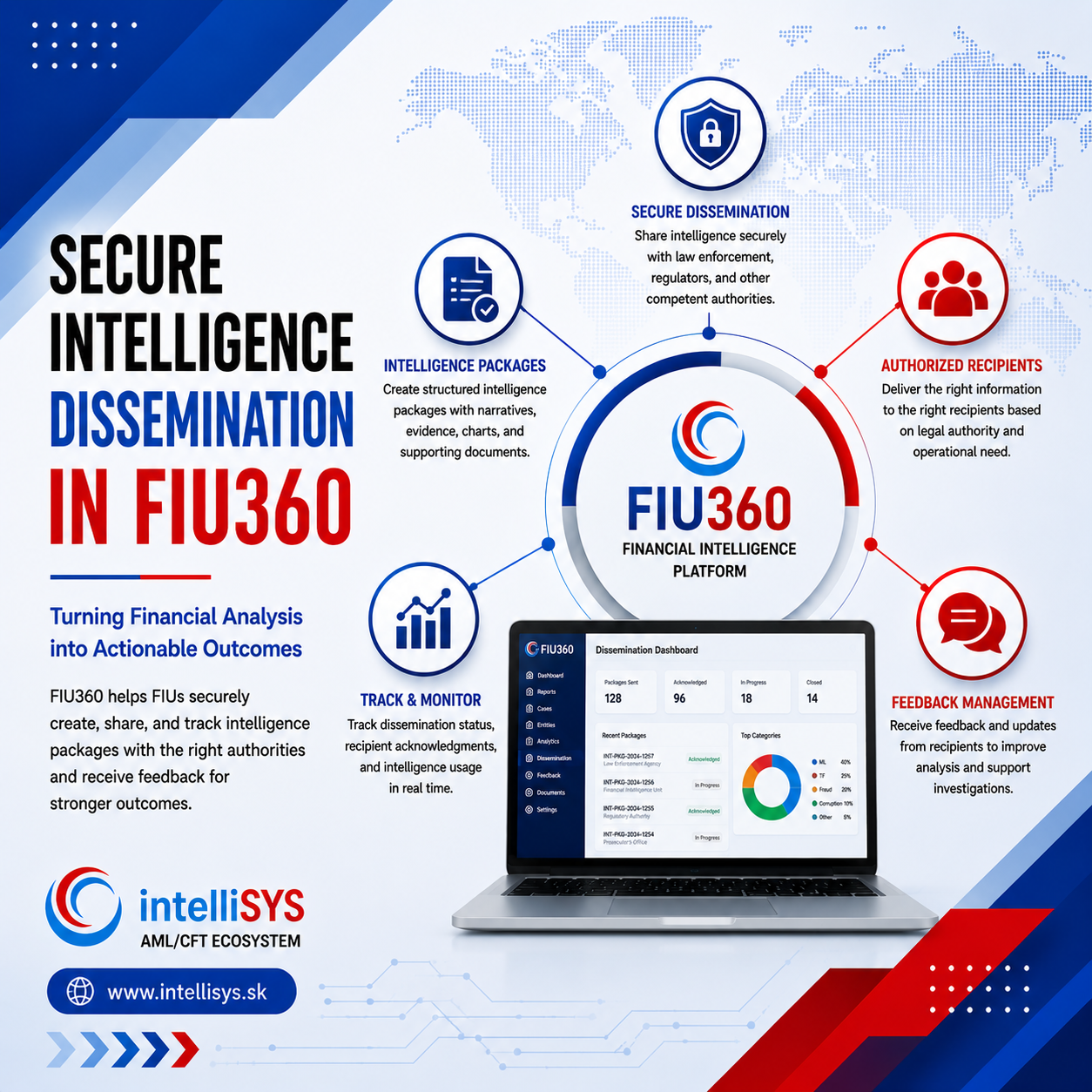
The final value of a Financial Intelligence Unit is not only in collecting reports or analyzing suspicious activity. The real value appears when the FIU produces intelligence that can support action. This action may come from law enforcement agencies, prosecutors, regulators, supervisory authorities, counterpart FIUs, or other competent bodies. For that reason, FIU intelligence dissemination must be secure, structured, traceable, and useful. An intelligence package should not only contain information. It should communicate the analytical findings clearly, protect sensitive data, and support the next operational step. FIU360 supports this critical stage of the intelligence lifecycle by helping FIUs generate, control, disseminate, and track intelligence packages inside a secure environment.
An FIU receives reports from accountable institutions, enriches data, analyzes subjects, identifies suspicious patterns, and develops intelligence. But analysis alone does not complete the FIU mission.
The intelligence must reach the right authority in a format that can be understood and used.
If dissemination is weak, even strong analysis may lose value.
A law enforcement agency may receive incomplete information. A regulator may not have the supporting evidence needed for action. A counterpart FIU may not understand the context. A case may be delayed because the intelligence package is unclear or poorly structured.
Effective dissemination turns analysis into operational value.
In many FIUs, dissemination still depends on manual processes. Analysts may prepare narrative reports in Word, create diagrams separately, attach supporting files manually, send documents by email, and track feedback through spreadsheets or correspondence.
This creates several risks.
Information may be incomplete.
Attachments may be missed.
Sensitive data may be shared through uncontrolled channels.
Feedback may not be properly recorded.
Management may not know whether the intelligence was used.
Audit trails may be fragmented.
Manual dissemination can also reduce consistency. Different analysts may prepare intelligence packages in different formats, making it harder for recipients to understand and act on the intelligence.
A modern FIU platform should make dissemination structured, secure, and measurable.
A strong intelligence package should communicate both the facts and the analytical view.
It may include a narrative intelligence report, subject profiles, linked entities, transaction summaries, charts, visualizations, supporting documents, risk indicators, analyst observations, and recommended areas for further investigation.
The package should be clear enough for external recipients to understand the intelligence hypothesis.
This is especially important when the recipient is a law enforcement agency that may not specialize in financial intelligence analysis.
A well-structured package helps the recipient answer practical questions:
Who is involved?
What activity appears suspicious?
How are the subjects connected?
What financial flows were identified?
What documents support the analysis?
What action or follow-up may be required?
FIU360 supports this by helping analysts organize intelligence outputs into structured and secure packages.
Dissemination should not be treated as a separate administrative task at the end of analysis. It should be part of the full FIU workflow.
FIU360 connects reporting, validation, enrichment, subject management, structured analysis, visualization, case management, document handling, and dissemination inside one platform.
This means the intelligence package can be built from the work already performed inside the FIU system.
The analyst does not need to reconstruct the case manually from disconnected files. Relevant subjects, documents, diagrams, charts, and analytical notes can remain connected to the case and used to support the final intelligence output.
This reduces duplication and improves consistency.
Financial intelligence is highly sensitive. Dissemination must be controlled carefully.
FIU360 supports secure dissemination to authorized recipients such as law enforcement agencies, counterpart FIUs, regulators, and other competent authorities.
The goal is to ensure that intelligence reaches the right recipient through a controlled process.
This is important because intelligence packages may include personal data, financial records, transaction details, suspicion indicators, beneficial ownership information, criminal intelligence links, or sensitive analytical conclusions.
A secure dissemination model helps protect confidentiality and reduce the risk of unauthorized disclosure.
Not every recipient should receive the same information. Dissemination must reflect legal authority, operational need, security classification, and case sensitivity.
FIU360 supports controlled access to intelligence packages by allowing the FIU to manage who receives the package and what information is included.
This helps the FIU avoid over-sharing while still supporting effective cooperation.
For example, one package may be prepared for a domestic law enforcement agency, while another may be prepared for a regulatory authority or international counterpart. Each recipient may need a different level of detail, different attachments, or different handling instructions.
A secure FIU platform should support this level of control.
The purpose of dissemination is not simply to send information. It is to support action.
An actionable intelligence package should help the recipient understand the suspected activity and decide what to do next.
This may include opening an investigation, requesting additional information, freezing assets, conducting interviews, coordinating with another agency, reviewing licensing or supervisory risks, or sharing intelligence internationally.
FIU360 helps analysts prepare intelligence products that are more complete and operationally useful.
By combining narrative analysis with subject profiles, visualizations, documents, and case context, the FIU can provide recipients with a clearer basis for action.
Financial crime cases often involve complex relationships.
A suspicious activity may involve multiple companies, directors, accounts, addresses, intermediaries, jurisdictions, and transaction flows. Explaining this through text alone can be difficult.
FIU360’s visualization capabilities support better dissemination by helping analysts create diagrams and visual representations of relationships, flows, and networks.
These visuals can be included in the intelligence package to help recipients understand the structure of the case faster.
For law enforcement agencies, this is especially valuable. A visual diagram can make a complex financial intelligence hypothesis easier to understand, communicate, and investigate.
An intelligence package is stronger when it includes relevant supporting material.
This may include reports, extracted records, correspondence, identity documents, registry results, spreadsheets, charts, previous case references, or other attachments.
FIU360 supports document management and case attachment handling, helping analysts keep supporting materials connected to the relevant intelligence case.
When the package is disseminated, the FIU can include the documents needed to support the analysis.
This helps avoid a common problem in manual dissemination: sending a narrative report without the supporting files needed by the recipient.
Consistency matters in intelligence reporting.
If every analyst uses a different structure, recipients may find it harder to interpret intelligence packages. Management may also find it harder to review quality across teams.
FIU360 supports configurable reporting templates aligned with FIU operational practices.
Templates help ensure that intelligence products follow a clear structure. They can guide analysts to include key sections, relevant fields, supporting context, and required handling information.
This improves the quality and consistency of intelligence dissemination.
It also supports training, supervision, and institutional knowledge management.
Sensitive intelligence should not always be disseminated without review.
Depending on the case type, risk level, security classification, or recipient, the FIU may require supervisory approval before sharing an intelligence package.
FIU360 supports workflow control, allowing dissemination processes to follow defined approval steps.
This helps ensure that intelligence packages are reviewed, authorized, and shared according to institutional procedures.
For high-risk cases involving terrorism financing, corruption, sanctions exposure, politically exposed persons, or organized crime, this control can be especially important.
A modern FIU must be able to prove how intelligence was handled.
This includes knowing who prepared the package, who reviewed it, who approved it, who received it, when it was shared, and what attachments were included.
FIU360 supports audit trails and system logging that help maintain traceability over dissemination activity.
This protects the FIU and strengthens governance.
If questions arise later about a specific dissemination, the institution can review the system record rather than relying on emails, memory, or separate files.
Dissemination should not be the end of the process.
The FIU should know whether the intelligence was useful, whether it supported an investigation, whether further information was requested, and whether the case contributed to operational or strategic outcomes.
Feedback is essential for improving FIU effectiveness.
FIU360 supports feedback tracking so that the FIU can monitor dissemination outcomes and follow-up actions.
This helps answer important questions:
Was the intelligence package used?
Did it support an investigation?
Did law enforcement request more information?
Was the case linked to asset recovery, prosecution, supervision, or another action?
What can the FIU learn for future analysis?
Without feedback, the FIU may not know whether its intelligence products are creating value.
Feedback helps FIUs improve both operational and strategic performance.
At the operational level, feedback shows analysts whether their intelligence packages were useful to recipients. This can improve future report writing, visualization, case development, and dissemination quality.
At the management level, feedback helps leadership understand the value of FIU outputs.
For example, management may identify which types of intelligence packages are most useful to law enforcement, which sectors generate the most actionable reports, or which typologies require stronger analysis.
This turns dissemination from a one-way process into a learning cycle.
FIU-law enforcement cooperation is one of the most important parts of national AML/CFT effectiveness.
FIUs may produce intelligence, but law enforcement agencies often conduct investigations and operational action.
If intelligence is poorly packaged, delayed, or difficult to understand, the cooperation gap widens.
FIU360 supports stronger cooperation by helping FIUs disseminate structured, secure, and complete intelligence packages.
A law enforcement recipient can receive a clearer view of the suspected activity, the subjects involved, the supporting documents, and the relationship analysis.
This makes it easier to move from intelligence to investigation.
Financial crime often crosses borders. FIUs may need to share intelligence with counterpart FIUs under applicable legal and cooperation frameworks.
In these cases, secure and traceable dissemination is critical.
FIU360 helps FIUs manage intelligence products in a controlled environment, supporting confidentiality, documentation, and follow-up.
A structured dissemination process can help ensure that shared intelligence is clear, relevant, and properly handled.
This is important for international cooperation, especially where cases involve cross-border transfers, foreign entities, international trade, sanctions risks, or multi-jurisdictional networks.
Consider an FIU analyzing a suspicious network involving multiple companies, several directors, foreign transfers, and possible links to trade-based money laundering.
The analyst enriches the report with company registry data, identifies shared directors, reviews transaction flows, attaches supporting documents, and creates a network visualization.
In a manual environment, the analyst may need to assemble the intelligence package across several tools and send it through a separate channel.
With FIU360, the analyst can prepare a structured intelligence package within the platform.
The package may include the narrative report, subject profiles, transaction charts, network diagrams, supporting documents, and case references. The dissemination workflow can route the package for review and approval. Once approved, it can be shared securely with the authorized recipient, and feedback can be tracked.
This creates a stronger chain from analysis to action.
After receiving an intelligence package, a law enforcement agency opens an investigation and later provides feedback to the FIU.
The feedback may indicate that the intelligence helped identify suspects, supported search warrants, linked to an existing investigation, or required additional financial analysis.
If feedback is received informally by email, it may be difficult to connect it back to the original dissemination.
With FIU360, feedback can be tracked against the dissemination record.
This helps the FIU understand the operational value of its intelligence and build better future products.
It also helps management report on outcomes and improve cooperation with external agencies.
Manual dissemination creates leakage risks. Intelligence may be sent to the wrong recipient, forwarded outside approved channels, stored in uncontrolled folders, or attached to unsecured emails.
FIU360 helps reduce these risks by supporting controlled dissemination through secure platform processes.
The FIU can manage recipients, package content, access rights, workflow approvals, and dissemination records.
This supports confidentiality and helps protect both the FIU and the recipient agency.
In sensitive cases, secure dissemination is not optional. It is a core operational requirement.
Feedback tracking helps the FIU improve.
If law enforcement repeatedly requests additional information, this may show that intelligence packages need stronger supporting detail. If certain visualizations are useful, the FIU can standardize them. If some typologies produce more actionable disseminations, the FIU can refine its analytical focus.
FIU360 enables the FIU to treat dissemination as a measurable process.
This supports continuous improvement.
Instead of only counting how many reports were disseminated, the FIU can begin assessing whether the disseminated intelligence produced useful outcomes.
FIU leadership needs visibility over dissemination activity.
Managers may need to know how many intelligence packages were sent, to which agencies, for which typologies, with what level of urgency, and with what feedback.
FIU360’s statistics, reporting, and BI dashboard capabilities support this type of oversight.
This allows management to monitor the FIU’s external impact and cooperation performance.
It also supports annual reporting, strategic planning, resource allocation, and preparation for institutional reviews.
An FIU’s effectiveness cannot be measured only by the number of reports received.
A more meaningful question is whether the FIU produces useful intelligence.
Dissemination and feedback provide important evidence of this.
If intelligence packages support investigations, regulatory action, international cooperation, asset recovery, typology development, or strategic risk understanding, the FIU can demonstrate stronger operational value.
FIU360 helps FIUs capture and manage this part of the intelligence lifecycle more effectively.
Every FIU has its own legal framework, cooperation model, reporting practices, approval requirements, and dissemination procedures.
IntelliSYS supports FIUs by configuring FIU360 workflows, templates, user roles, dissemination channels, security settings, and feedback processes according to institutional needs.
This matters because dissemination is not only technical.
It must align with laws, mandates, confidentiality obligations, inter-agency protocols, and operational realities.
IntelliSYS helps ensure that FIU360 dissemination capabilities are implemented in a way that supports the FIU’s actual working environment.
FIU360 dissemination is powerful because it connects intelligence production with operational use.
It helps analysts create structured packages, attach supporting material, include visual analysis, follow approval workflows, share intelligence securely, track recipients, record feedback, and support management oversight.
This creates a stronger chain from report intake to intelligence outcome.
For modern FIUs, that chain is essential.
The purpose of the FIU is not only to process information. It is to produce intelligence that helps competent authorities act.
Financial intelligence becomes valuable when it reaches the right authority, in the right format, through the right controls, at the right time.
FIU360 helps FIUs manage this process securely and effectively. It supports structured intelligence packages, controlled dissemination, auditability, feedback tracking, and management oversight.
For FIUs seeking to strengthen cooperation with law enforcement, regulators, counterpart FIUs, and competent authorities, secure dissemination and feedback management should be core modernization priorities.
If your organization wants to improve intelligence dissemination, strengthen feedback tracking, or build a more secure FIU cooperation workflow, IntelliSYS can help configure FIU360 to support your operational requirements.
Contact IntelliSYS to discuss FIU360 dissemination and feedback capabilities or request a tailored demonstration.