
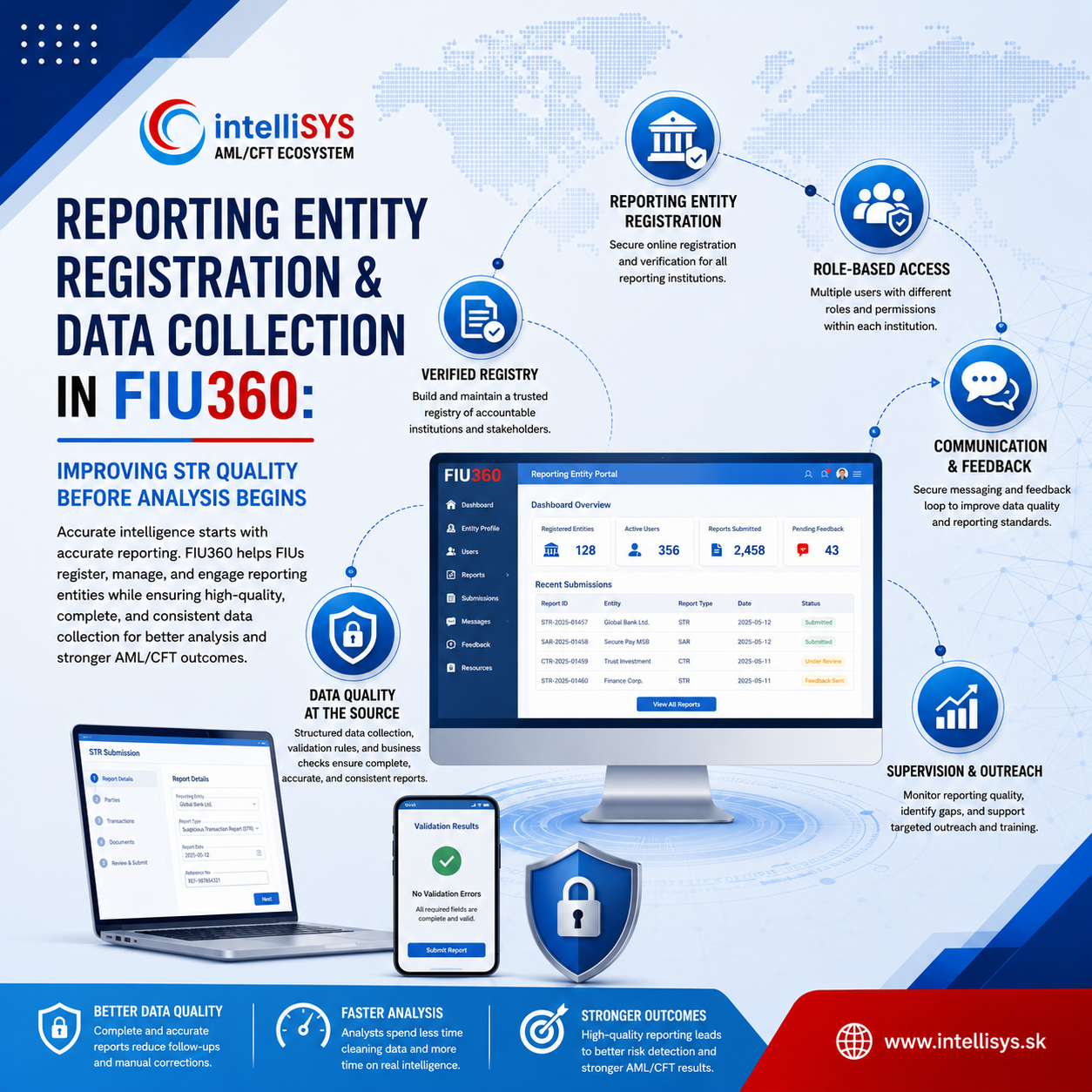
Financial Intelligence Units depend on the quality of the information they receive from accountable institutions. If suspicious transaction reports are incomplete, inconsistent, poorly structured, or difficult to validate, analysts lose valuable time before the real intelligence work can begin. A modern FIU must therefore improve data quality at the source. This begins with secure reporting entity registration, controlled access, structured report submission, automated validation, and clear communication with reporting institutions. FIU360 supports this foundation through dedicated registration and data collection capabilities designed specifically for Financial Intelligence Units and national AML/CFT reporting ecosystems.
Every FIU needs to know who is interacting with it.
Reporting entities, regulators, law enforcement agencies, supervisory bodies, and other stakeholders may all need controlled access to FIU systems. However, they should not all have the same permissions or responsibilities.
A commercial bank may need several users with different roles. A money service business may have a smaller team. A regulator may need a different interaction model. A law enforcement agency may need access only to specific intelligence dissemination functions or communication channels.
Without a structured registration model, the FIU may struggle to manage access, verify counterparties, and control communication.
FIU360 helps address this by supporting secure online registration and verified counterpart management.
Every FIU needs to know who is interacting with it.
Reporting entities, regulators, law enforcement agencies, supervisory bodies, and other stakeholders may all need controlled access to FIU systems. However, they should not all have the same permissions or responsibilities.
A commercial bank may need several users with different roles. A money service business may have a smaller team. A regulator may need a different interaction model. A law enforcement agency may need access only to specific intelligence dissemination functions or communication channels.
Without a structured registration model, the FIU may struggle to manage access, verify counterparties, and control communication.
FIU360 helps address this by supporting secure online registration and verified counterpart management.
A strong registration process does more than create user accounts.
It creates a verified registry of institutions and stakeholders connected to the FIU. This registry becomes an important operational asset because it allows the FIU to manage who can submit reports, who can communicate with the FIU, and who can receive specific types of messages or intelligence outputs.
For accountable institutions, this creates a clearer and more formal relationship with the FIU.
For the FIU, it improves oversight and reduces the risks associated with informal or unmanaged access.
A verified registry also supports better supervision, outreach, communication, and reporting sector management.
Reporting institutions are not all structured the same way.
A large financial institution may need separate users for preparing draft reports, reviewing submissions, approving reports, communicating with the FIU, managing institutional details, and receiving feedback. Smaller entities may need a simpler access model.
FIU360 supports role-based access and hierarchical permissions so that multiple users can operate under the same institution with different rights.
This is important because AML/CFT reporting should not depend on one shared account or one uncontrolled access point.
Role-based permissions help ensure that the right users perform the right actions, while the FIU maintains visibility and control.
When reporting access is structured, accountability improves.
The FIU can better understand which institution submitted a report, which user performed an action, when the submission occurred, and whether follow-up communication was required.
This is important for governance and operational traceability.
If a report requires correction, the FIU can communicate with the appropriate institution through a controlled channel. If a reporting entity repeatedly submits poor-quality reports, the FIU can identify the issue and support targeted outreach or training.
Good registration is therefore not only an access control function. It is part of the broader data quality and reporting governance framework.
Many FIUs face the same problem: reports arrive with missing information, weak narratives, inconsistent fields, formatting errors, duplicate details, or unclear transaction structures.
These issues create unnecessary work.
Analysts may need to request corrections, search for missing information, manually clean data, or interpret poorly structured submissions before assessing the actual suspicious activity.
This delays intelligence production and reduces the operational value of incoming reports.
Data quality must therefore be addressed before the report enters the analytical workflow.
FIU360 supports this through structured data collection, configurable schemas, validation rules, and business rule checks.
FIU360 supports structured data collection for different report types, including suspicious transaction reports, suspicious activity reports, currency transaction reports, electronic funds transfer reports, terrorist financing reports, politically exposed person-related reports, and account information files.
The platform allows accountable institutions to submit information through XML data files or web forms.
This dual submission model is important.
Larger institutions may prefer automated XML reporting from internal systems. Smaller reporting entities may need secure web forms that guide them through the required fields.
FIU360 supports both approaches while maintaining structured reporting standards.
Every jurisdiction may have different reporting requirements.
One FIU may require specific fields for STRs. Another may need different transaction details for EFTs, CTRs, or account information files. Some jurisdictions may require sector-specific fields or national risk indicators.
FIU360 supports configurable XML schema design, allowing the FIU to define what information should be collected for each report type.
This flexibility helps the FIU align reporting requirements with national legislation, operational needs, and AML/CFT priorities.
It also helps create standardization across report types, making it easier for analysts to review and compare information.
Modern FIUs do not receive only one type of report.
They may receive suspicious transaction reports, suspicious activity reports, currency transaction reports, electronic funds transfer reports, terrorist financing reports, politically exposed person-related reports, threshold reports, account information files, and sector-specific disclosures.
A weak reporting system may treat these reports as isolated formats.
FIU360 helps standardize reporting structures while still allowing different report types to capture the required information.
This gives analysts a more consistent view of transactions, persons, accounts, entities, and related subjects across different submissions.
Consistency at intake improves analysis later.
Automated validation is one of the most important data collection capabilities in FIU360.
When a report is submitted, the system can check whether the submission complies with the expected schema, whether required fields are complete, and whether the structure meets the FIU’s reporting rules.
This reduces the number of weak reports entering the FIU workflow.
Validation also helps reporting entities understand what needs to be corrected before the report is accepted.
Instead of discovering errors later during analysis, the system can identify issues at the point of submission.
This saves time for both the FIU and the reporting institution.
Schema validation checks whether data is structurally complete. Business rules go further.
Business rules can check whether the content of a report makes sense according to FIU-defined logic.
For example, a report may contain required fields but still have inconsistent dates, incomplete party information, invalid combinations of values, or transaction details that do not meet reporting expectations.
FIU360 supports business rule checks to strengthen report quality.
This helps the FIU reduce avoidable errors and improve the reliability of incoming data.
Better input quality leads to better financial intelligence analysis.
Reporting entities need clear feedback.
If a report is accepted, the institution should receive confirmation. If a report contains errors, the institution should understand what needs to be corrected.
FIU360 can generate confirmation letters or correction feedback automatically, helping reporting institutions respond quickly.
This improves communication between the FIU and accountable institutions.
It also creates a more professional and consistent reporting experience.
Instead of relying on informal emails or delayed manual responses, FIU360 supports structured feedback directly within the reporting process.
Analysts should not spend most of their time correcting basic reporting errors.
Their value is in identifying risk, connecting subjects, developing intelligence, and supporting competent authorities.
When incoming data is incomplete or inconsistent, analysts are forced into administrative correction work.
FIU360 helps reduce this burden by improving report quality before analysis begins.
Automated validation, structured reporting, business rule checks, and clear feedback help prevent poor-quality submissions from consuming analyst time.
This allows analysts to focus more on intelligence production.
Data collection affects every later stage of the FIU lifecycle.
If report data is structured and validated properly, it becomes easier to enrich, search, link, analyze, visualize, and manage inside the FIU platform.
For example, if persons, entities, accounts, addresses, and transaction details are submitted consistently, FIU360 can better support subject data management and relationship discovery.
If transaction fields are standardized, analysts can compare activity across report types more effectively.
If reporting entities submit clean and complete data, enrichment sources can be connected more accurately.
Strong data intake is therefore the foundation for strong financial intelligence.
Reporting entities often want to comply but may struggle with technical requirements, XML structures, field definitions, and report formatting.
FIU360’s structured submission model can help institutions understand what is required.
Web forms can guide smaller institutions through the submission process. XML submission can support larger institutions with automated reporting. Validation and correction feedback can help all institutions improve over time.
This supports a healthier national AML/CFT reporting ecosystem.
When the FIU provides clear digital processes, reporting entities can submit better information with fewer avoidable errors.
A strong reporting ecosystem depends on communication.
The FIU may need to confirm registration status, approve users, request corrections, send guidance, provide feedback, or communicate changes in reporting requirements.
FIU360 provides a controlled environment for managing these interactions.
This helps reduce dependence on informal email exchanges and improves traceability.
When communication is managed through the platform, the FIU can maintain a clearer record of interactions with reporting entities.
This is useful for supervision, training, outreach, and operational governance.
Consider a newly regulated reporting entity that must begin submitting suspicious transaction reports to the FIU.
In a manual environment, the institution may send forms by email, wait for approval, receive unclear instructions, and share credentials internally after access is created.
This creates risks and delays.
With FIU360, the institution can register through a secure online process. The FIU can review and approve the registration. Different users can receive different roles based on their responsibilities. The institution can begin submitting reports through controlled access.
This creates a more secure and organized start to the reporting relationship.
A financial institution submits an STR involving several transactions and related parties.
In a weak reporting process, the report may arrive with missing fields, unclear transaction structure, or inconsistent subject details. The analyst may need to contact the institution manually to request corrections.
With FIU360, the report can be checked at submission.
If required information is missing or validation rules are not met, the system can generate correction feedback. If the report is accepted, the reporting entity receives confirmation, and the report enters the FIU workflow with stronger structure and data quality.
This improves the entire downstream process.
Risk-based prioritization depends on reliable input data.
If key fields are missing or inconsistent, the FIU’s ability to score and prioritize reports becomes weaker.
FIU360’s data collection and validation capabilities help ensure that the information needed for risk assessment is captured more consistently.
This supports the FIU’s ability to identify higher-risk reports, route them through appropriate workflows, and allocate analyst attention more effectively.
Strong data collection is therefore directly connected to better risk-based operations.
High-quality reporting is not only useful for individual cases.
Over time, structured data helps the FIU identify broader trends, typologies, sector risks, geographic patterns, and reporting quality issues.
For example, the FIU may identify which sectors submit the most reports, which report types contain frequent errors, which regions generate higher-risk activity, or which typologies are emerging.
FIU360’s structured data collection and reporting services support this strategic view.
This helps the FIU move from case-by-case processing toward broader national AML/CFT insight.
Reporting quality can also inform supervision and outreach.
If certain institutions repeatedly submit incomplete reports, the FIU may need to provide guidance or training. If a sector shows weak reporting behavior, supervisory authorities may need to understand the issue.
FIU360 helps create visibility over reporting behavior.
This can support targeted engagement with accountable institutions.
Instead of treating reporting quality problems as isolated analyst frustrations, the FIU can identify patterns and address them systematically.
Report submission involves sensitive information from the start.
FIU360 supports controlled access, role-based permissions, audit logging, and secure communication. This helps protect the confidentiality of reports and the integrity of the submission process.
The FIU can maintain traceability over who submitted a report, when it was submitted, whether it passed validation, and what feedback was provided.
This is important because secure intake is the first stage of secure intelligence management.
A report should not only be received. It should be received through a controlled and auditable process.
FIU360’s registration and data collection capabilities are powerful because they improve the FIU lifecycle from the beginning.
They help create a verified national registry of reporting institutions and stakeholders. They support controlled access and role-based permissions. They allow structured submission through XML files or web forms. They improve data quality through validation and business rules. They support feedback to reporting institutions and reduce avoidable analyst workload.
This strengthens the entire intelligence process.
Better registration leads to better control. Better data collection leads to better analysis.
Implementing a strong reporting process requires more than activating a portal.
The FIU must define report types, data fields, XML schemas, validation rules, business rules, user roles, institutional registration requirements, communication procedures, and correction workflows.
IntelliSYS supports FIUs through FIU360 configuration, workflow design, training, consulting, integration, and implementation services.
This helps ensure that the reporting process reflects the FIU’s legal framework, national reporting requirements, sector structure, and operational needs.
The result is a reporting environment that is both technically structured and operationally practical.
Financial intelligence begins before the analyst opens a case.
It begins when reporting entities register, receive controlled access, submit structured reports, and provide complete, validated information.
FIU360 helps FIUs improve this foundation through secure reporting entity registration, role-based access, structured data collection, XML and web form submission, validation rules, business rule checks, and automated feedback.
For FIUs seeking to improve STR quality, reduce correction workload, strengthen reporting entity communication, and build a more effective AML/CFT reporting ecosystem, registration and data collection should be treated as core modernization priorities.
Contact IntelliSYS to discuss how FIU360 can strengthen reporting entity registration, data collection, and STR quality in your FIU environment.