
Financial Intelligence Units manage complex workflows. A report may begin as a suspicious transaction submission, but it can quickly become an analytical review, an intelligence case, a request for enrichment, a supervisory approval, a dissemination package, or a referral to law enforcement. Without structured case and workflow management, this process can become fragmented. Analysts may rely on emails, spreadsheets, shared folders, manual notes, and informal task assignments. Supervisors may struggle to see what is delayed. Managers may lack reliable performance information. Sensitive cases may not receive the right level of access control. FIU360 addresses this challenge through integrated case and workflow management designed specifically for FIU operations.
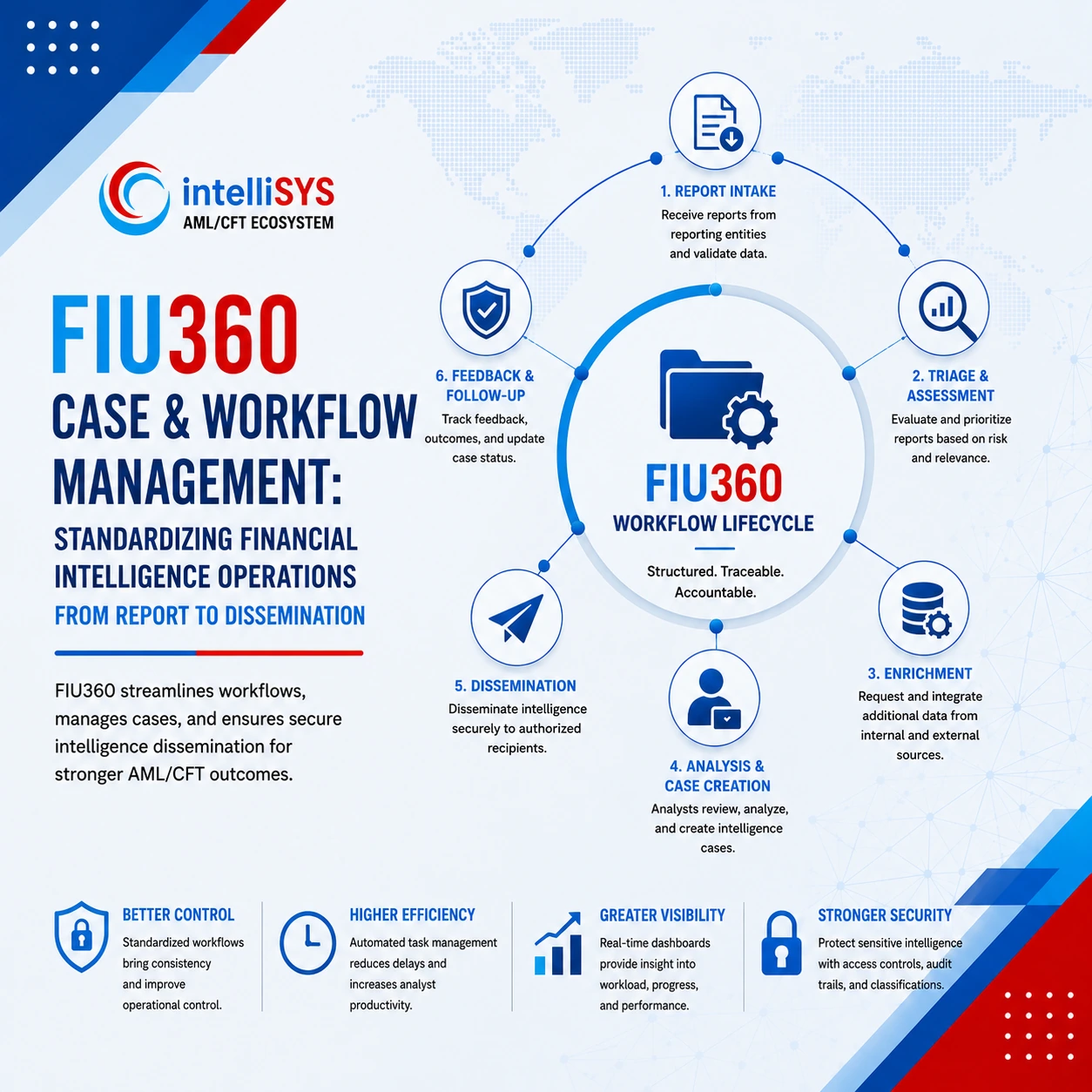
FIU work is not a single task. It is a sequence of decisions, reviews, actions, and controls.
A suspicious transaction report may need validation, triage, enrichment, analyst review, case creation, document attachment, visualization, supervisory approval, dissemination, and feedback tracking.
If these steps are handled manually, the FIU may lose consistency.
One analyst may follow one approach, while another may follow a different process. Some cases may be escalated quickly, while others wait without clear visibility. Sensitive information may be stored outside the official case record.
A structured FIU case management system helps ensure that work follows defined procedures and remains traceable from beginning to end.
Many FIUs have dedicated analysts and strong institutional knowledge, but their systems may not fully support structured operations.
Reports may be received in one system. Analyst notes may be kept in documents. Tasks may be assigned by email. Case progress may be tracked in spreadsheets. Supporting documents may be stored in separate folders. Approvals may be handled manually.
This creates operational risk.
The FIU may not have a complete view of case status. Supervisors may not know which cases are delayed. Management may struggle to measure performance. Audit trails may be incomplete. Sensitive intelligence may be harder to protect.
Informal workflows also make it difficult to scale when reporting volumes increase.
A modern FIU platform must bring workflow, case management, documents, security, and oversight into one controlled environment.
FIU360 includes a process manager designed to standardize FIU operations.
The process manager allows system administrators to design workflows and link them to report types, case types, and operational procedures. Once a report or case enters the workflow, the system can assign the next task to the appropriate staff member and track progress.
This helps the FIU move from informal work allocation to structured task management.
For example, an STR may follow a defined path from intake to triage, enrichment, analyst review, supervisory approval, case creation, and dissemination. A compliance case may follow a different workflow. A terrorism financing-related report may require faster escalation and restricted handling.
FIU360 supports these differences through configurable workflows.
Not every report should follow the same process.
A low-risk report may require standard review. A high-risk STR may require enrichment and supervisory approval. A sanctions-related alert may need immediate escalation. A corruption case may require enhanced security restrictions. A strategic analysis project may follow a different workflow from an operational intelligence case.
FIU360 allows FIUs to design workflows that reflect these different needs.
This is important because standardization does not mean treating all cases the same. It means applying the right procedure consistently to the right type of work.
By linking workflows to report and case types, FIU360 helps ensure that operational procedures are followed correctly.
A workflow is only useful when responsibilities are clear.
FIU360 can assign workflow steps to the appropriate staff members or roles. This helps users understand what they need to do, when it is due, and where the task sits within the broader process.
This improves accountability.
Instead of relying on informal reminders or email follow-ups, the system can show which tasks are pending, who owns them, and how long they have been open.
For supervisors, this creates better visibility. For analysts, it creates clearer expectations. For management, it creates a more reliable basis for measuring operations.
FIUs need to understand how long work takes.
How long does it take to review an STR?
How long does enrichment take?
Which workflow steps cause delays?
Which teams are overloaded?
Which report types require more analyst time?
Which cases remain pending beyond expected timelines?
FIU360’s process management capabilities support time tracking across workflow steps.
This allows the FIU to measure performance more objectively.
Instead of relying only on manual reporting, management can generate statistics on task completion, processing times, workflow bottlenecks, and operational workload.
This supports better planning and stronger institutional oversight.
FIUs need to understand how long work takes.
How long does it take to review an STR?
How long does enrichment take?
Which workflow steps cause delays?
Which teams are overloaded?
Which report types require more analyst time?
Which cases remain pending beyond expected timelines?
FIU360’s process management capabilities support time tracking across workflow steps.
This allows the FIU to measure performance more objectively.
Instead of relying only on manual reporting, management can generate statistics on task completion, processing times, workflow bottlenecks, and operational workload.
This supports better planning and stronger institutional oversight.
Workflow automation helps reduce manual administrative burden.
FIU360 can support standard actions within workflows, such as sending notifications, generating status reports, creating reminders, or updating the risk classification of a report or case.
These automated actions help ensure that important steps are not missed.
For example, a high-risk case may trigger a supervisor notification. A pending task may generate a reminder. A specific workflow decision may update the status or risk classification of the case.
Automation does not replace analyst judgment. It supports consistent execution of operational procedures.
Once a matter becomes an intelligence case, the FIU needs a secure way to manage all related information.
A case may include reports, persons, entities, accounts, transactions, documents, notes, visualizations, enrichment results, analyst findings, supervisory decisions, and dissemination records.
FIU360 case management helps consolidate these assets into a structured case environment.
This allows analysts and case officers to manage the complete intelligence picture rather than working across separate files and systems.
A strong case management function helps preserve context.
It ensures that the case is not just a collection of documents, but a structured intelligence record.
FIU360 case management can consolidate related data, documents, and entities into a case binder.2tt
This is important because intelligence work depends on context.
A report may connect to a person. That person may connect to a company. The company may connect to other accounts, addresses, directors, and historical reports. Supporting documents may explain parts of the network. Visualizations may help describe the relationship structure.
A case binder keeps these elements together.
This helps analysts review, develop, and present intelligence more effectively.
It also helps supervisors and managers understand the case without searching across multiple locations.
A case should have clear ownership.
FIU360 allows the FIU to assign a case officer to oversee the case. This creates responsibility for case development, documentation, workflow progress, and coordination with relevant users.
Case officer assignment is important for operational control.
It helps ensure that the case is actively managed and that decisions are recorded by the appropriate person.
For sensitive or complex cases, clear ownership also supports accountability and confidentiality.
Not all FIU cases carry the same sensitivity.
Some cases may involve routine financial intelligence. Others may involve corruption, politically exposed persons, organized crime, terrorist financing, sanctions exposure, active law enforcement investigations, or international cooperation.
FIU360 supports case-level security controls, allowing different cases to have different access restrictions.
This means that sensitive cases can be protected more tightly than standard cases.
Access can be limited to specific authorized staff, even if other users have general access to the case management module.
This is essential for protecting sensitive intelligence assets.
In high-sensitivity cases, role-based access may not be enough.
A case officer may need to restrict access to named staff members only. FIU360 supports this type of control, helping ensure that only authorized users can view or interact with sensitive case files.
This is particularly important for cases involving corruption, insider concerns, politically exposed persons, terrorism financing, or highly confidential law enforcement cooperation.
By allowing access to be restricted at case level, FIU360 helps the FIU protect information according to operational need.
Security becomes part of case management, not a separate afterthought.
Financial intelligence cases are built around relationships.
A case may involve persons, entities, accounts, addresses, phone numbers, transactions, documents, and historical reports.
FIU360 allows related subjects to be linked to case files, helping analysts build a clearer intelligence picture.
This improves case development.
Instead of treating each subject as a separate record, the analyst can understand how the subjects relate to the case and to each other.
This is especially useful in complex financial crime matters involving networks, beneficial ownership structures, intermediaries, and repeated transaction patterns.
FIU cases often include unstructured information.
This may include scanned documents, correspondence, account statements, company records, identity documents, spreadsheets, PowerPoint files, law enforcement responses, or supporting evidence.
FIU360 includes document management capabilities that allow documents to be attached, searched, meta-tagged, versioned, and managed within the platform.
This keeps documents connected to the relevant case.
It also reduces the risks associated with storing documents in shared folders, personal drives, or email attachments.
Document management strengthens both analysis and governance.
Many FIU cases require review.
A supervisor may need to review the analysis before a case is escalated, closed, disseminated, or referred to another authority.
FIU360 workflow management can support these approval steps.
This helps ensure that sensitive decisions are not made informally or outside defined procedures.
Supervisory review also improves quality control. It allows senior staff to assess whether the analysis is complete, whether supporting documents are adequate, whether dissemination is appropriate, and whether further enrichment is required.
Not every report becomes a case.
Some reports may be reviewed and retained. Others may be linked to existing subjects. Some may require enrichment. High-risk reports may become intelligence cases.
FIU360 helps support this transition.
A report can move through a defined review process. If the analysis indicates that further work is required, the FIU can create a case, assign a case officer, link related subjects, attach documents, define workflow steps, and apply security classifications.
This creates a controlled path from report intake to intelligence development.
Supervisors need to know what is happening across their teams.
Which cases are pending?
Which reports are overdue?
Which analysts have the heaviest workload?
Which high-risk matters require review?
Which workflow steps are causing delays?
FIU360 supports visibility through workflow tracking, statistics, dashboards, and reporting services.
This helps supervisors manage operations in real time.
Instead of waiting for manual updates, supervisors can monitor case and workflow status directly inside the platform.
This improves responsiveness and accountability.
FIU leadership needs more than case-level visibility. It needs operational intelligence about the FIU itself.
FIU360 can support statistics and BI dashboards that show performance across analysts, units, workflows, report types, and case categories.
This helps management understand how the FIU is operating.
For example, leadership can review processing times, backlog, workload distribution, case volumes, dissemination activity, and workflow efficiency.
This information supports strategic planning, resource allocation, annual reporting, and institutional performance improvement.
A modern FIU should be able to measure its own operations.
Case and workflow management support both operational and strategic intelligence.
At the operational level, case management helps analysts develop specific intelligence cases and manage related subjects, documents, and decisions.
At the strategic level, workflow and case data help the FIU identify patterns across operations.
For example, the FIU may identify that certain report types take longer to process, that certain sectors generate more complex cases, or that specific typologies require more enrichment.
This information can support outreach, training, supervision, staffing decisions, and national risk understanding.
Consider an FIU receiving a high-risk STR involving a legal entity, multiple foreign transfers, and possible links to a politically exposed person.
In a manual workflow, the report may be assigned by email, supporting documents may be stored separately, enrichment may be tracked informally, and supervisory approval may happen outside the main system.
This creates delays and weakens auditability.
With FIU360, the report can enter a defined workflow. The system can assign the task to an analyst, trigger enrichment, apply a higher risk classification, create an intelligence case, link related subjects, attach documents, restrict access, route the case for supervisory review, and prepare it for dissemination if required.
The process becomes structured, measurable, and secure.
A corruption-related intelligence case may involve public officials, legal entities, complex ownership structures, and sensitive law enforcement cooperation.
This type of case requires strict access control.
With FIU360, the FIU can create a specific case type with enhanced security settings. The case officer can restrict access to named users. Relevant subjects and documents can be linked to the case. Workflow steps can require supervisory review before dissemination.
This helps protect confidentiality while allowing authorized analysts to continue their work.
The case remains inside a controlled environment with audit trails and documented decisions.
Spreadsheets and emails are common in many FIU environments, but they are not suitable for managing sensitive intelligence workflows at scale.
They are difficult to audit, easy to duplicate, hard to secure, and weak for case lifecycle management.
FIU360 reduces this dependency by bringing task management, case files, documents, workflow steps, approvals, and performance statistics into the platform.
This does not only improve efficiency. It strengthens governance.
A controlled system helps the FIU preserve institutional memory and protect sensitive information.
FIU360 case and workflow management is powerful because it connects process, security, intelligence, and oversight.
It helps FIUs standardize work, assign tasks, track time, automate actions, manage cases, protect sensitive information, link subjects, store documents, route approvals, monitor performance, and support dissemination.
This integrated model is important because financial intelligence work cannot be reduced to simple case storage.
A modern FIU needs to manage the full operational journey from report intake to intelligence outcome.
FIU360 supports that journey.
Every FIU has different procedures, case categories, approval models, reporting requirements, and security policies.
IntelliSYS supports FIUs by configuring FIU360 workflows, case types, user roles, templates, security levels, dashboards, and reporting services according to institutional needs.
This may include mapping standard operating procedures, designing workflow diagrams, configuring process steps, setting role-based permissions, defining case types, and training users.
This implementation support is important because workflow modernization must reflect how the FIU actually operates.
The goal is not to force a generic process. The goal is to create a controlled digital workflow that supports the FIU’s mandate.
Financial intelligence depends on disciplined operations.
Reports must be reviewed, enriched, analyzed, escalated, managed, secured, disseminated, and measured through clear processes.
FIU360 helps FIUs achieve this through integrated case and workflow management. It supports standardized procedures, task assignment, time tracking, case binders, document handling, security controls, supervisory review, dashboards, and operational reporting.
For FIUs seeking to reduce fragmentation, improve accountability, protect sensitive cases, and strengthen operational performance, case and workflow management should be a central modernization priority.
Contact IntelliSYS to discuss how FIU360 can support your FIU case management, workflow automation, and operational oversight requirements.