
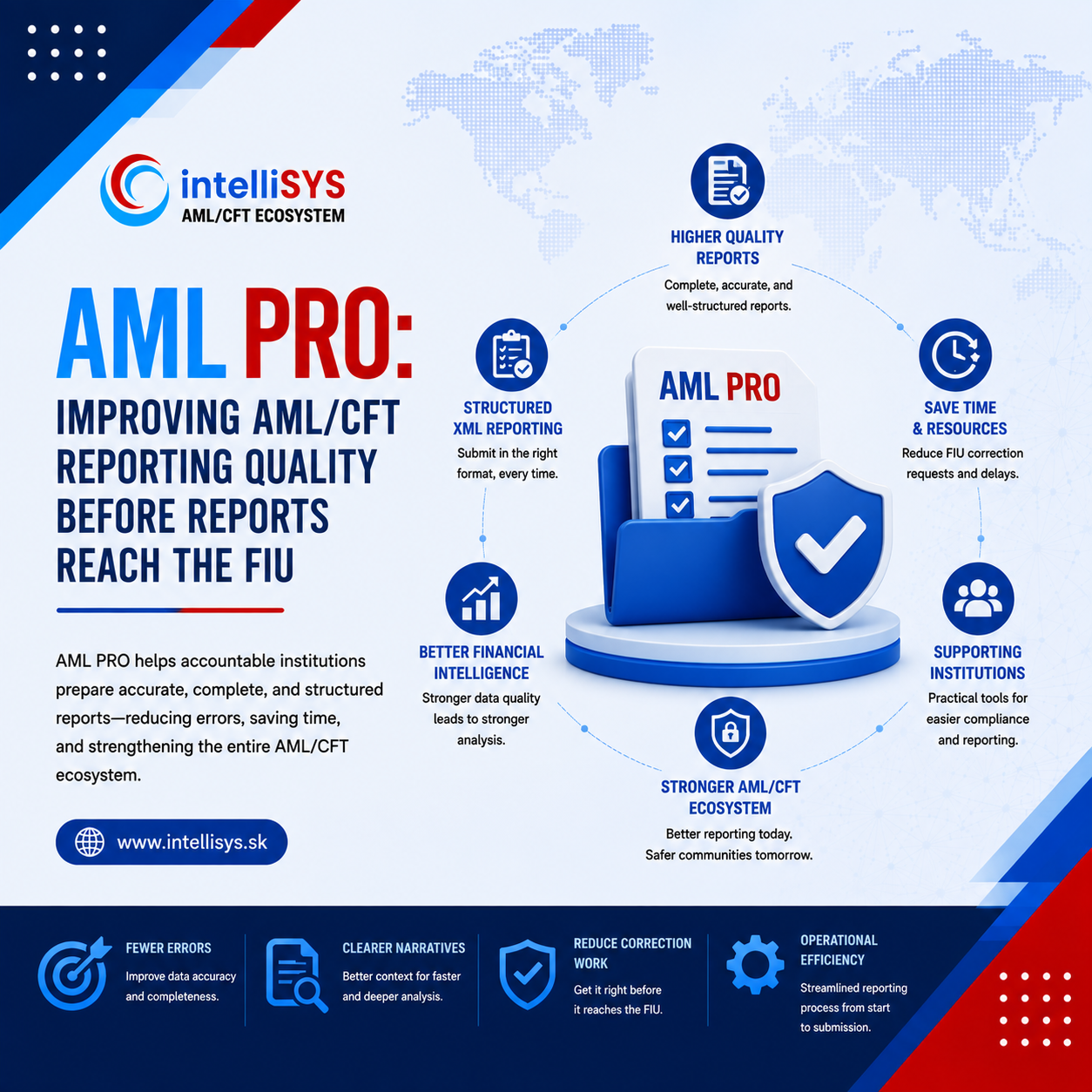
Financial Intelligence Units depend on the quality of reports submitted by accountable institutions. If suspicious transaction reports are incomplete, inconsistent, poorly structured, or missing important details, the FIU must spend valuable time correcting problems before analysis can begin. This weakens the entire AML/CFT chain. A stronger national AML/CFT ecosystem does not start only inside the FIU. It starts earlier, at the point where banks, financial institutions, DNFBPs, and other accountable institutions identify suspicious activity and prepare reports. AML PRO is IntelliSYS’s solution designed to help accountable institutions improve AML/CFT reporting quality before reports reach the FIU.
Suspicious transaction reporting is one of the most important channels between accountable institutions and the FIU.
When a report is strong, it gives the FIU a better starting point. It includes the right subjects, transactions, account details, suspicion indicators, supporting context, and structured data.
When a report is weak, the FIU loses time.
Analysts may need to request corrections, search for missing information, interpret unclear narratives, clean data manually, or review incomplete fields before assessing the actual risk.
Poor reporting quality does not only create administrative work. It delays intelligence production.
For this reason, improving reporting quality should be treated as a core AML/CFT priority.
Many reporting institutions want to comply with AML/CFT obligations, but reporting can still be difficult.
Staff may struggle with report formats, XML structures, required fields, suspicion narratives, internal approvals, or the technical expectations of the FIU.
As a result, reports may contain missing information, inconsistent customer details, unclear transaction structures, weak narratives, or formatting errors.
These problems affect the FIU’s ability to analyze reports efficiently.
If a report does not clearly identify the involved persons, entities, accounts, transactions, dates, values, and suspicion indicators, analysts must spend time reconstructing the case.
This creates friction between reporting entities and the FIU.
AML PRO is designed for accountable institutions.
Its role is to support better AML/CFT compliance reporting before the report is submitted to the FIU.
This matters because FIU modernization should not focus only on the FIU platform. The quality of the FIU’s work also depends on the quality of information submitted by reporting sectors.
AML PRO helps institutions prepare structured, higher-quality reports that can be submitted to the FIU in the expected format.
This supports the entire reporting ecosystem.
The FIU’s analytical capability depends heavily on input data.
If the FIU receives stronger reports, it can move faster into enrichment, risk prioritization, subject linking, case management, visualization, and dissemination.
Better reporting improves every later stage of the intelligence lifecycle.
For example, a well-structured report can make it easier to identify persons, accounts, entities, addresses, and transactions. It can also support more accurate data enrichment and stronger link analysis inside FIU360.
The benefit is not limited to one institution.
When reporting quality improves across the sector, the FIU gains better visibility over national AML/CFT risks.
Structured reporting is essential for modern FIU operations.
XML reporting allows accountable institutions to submit data in a standardized format that can be validated, processed, and analyzed more efficiently by the FIU.
AML PRO supports the preparation of high-quality XML reports so that accountable institutions can align more effectively with FIU reporting requirements.
This helps reduce avoidable formatting problems and improves consistency.
When reports are submitted in a structured format, the FIU can process them more reliably and connect them with downstream analytical tools.
One of the hidden costs of weak reporting is correction work.
If a report is incomplete or incorrectly formatted, the FIU may need to return it to the reporting entity or request additional information. This creates delays for both sides.
AML PRO helps reduce this problem by supporting better preparation before submission.
The goal is simple: improve the report before it reaches the FIU.
This reduces friction, supports faster review, and allows analysts to focus on intelligence rather than administrative correction.
Accountable institutions face increasing AML/CFT expectations.
They must monitor suspicious activity, identify relevant indicators, collect supporting details, prepare reports, and submit them in the correct format.
This can be challenging, especially for institutions with limited technical capacity or complex internal approval processes.
AML PRO helps institutions structure their reporting work more effectively.
It supports the practical side of compliance: preparing reports that are complete, structured, and suitable for FIU submission.
This helps institutions improve their role in the national AML/CFT framework.
The relationship between FIUs and reporting entities should not be limited to report submission and correction requests.
A stronger relationship is built around better data, clearer requirements, and continuous improvement.
AML PRO supports this by helping reporting entities submit better information from the start.
This can reduce repeated correction cycles and improve communication between the FIU and accountable institutions.
When institutions submit better reports, FIUs can provide more meaningful feedback and focus on higher-value intelligence work.
AML/CFT reporting is not limited to banks.
Depending on national law, accountable institutions may include money service businesses, insurance companies, securities firms, real estate professionals, casinos, dealers in precious metals and stones, lawyers, accountants, trust and company service providers, and other DNFBPs.
Different sectors may have different reporting maturity levels.
AML PRO can support a more structured reporting approach across accountable institutions by helping them prepare reports in line with expected FIU formats.
This is important for countries seeking to improve reporting consistency across the wider AML/CFT ecosystem.
FIUs increasingly rely on risk-based prioritization.
To prioritize effectively, they need reliable information about customers, entities, transactions, jurisdictions, reporting sectors, suspicion indicators, and related parties.
Weak reports reduce the quality of risk-based analysis.
AML PRO helps improve the input data that FIUs need for risk scoring and prioritization.
When reports contain clearer and more complete information, FIU360 and other FIU tools can better support risk-based workflows, case routing, enrichment, and management oversight.
Data enrichment depends on accurate identifiers.
If a report contains incomplete names, unclear company details, missing account numbers, or inconsistent addresses, enrichment becomes harder.
A strong report gives the FIU better identifiers to query national databases, company registries, population records, sanctions lists, tax records, customs sources, and other authorized data sources.
AML PRO supports this by helping accountable institutions prepare more complete and structured reports.
This improves the FIU’s ability to connect submitted reports with external sources and historical intelligence.
Financial crime networks are often hidden in relationships.
A person may appear across multiple reports. A company may share directors with other entities. An address may link several subjects. A phone number may connect reports that appear unrelated.
To detect these links, the FIU needs structured and reliable data.
AML PRO helps improve the quality of the data submitted by accountable institutions, making it easier for FIU systems to identify connections later.
This supports stronger subject management, visualization, and network analysis inside FIU360.
Consider a reporting institution identifying suspicious transfers involving a company and several foreign counterparties.
In a weak report, the institution may submit a short narrative, incomplete company details, limited transaction references, and unclear suspicion indicators.
The FIU analyst must then request clarification, search for missing data, and manually reconstruct the transaction context.
In a stronger AML PRO-supported process, the institution prepares a structured report with clearer subject details, transaction information, supporting context, and the required XML structure.
The FIU receives a more usable report and can move faster into analysis.
A reporting entity repeatedly submits reports with missing account details and inconsistent customer identifiers.
Without a structured reporting tool, the FIU may continue returning correction requests.
This wastes time for both the institution and the FIU.
With AML PRO, the reporting institution can improve report preparation before submission. Required fields, structured formats, and clearer reporting logic help reduce repeated errors.
Over time, this supports better compliance behavior and stronger reporting quality.
Smaller accountable institutions may not have the same technical capacity as large banks.
They may struggle with XML formatting, report structure, internal documentation, or consistent submission practices.
AML PRO can help create a more guided reporting process.
This supports smaller institutions in meeting their AML/CFT reporting responsibilities more effectively.
For the FIU, this can improve report quality across sectors that may otherwise require additional support and training.
AML PRO and FIU360 support different parts of the same AML/CFT chain.
AML PRO helps accountable institutions prepare stronger reports before submission.
FIU360 helps the FIU receive, validate, enrich, analyze, manage, visualize, disseminate, and monitor intelligence after submission.
Together, they help connect the reporting institution side with the FIU side.
This creates a more complete digital AML/CFT ecosystem.
The reporting entity submits better data. The FIU receives stronger input. Analysts can produce better intelligence. Competent authorities receive more useful outputs.
The AML/CFT chain does not end with the FIU.
After analysis, intelligence may be disseminated to law enforcement agencies or other competent authorities. This is where LEA360 can support investigation management and intelligence-led law enforcement.
In this wider ecosystem, AML PRO supports the reporting institution side, FIU360 supports the FIU side, and LEA360 supports the law enforcement investigation side.
This reflects IntelliSYS’s broader approach.
The goal is not to digitize one isolated step. The goal is to support the full journey from suspicious activity detection to financial intelligence and possible investigation.
Fragmentation weakens AML/CFT effectiveness.
If reporting entities use weak reporting tools, FIUs use separate systems, and law enforcement agencies receive incomplete intelligence packages, the chain becomes slower and less effective.
AML PRO helps address fragmentation at the reporting stage.
By improving report preparation and structured submission, it creates better input for FIU systems.
When combined with FIU360 and LEA360, IntelliSYS provides a stronger connected model for AML/CFT operations.
This helps institutions move from isolated tools toward a more coordinated national ecosystem.
Technology alone does not create a strong compliance culture, but it can support it.
AML PRO gives accountable institutions a more structured way to prepare AML/CFT reports.
This can help staff understand reporting requirements, improve consistency, and reduce avoidable mistakes.
Over time, better reporting processes can reinforce stronger internal compliance behavior.
Institutions become more capable of submitting clear, complete, and useful information to the FIU.
This strengthens the national AML/CFT framework.
FIUs often need to improve reporting quality through guidance, outreach, training, and feedback.
AML PRO can support this broader objective by helping reporting entities align with expected reporting structures.
If the FIU is modernizing reporting requirements, implementing new schemas, or improving data standards, AML PRO can help accountable institutions adapt.
This creates a more practical path for sector-wide improvement.
The FIU can define clearer expectations, and reporting entities can use structured tools to meet them.
AML/CFT reporting must be traceable.
Institutions need to know who prepared a report, who reviewed it, what information was included, and when it was submitted.
A structured reporting system can help create better internal accountability.
AML PRO supports a more controlled reporting process compared with informal preparation through documents, spreadsheets, or manual copying.
This strengthens governance inside accountable institutions and improves the reliability of the information sent to the FIU.
AML PRO is powerful because it addresses a problem that appears before the FIU begins analysis.
It improves the quality of AML/CFT reporting at the source.
This matters because weak data creates weak intelligence workflows. Stronger reporting gives the FIU a better foundation for validation, enrichment, analysis, prioritization, visualization, case management, and dissemination.
AML PRO helps accountable institutions become better participants in the national AML/CFT ecosystem.
It is not only a compliance tool. It is a data quality and reporting improvement solution.
Implementing AML PRO requires alignment with national reporting requirements, FIU schemas, accountable institution workflows, user roles, report types, and technical integration needs.
IntelliSYS supports this process through implementation, configuration, training, consulting, and integration services.
This helps reporting entities and FIUs create a reporting environment that is practical, structured, and aligned with AML/CFT obligations.
The objective is to improve reporting quality without creating unnecessary operational complexity.
The quality of financial intelligence depends on the quality of the reports submitted by accountable institutions.
If reports are weak, incomplete, or poorly structured, the FIU must spend time correcting problems before analysis can begin.
AML PRO helps improve AML/CFT reporting quality before reports reach the FIU. It supports structured report preparation, better XML reporting, stronger consistency, reduced correction work, and better input for FIU360.
For national AML/CFT ecosystems seeking to improve reporting quality, strengthen accountable institution compliance, and support better FIU analysis, AML PRO is an important part of the modernization journey.
Contact IntelliSYS to discuss how AML PRO can help accountable institutions improve AML/CFT reporting quality and strengthen the connection with FIU360.