
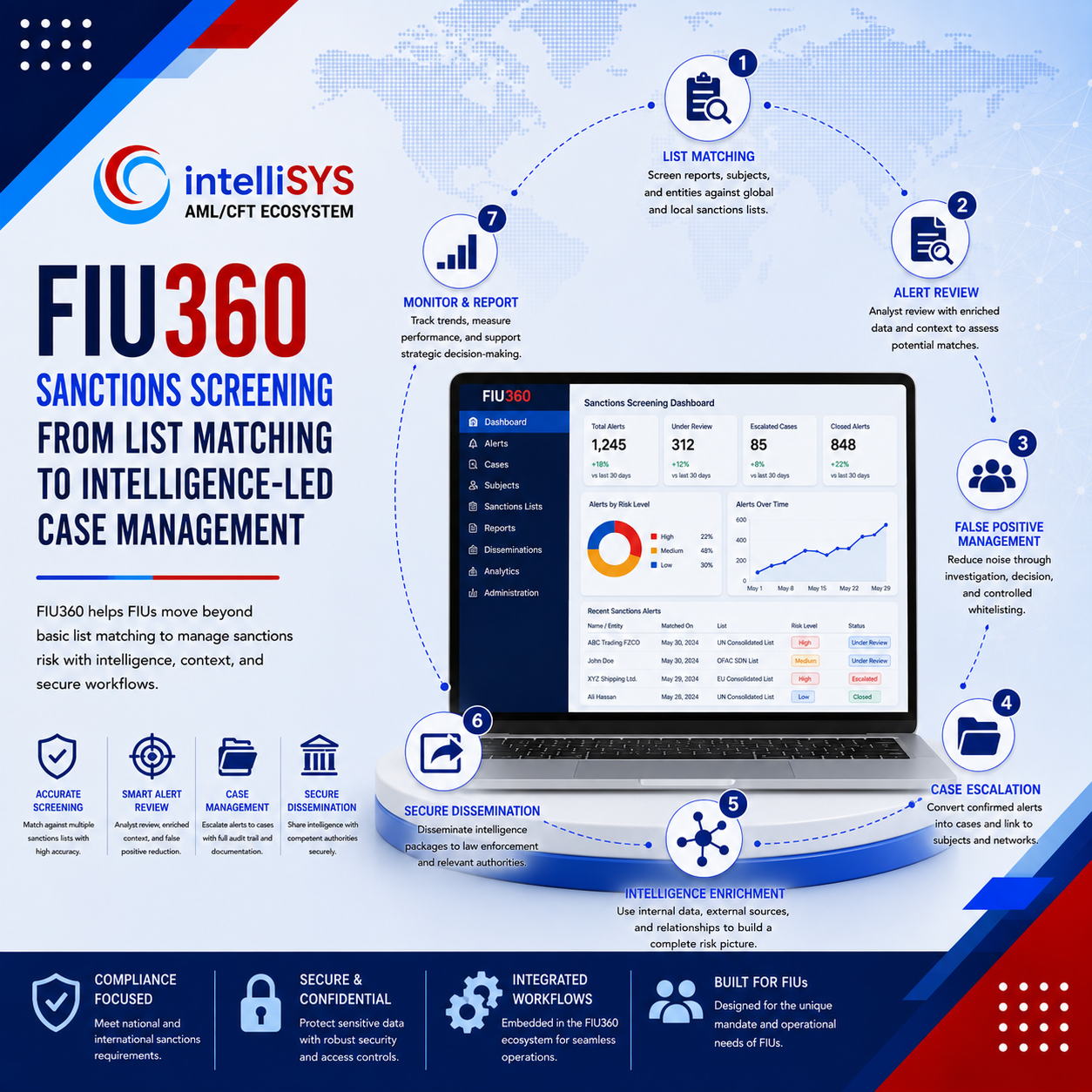
Sanctions exposure is one of the most sensitive risk areas in financial intelligence work. Financial Intelligence Units may receive reports involving sanctioned individuals, entities, vessels, organizations, jurisdictions, intermediaries, beneficial owners, transaction counterparties, or related networks. A potential sanctions match cannot be treated as a simple data point. It may require review, validation, enrichment, case escalation, secure handling, dissemination, and cooperation with competent authorities. FIU360 supports sanctions screening as part of the wider financial intelligence lifecycle, helping FIUs move from basic list matching to structured sanctions intelligence management.
Sanctions are used to restrict financial access for designated individuals, entities, organizations, and networks linked to serious risks.
These risks may involve terrorism, proliferation financing, organized crime, corruption, human rights abuses, conflict financing, sanctions evasion, or other national and international security concerns.
FIUs play an important role in identifying possible sanctions exposure inside financial reports and related intelligence.
A suspicious transaction report may involve a name that appears similar to a sanctioned person. A company may be linked to a designated entity. A transaction may involve a high-risk counterparty. A beneficial owner may be hidden behind several legal entities.
Sanctions screening helps FIUs identify these risks earlier and manage them through controlled analytical workflows.
Basic list matching is useful, but it is not enough on its own.
A name match may be a true hit, a false positive, or an unclear result requiring further review. Names may be spelled differently across languages. Entities may use aliases. Dates of birth may be missing. Companies may appear through ownership links rather than direct names.
If sanctions screening produces alerts without context, analysts can be overwhelmed.
A modern FIU needs more than a match result.
It needs an environment where alerts can be reviewed, enriched, linked to subjects, escalated into cases, documented, audited, and disseminated when required.
FIU360 supports this wider approach.
FIU360 supports sanctions list matching against relevant international, regional, and country-specific lists.
This helps FIUs screen incoming data, reports, subjects, entities, and related information for possible sanctions exposure.
The objective is to identify potential matches that require analyst review.
A potential match may involve a person, legal entity, account holder, transaction counterparty, beneficial owner, director, shareholder, address, or other subject connected to the report.
This allows sanctions risk to be detected earlier in the FIU workflow.
A sanctions alert should not automatically be treated as confirmed intelligence.
Analysts need to review the quality of the match.
They may compare names, aliases, dates of birth, nationalities, registration numbers, addresses, ownership links, transaction data, and other identifiers.
FIU360 helps place sanctions alerts inside an analytical workflow rather than leaving them as isolated system notifications.
This gives analysts a controlled way to assess whether the alert is relevant, whether more data is needed, and whether the matter should be escalated.
The analyst remains central to the decision.
Sanctions screening can generate false positives.
This is especially common when names are common, transliterated differently, incomplete, or submitted with limited identifiers.
If false positives are not managed well, they create unnecessary workload and may delay more important cases.
FIU360 supports a structured review process where analysts can examine potential matches with additional context.
Data enrichment, subject management, previous reports, documents, and case history can help analysts determine whether an alert is meaningful.
The goal is not to eliminate all alerts. The goal is to manage them intelligently.
Some matches may be reviewed and determined not to represent the sanctioned subject.
In such cases, controlled whitelisting can help reduce repeated false alerts for the same known non-match.
Whitelisting must be governed carefully.
It should be based on clear review, proper documentation, and authorized decisions. It should not become a way to ignore risk without analysis.
FIU360 supports controlled sanctions alert handling so that reviewed decisions can be managed within the platform.
This helps improve efficiency while preserving governance.
A sanctions alert becomes more useful when it is linked to the relevant subject inside the FIU database.
The subject may be a person, entity, account, transaction, address, phone number, or related identifier.
FIU360 subject data management allows analysts to connect alerts to the broader intelligence record.
This is important because the same subject may appear in previous reports, other cases, enrichment results, or external data sources.
A sanctions alert should not be viewed in isolation. It should be understood as part of the complete intelligence profile.
Data enrichment can help analysts validate or reject a potential sanctions match.
For example, a report may include a company name that resembles a designated entity. Enrichment may provide registration details, directors, shareholders, addresses, beneficial ownership information, or links to other entities.
This additional context can help determine whether the match is relevant.
Enrichment can also reveal indirect exposure.
A company may not appear on a sanctions list directly, but its owner, director, shareholder, or transaction counterparty may be linked to a designated subject.
This makes enrichment an important part of sanctions intelligence analysis.
Sanctions risk does not always appear through direct name matching.
A sanctioned person may use front companies. A designated entity may operate through intermediaries. Ownership may be layered through several legal entities. Transactions may move through unrelated-looking counterparties.
FIU360 helps analysts investigate these indirect links by combining sanctions screening with subject management, enrichment, link analysis, visualization, and case management.
This is important because sanctions evasion often depends on hiding relationships.
A strong FIU platform should help analysts move beyond the first visible name and examine the network behind the transaction.
Beneficial ownership is critical in sanctions analysis.
A legal entity may not appear on a sanctions list, but its beneficial owner may be designated. A company may be controlled by a sanctioned individual through nominees, related entities, or complex ownership structures.
FIU360 data enrichment and subject management can help analysts examine ownership relationships.
When company registry data, related entities, directors, shareholders, and subject records are connected, the FIU can better assess whether sanctions exposure exists behind the reported entity.
This strengthens the analytical quality of sanctions review.
Sanctions-related cases can involve complex networks.
A sanctioned person may connect to companies, accounts, family members, intermediaries, transactions, documents, addresses, and foreign counterparties.
FIU360 visualization capabilities can help analysts map these relationships.
A visual network can show how a potential sanctions subject connects to other persons and entities. It can also show money flows, shared addresses, ownership links, and transaction paths.
This helps analysts understand the structure of the risk and explain it more clearly to supervisors or competent authorities.
Not every sanctions alert becomes a case.
Some alerts may be false positives. Others may require additional review. Some may indicate serious risk and need immediate escalation.
FIU360 allows alerts to be managed through workflow and case management processes.
If a potential match is confirmed or requires deeper analysis, the alert can be escalated into a case. The case can include the original report, alert details, related subjects, enrichment results, documents, visualizations, analyst notes, and supervisory decisions.
This creates a structured path from detection to investigation.
Sanctions alerts may require urgent handling.
A confirmed or high-confidence alert may need supervisory review, additional enrichment, secure dissemination, or coordination with competent authorities.
FIU360 workflow capabilities can support defined procedures for sanctions-related alerts and cases.
For example, a high-risk alert may trigger priority assignment, restricted access, automatic notification to a supervisor, or a specific review path.
This helps ensure that sanctions risk is handled consistently and quickly.
Sanctions-related intelligence may be highly sensitive.
It may involve designated subjects, financial institutions, law enforcement activity, international cooperation, politically exposed persons, or possible sanctions evasion networks.
FIU360 case management supports secure handling of sensitive cases.
Access can be restricted according to role, security classification, and operational need. Documents and subject records can be linked to the case. Supervisory review can be recorded. Dissemination can be controlled.
This protects the confidentiality and integrity of sanctions intelligence.
Sanctions decisions must be traceable.
The FIU should know which list produced the alert, which analyst reviewed it, what information was considered, whether the alert was confirmed or rejected, and whether the matter was escalated or disseminated.
FIU360 supports audit logging and controlled workflow records.
This helps the FIU demonstrate that sanctions alerts were handled through a documented process.
Auditability is especially important when a sanctions-related case leads to external action, referral, freezing measures, investigation, or international cooperation.
Sanctions alerts may require review by senior analysts or supervisors.
This is particularly important where the match is unclear, the case is sensitive, or the potential consequences are significant.
FIU360 workflow management can support supervisory review steps before escalation, closure, or dissemination.
This helps improve quality control.
A supervisor can review the alert, the supporting identifiers, the enrichment results, the analyst’s reasoning, and the proposed next action.
This creates stronger governance over sanctions-related decisions.
When a sanctions-related case is confirmed or assessed as significant, the FIU may need to disseminate intelligence to law enforcement, regulators, supervisory authorities, counterpart FIUs, or other competent authorities.
FIU360 supports secure dissemination of intelligence packages.
A sanctions intelligence package may include narrative analysis, alert details, subject profiles, transaction summaries, ownership relationships, visualizations, supporting documents, and recommended follow-up points.
Secure dissemination helps ensure that the right authority receives the right information through a controlled and auditable process.
Dissemination should not end the FIU’s involvement.
The FIU may need feedback from the receiving authority.
Did the intelligence support an investigation?
Was additional information requested?
Did the authority take supervisory or enforcement action?
Was the case linked to another investigation?
Were further sanctions indicators identified?
FIU360 feedback tracking helps the FIU understand the operational value of its sanctions intelligence.
This supports continuous improvement and institutional learning.
Sanctions-related cases often require cooperation.
A potential sanctions evasion network may involve foreign companies, cross-border transfers, international trade, shipping routes, or counterparties in multiple jurisdictions.
FIUs may need to cooperate with domestic agencies and counterpart FIUs.
FIU360 supports structured intelligence management, secure dissemination, and feedback tracking, helping the FIU manage cooperation more effectively.
A controlled system record helps preserve the context of what was shared, when it was shared, and why.
An FIU receives an STR involving an individual whose name is similar to a person listed on a sanctions list.
In a basic system, the alert may appear as a simple match requiring manual review.
With FIU360, the analyst can review the alert inside the platform, compare identifiers, enrich the subject with additional data, check previous reports, attach supporting documents, and document the decision.
If the match is false, the decision can be recorded. If the match appears relevant, the alert can be escalated into a case.
This creates a more controlled review process.
A report involves a legal entity that does not appear directly on a sanctions list.
However, enrichment reveals that one of the company’s beneficial owners is linked to a designated subject.
FIU360 can help analysts connect the company, owner, related entities, transactions, and documents into one case view.
Visualization can help show the ownership structure.
The FIU can then assess whether the matter requires further investigation, dissemination, or cooperation with another authority.
This demonstrates why sanctions screening must be combined with enrichment and link analysis.
Several reports involve different companies sending funds through similar routes.
Individually, the reports appear separate.
FIU360 link analysis shows shared directors, repeated counterparties, and connections to a sanctioned entity through intermediaries.
The FIU creates a case, restricts access, attaches supporting documents, visualizes the network, and prepares an intelligence package for dissemination.
This is where sanctions screening becomes intelligence-led.
The platform helps analysts move from separate alerts to a broader network view.
Sanctions screening is important, but automated matches should not replace analysis.
A sanctions alert is an indicator. It must be reviewed in context.
Analysts must consider identifiers, data quality, source reliability, ownership links, transaction behavior, historical reports, and legal requirements.
FIU360 supports this human-led review model.
The system helps detect, organize, enrich, visualize, and manage potential sanctions risk, while analysts remain responsible for professional assessment and decision-making.
FIU360 sanctions screening is powerful because it is connected to the wider FIU lifecycle.
It does not treat sanctions matching as an isolated technical function.
It connects list matching with alert review, enrichment, subject management, link analysis, visualization, workflow escalation, case management, secure dissemination, feedback, security, and auditability.
This integrated model helps FIUs manage sanctions risk more effectively.
For modern FIUs, sanctions screening must be part of intelligence operations, not only compliance checking.
Implementing sanctions screening requires careful configuration.
The FIU must define which lists are used, how frequently they are updated, which subjects are screened, how alerts are reviewed, how false positives are handled, when alerts become cases, who approves decisions, and how dissemination is managed.
IntelliSYS supports FIUs through FIU360 configuration, workflow design, data integration, security setup, training, and operational consulting.
This helps ensure that sanctions screening aligns with the FIU’s legal framework, national priorities, internal procedures, and cooperation model.
The objective is to create a sanctions workflow that is practical, secure, auditable, and intelligence-led.
Sanctions screening is not only about identifying name matches.
It is about understanding risk, validating alerts, detecting hidden relationships, managing sensitive cases, and disseminating intelligence to the right authority when required.
FIU360 helps FIUs move from basic sanctions list matching to structured sanctions intelligence management.
Through sanctions screening, enrichment, subject linking, visualization, workflow control, case management, audit trails, secure dissemination, and feedback tracking, FIU360 supports a stronger and more accountable sanctions risk workflow.
For FIUs seeking to strengthen sanctions intelligence, reduce manual alert handling, improve case escalation, and support secure cooperation, sanctions screening should be treated as a core modernization capability.
Contact IntelliSYS to discuss how FIU360 can support sanctions screening, alert management, and sanctions intelligence workflows in your FIU environment.
Implementing sanctions screening requires careful configuration.
The FIU must define which lists are used, how frequently they are updated, which subjects are screened, how alerts are reviewed, how false positives are handled, when alerts become cases, who approves decisions, and how dissemination is managed.
IntelliSYS supports FIUs through FIU360 configuration, workflow design, data integration, security setup, training, and operational consulting.
This helps ensure that sanctions screening aligns with the FIU’s legal framework, national priorities, internal procedures, and cooperation model.
The objective is to create a sanctions workflow that is practical, secure, auditable, and intelligence-led.