
FATF mutual evaluations are not only about having laws, regulations, and institutions in place. They are also about demonstrating effectiveness. Financial Intelligence Units must show that they can receive quality reports, analyze suspicious activity, enrich information, prioritize risk, manage cases, disseminate useful intelligence, cooperate with competent authorities, protect sensitive data, and produce measurable results. This requires strong operational capability. FIU360 supports FIUs by helping them build a more structured, secure, auditable, and intelligence-led operating environment that can contribute to mutual evaluation readiness.
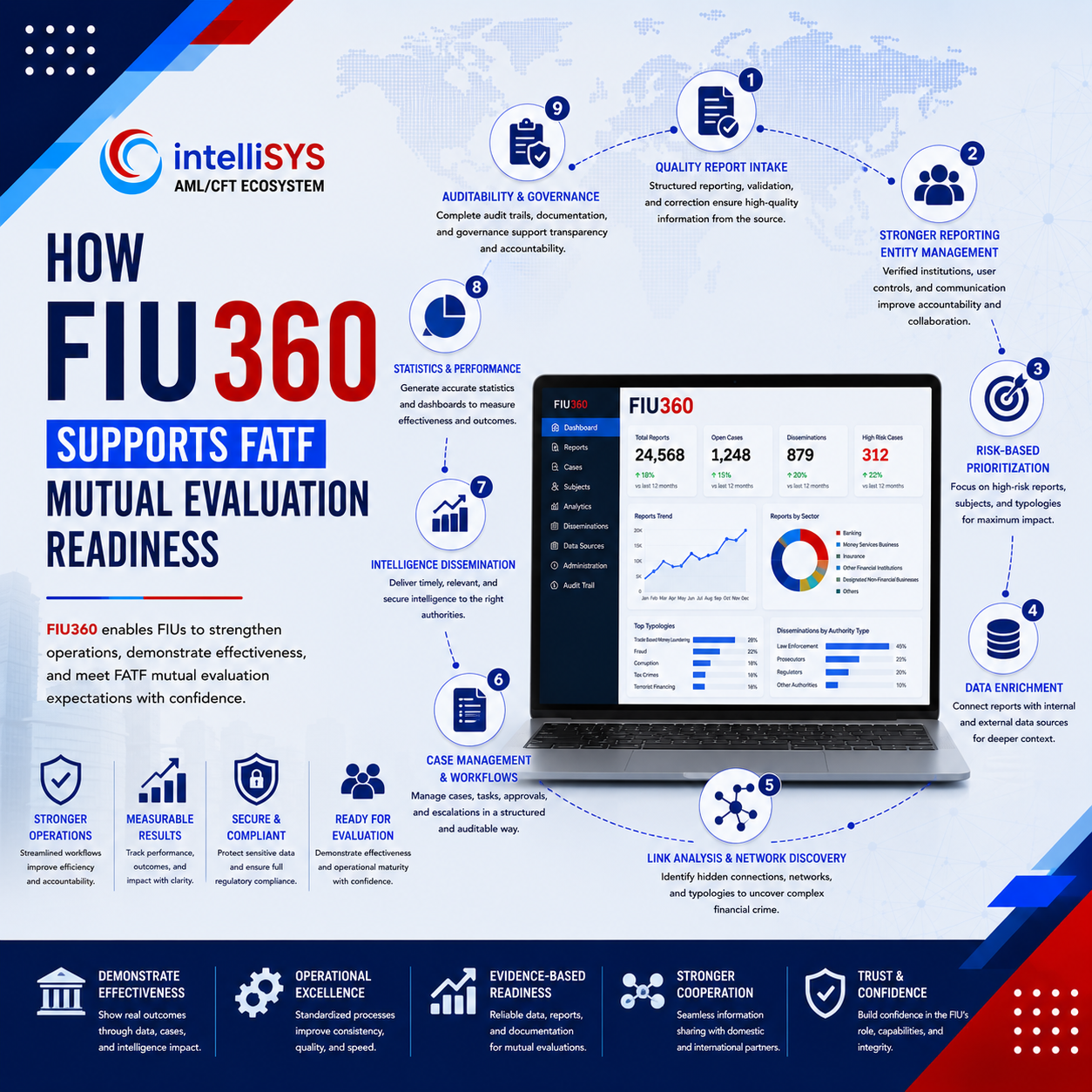
A FATF mutual evaluation examines how well a country’s AML/CFT framework works in practice.
For FIUs, this means demonstrating more than technical compliance.
The FIU must show that it receives relevant information, analyzes it effectively, supports investigations, cooperates with domestic and international partners, and contributes to national AML/CFT outcomes.
This can be difficult if FIU operations are fragmented across emails, spreadsheets, shared folders, manual workflows, and disconnected databases.
A modern FIU needs a platform that supports both daily operations and institutional evidence.
FIU360 helps create that foundation.
Many FIUs can describe their mandate, legal powers, and reporting obligations.
The harder question is whether the FIU can prove that those powers are being used effectively.
Effectiveness depends on operational evidence.
How many reports were received?
Which sectors reported?
How many reports were rejected or corrected?
How were high-risk cases prioritized?
How long did cases take?
What intelligence was disseminated?
Which authorities received it?
Was feedback received?
Did the intelligence support investigations?
FIU360 helps FIUs capture and manage this type of operational information inside a structured platform.
Mutual evaluation readiness begins with the quality of information entering the FIU.
If reports are incomplete, inconsistent, or poorly structured, the FIU’s ability to analyze and disseminate useful intelligence is weakened.
FIU360 supports structured report intake through configurable report types, XML schemas, validation rules, web forms, and business rules.
This helps improve the quality and consistency of reports submitted by accountable institutions.
Better intake supports better analysis.
It also gives the FIU stronger evidence of how reporting obligations are managed, validated, corrected, and monitored.
A strong FIU needs a controlled relationship with reporting entities.
FIU360 supports reporting entity registration, user management, role-based permissions, and institutional access control.
This helps the FIU maintain a verified counterpart registry.
It also supports better governance over who can submit reports, who can correct data, and how institutions interact with the FIU.
For mutual evaluation readiness, this matters because reporting sector supervision, communication, and data quality are closely connected to FIU effectiveness.
A controlled registration process helps strengthen the reporting ecosystem.
FIUs may receive large volumes of reports.
Not every report carries the same risk or urgency.
A risk-based operating model helps FIUs focus resources on higher-risk matters.
FIU360 can support risk-based prioritization through structured data, classification, workflow rules, enrichment, subject history, and case management.
This allows analysts and supervisors to identify reports or subjects that require closer attention.
For mutual evaluations, risk-based prioritization helps demonstrate that the FIU is not only processing reports mechanically.
It is applying intelligence judgment and operational focus.
Financial intelligence depends on context.
A suspicious report may not be enough on its own. Analysts often need company records, population data, tax information, customs data, sanctions exposure, law enforcement indicators, open-source information, or previous FIU records.
FIU360 supports data enrichment by helping FIUs connect reports and cases with authorized internal and external data sources.
This strengthens the analytical process.
It allows the FIU to move beyond report review and build a more complete understanding of subjects, relationships, ownership structures, and risk indicators.
Stronger enrichment supports stronger intelligence products.
Financial crime often operates through networks.
Persons, companies, accounts, addresses, directors, beneficial owners, intermediaries, and transaction counterparties may all connect across multiple reports.
FIU360 supports subject management, link analysis, and visualization to help analysts identify these relationships.
This is important for demonstrating FIU effectiveness.
A strong FIU should be able to identify patterns, connect separate reports, detect hidden relationships, and produce intelligence that adds value beyond the original submission.
Network discovery is one of the key ways an FIU turns reporting data into intelligence.
Mutual evaluation readiness requires consistency.
If analysts manage cases differently, store documents separately, or track decisions informally, the FIU may struggle to demonstrate how work was handled.
FIU360 supports structured case management and workflow control.
Reports can move through defined processes such as validation, triage, enrichment, analysis, supervisory review, dissemination, feedback, and closure.
Cases can include subjects, documents, notes, visualizations, enrichment results, decisions, and dissemination records.
This creates a more complete and traceable case history.
FIU effectiveness depends on the quality of analysis and decision-making.
Supervisors need visibility over cases, workloads, delays, high-risk matters, and dissemination decisions.
FIU360 supports supervisory review through workflow assignment, approval steps, dashboards, case visibility, and audit trails.
This helps management ensure that cases are being handled according to institutional procedures.
Quality control is important for mutual evaluation readiness because it shows that the FIU has governance over its analytical process.
It also helps improve the consistency and reliability of intelligence products.
The value of FIU analysis depends on whether intelligence reaches the right authority in a useful and secure form.
FIU360 supports intelligence reporting and dissemination workflows.
A dissemination package may include narrative analysis, subject profiles, transaction summaries, diagrams, documents, and supporting attachments.
The platform helps manage who receives intelligence, when it is sent, what was included, and how the process was recorded.
For mutual evaluations, this is important because FIUs must show that their intelligence is disseminated to competent authorities and supports AML/CFT outcomes.
Feedback is essential for measuring intelligence value.
If the FIU disseminates intelligence but does not know whether it was used, it becomes difficult to assess effectiveness.
FIU360 supports feedback tracking from recipient authorities.
This can help the FIU understand whether intelligence supported an investigation, whether additional information was requested, whether the case was linked to another matter, or whether the dissemination contributed to operational outcomes.
Feedback helps close the intelligence loop.
It also gives the FIU stronger evidence for performance review and mutual evaluation preparation.
Mutual evaluations require reliable statistics.
FIUs may need to provide information on report volumes, report types, reporting sectors, rejected reports, corrected reports, cases opened, disseminations, feedback, typologies, workload, and operational trends.
FIU360 supports statistics, BI dashboards, KPIs, drill-down reporting, and management oversight.
This helps the FIU produce evidence-based reporting.
Instead of manually compiling statistics from spreadsheets and emails, management can rely on structured operational data.
Reliable statistics support institutional credibility.
Dashboards help FIU leadership understand what is happening inside the institution.
They can show report intake trends, analyst workloads, validation issues, high-risk cases, dissemination activity, feedback status, and workflow delays.
This visibility supports better management decisions.
For mutual evaluation readiness, dashboards can help demonstrate that the FIU monitors performance and manages operations actively.
A platform that only stores data is not enough.
The FIU also needs visibility into how the work is progressing.
Auditability is central to FIU governance.
The FIU must protect sensitive intelligence and maintain a clear record of important actions.
FIU360 supports audit logging so that user activity, record changes, access, workflow actions, and dissemination steps can be traced.
This helps the FIU demonstrate control over sensitive information.
It also supports internal review, security oversight, and accountability.
For mutual evaluations, audit trails help show that the FIU operates through controlled and documented processes.
FIU data is highly sensitive.
It may include suspicious transaction reports, personal data, financial records, criminal intelligence indicators, sanctions-related information, documents, and case notes.
FIU360 supports role-based access control, security classifications, segregation of duties, encryption principles, and case-level restrictions.
This helps ensure that users access only the information they are authorized to see.
Security controls are important not only for compliance, but also for trust.
Reporting entities, domestic partners, and international counterparts must trust that the FIU can protect sensitive intelligence.
FIUs often cooperate with foreign counterparts.
International cooperation requires secure information handling, clear records, and reliable case context.
FIU360 can support cooperation by helping the FIU manage requests, related cases, disseminations, supporting documents, and feedback.
A structured platform makes it easier to preserve what was received, what was shared, what action was taken, and which authority was involved.
This supports both operational cooperation and institutional accountability.
International cooperation is a key part of effective AML/CFT systems.
FIUs also need strong cooperation with domestic authorities.
This may include law enforcement, prosecutors, regulators, customs, tax authorities, anti-corruption agencies, intelligence agencies, and supervisory bodies.
FIU360 supports structured dissemination and feedback workflows so domestic cooperation can be managed more effectively.
The FIU can track which authority received intelligence, whether feedback was provided, and whether additional support was requested.
This helps demonstrate that FIU intelligence is not isolated.
It is connected to the wider national AML/CFT response.
Mutual evaluation preparation often requires historical evidence.
The FIU may need to show how cases were handled, how reporting improved, how typologies developed, or how disseminated intelligence supported competent authorities.
If records are scattered across folders, emails, and older systems, this becomes difficult.
FIU360 helps preserve institutional memory by keeping reports, subjects, cases, documents, workflows, disseminations, feedback, and audit logs inside a structured environment.
This supports continuity even when staff change.
Strong institutional memory helps the FIU demonstrate progress over time.
Technology should support institutional procedures.
FIU360 can be configured to reflect the FIU’s SOPs, workflows, approval steps, access rules, and reporting practices.
This helps turn written procedures into actual operational behavior.
For mutual evaluation readiness, this is important because procedures should not exist only on paper.
The FIU should be able to show that processes are implemented, followed, monitored, and improved.
FIU360 helps connect policy with practice.
A platform supports effectiveness only when users know how to use it properly.
Analysts, supervisors, administrators, IT staff, reporting entity users, and management may all require role-based training.
FIU360 implementation can be supported by training and mentoring focused on practical FIU work.
This includes report review, enrichment, case management, visualization, dashboards, dissemination, and feedback.
Capacity building strengthens the FIU’s ability to produce useful intelligence consistently.
Technology and training should work together.
An FIU preparing for a mutual evaluation needs statistics on report volumes, sectors, case outcomes, disseminations, and feedback.
In a fragmented environment, staff may need to collect this information manually from spreadsheets, emails, and separate systems.
With FIU360, the FIU can use structured data, dashboards, and reports to support evidence preparation.
This reduces manual effort and improves reliability.
It also allows leadership to identify weaknesses before the evaluation process begins.
An FIU disseminates intelligence to law enforcement regarding a complex network of companies and cross-border transfers.
Later, law enforcement provides feedback that the intelligence supported an investigation.
With FIU360, the dissemination package, recipient authority, supporting documents, case notes, visualizations, and feedback can be linked to the case record.
This gives the FIU a stronger evidence trail.
It can show not only that intelligence was sent, but also that the intelligence contributed to action.
A mutual evaluation may examine whether reporting entities submit useful information.
FIU360 validation rules, registration controls, correction workflows, and reporting statistics can help the FIU monitor reporting quality.
The FIU can identify sectors or institutions with repeated errors and target outreach or training accordingly.
This supports continuous improvement.
It also shows that the FIU is actively managing the quality of information received.
Mutual evaluation readiness should not begin shortly before assessors arrive.
It should be built into daily FIU operations.
FIU360 helps by capturing operational evidence as part of normal work.
Reports, cases, decisions, statistics, disseminations, feedback, and audit trails are created during the FIU lifecycle, not reconstructed at the last minute.
This makes readiness more sustainable.
A strong FIU should be evaluation-ready because its operations are already structured, measured, and traceable.
FIU360 is powerful because it supports the operational areas that matter for FIU effectiveness.
It helps improve report intake, data quality, enrichment, risk prioritization, case management, workflow control, document handling, visualization, dissemination, feedback, dashboards, statistics, security, and auditability.
These capabilities help FIUs demonstrate that they are not only receiving reports.
They are transforming information into actionable financial intelligence.
For mutual evaluation readiness, that distinction matters.
Mutual evaluation readiness is not achieved through software alone.
FIUs also need process design, SOP development, training, reporting entity onboarding, data migration, integration, infrastructure planning, security governance, and operational support.
IntelliSYS supports FIUs through both technology and domain expertise.
This helps institutions align FIU360 with their mandate, legal framework, reporting ecosystem, and operational priorities.
The objective is to strengthen the FIU’s real-world effectiveness.
FATF mutual evaluation readiness depends on more than legal frameworks and written procedures.
FIUs must demonstrate that they can operate effectively.
They need strong reporting intake, analytical capability, case management, dissemination, feedback, statistics, security, auditability, cooperation, and governance.
FIU360 helps FIUs build the operational evidence needed to support that readiness.
By connecting reporting, enrichment, analysis, workflow, case management, dashboards, dissemination, feedback, and audit trails, FIU360 helps transform daily FIU work into a structured and measurable operating model.
For FIUs preparing for mutual evaluation or strengthening long-term AML/CFT effectiveness, FIU360 provides a practical foundation for readiness.
Contact IntelliSYS to discuss how FIU360 can support your FIU’s mutual evaluation readiness, operational effectiveness, and AML/CFT modernization goals.