
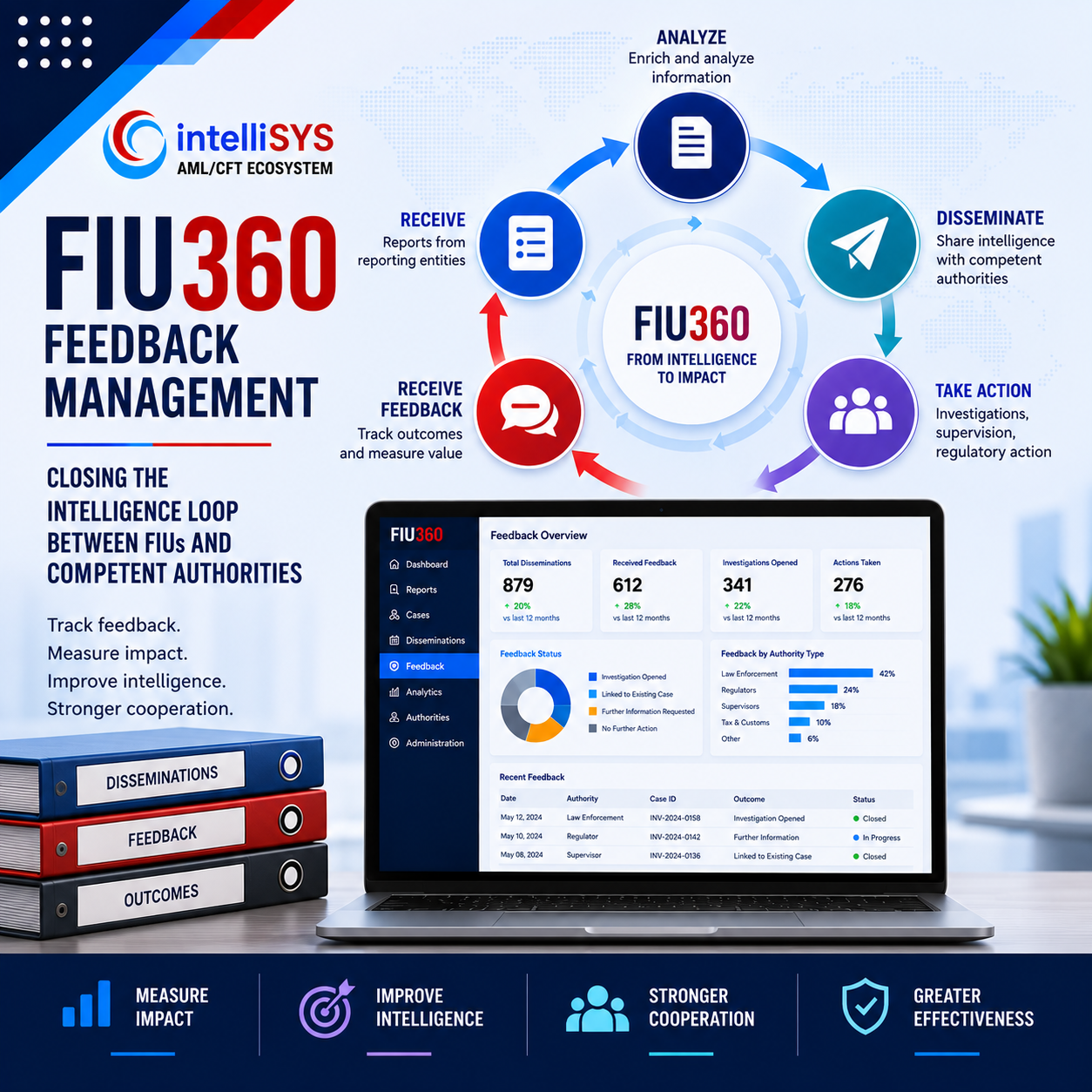
Financial intelligence does not end when an FIU sends a dissemination package. The real question is what happens next. Was the intelligence reviewed? Did it support an investigation? Was additional information requested? Did it help identify assets, subjects, or networks? Was it useful to law enforcement, regulators, supervisors, or other competent authorities? Without feedback, FIUs may not know whether their intelligence products are producing value. FIU360 feedback management helps FIUs close the intelligence loop by tracking how disseminated intelligence is received, used, reviewed, and acted upon.
FIUs produce intelligence for a purpose.
They support investigations, supervision, prosecution, asset tracing, sanctions review, regulatory action, international cooperation, and national AML/CFT decision-making.
But if the FIU does not receive feedback from recipients, it becomes difficult to measure impact.
The FIU may know that intelligence was sent, but not whether it was useful.
Feedback helps the FIU understand the quality and value of its outputs.
It also helps improve future analysis, dissemination structure, templates, prioritization, and cooperation with competent authorities.
In many environments, dissemination is treated as the final step.
The FIU prepares an intelligence package, sends it to the recipient authority, and closes the case or moves on to the next matter.
This creates a one-way process.
The FIU may not know whether the package was used, whether the recipient needed clarification, whether an investigation was opened, or whether the intelligence contributed to an outcome.
Over time, this weakens institutional learning.
FIU360 supports a stronger model where dissemination and feedback are connected parts of the same intelligence lifecycle.
The intelligence loop includes several stages.
A report is received.
The FIU enriches and analyzes the information.
A case is developed.
Intelligence is disseminated.
The recipient authority reviews and uses the intelligence.
Feedback returns to the FIU.
This final feedback step is essential.
It tells the FIU whether the intelligence product was relevant, timely, clear, complete, and actionable.
FIU360 helps manage this loop in a structured way so feedback becomes part of the official intelligence record.
FATF mutual evaluations and institutional performance reviews focus heavily on effectiveness.
It is not enough to show that reports were received or that disseminations were sent.
FIUs must show that their intelligence supports competent authorities and contributes to AML/CFT outcomes.
Feedback helps provide this evidence.
A law enforcement agency may confirm that an FIU dissemination supported an investigation. A regulator may confirm that intelligence informed supervisory action. A counterpart FIU may request follow-up information. A prosecutor may use intelligence to support asset tracing or case preparation.
FIU360 feedback tracking helps preserve this evidence.
Feedback can take different forms.
It may show whether the intelligence was useful, whether an investigation was opened, whether the case was linked to an existing matter, whether additional information was requested, or whether the dissemination supported operational action.
Feedback may also indicate weaknesses.
A recipient may report that the transaction summary was unclear, that supporting documents were missing, that the narrative needed more structure, or that visualizations would have helped.
Both positive and negative feedback are valuable.
They help the FIU improve its intelligence products over time.
Law enforcement agencies are often key recipients of FIU intelligence.
They may use disseminations to open investigations, support existing cases, identify suspects, trace assets, locate companies, understand transaction flows, or request further information.
FIU360 helps FIUs track feedback from law enforcement recipients.
This can show whether the intelligence supported action and what additional support may be needed.
The feedback also helps the FIU understand which types of disseminations are most useful for investigators.
This strengthens FIU-law enforcement cooperation.
Not every dissemination goes to law enforcement.
Some intelligence may be sent to regulators, supervisors, tax authorities, customs, sanctions authorities, anti-corruption bodies, or other competent authorities.
These authorities may use FIU intelligence for different purposes.
A supervisor may use intelligence to guide inspection priorities. A regulator may review compliance weaknesses. A sanctions authority may assess exposure. A tax authority may examine unexplained financial activity.
FIU360 feedback management helps capture how different authorities use intelligence.
This gives the FIU a more complete view of impact.
International cooperation is an important part of financial intelligence work.
A domestic FIU may send intelligence to a counterpart FIU or receive requests and responses from foreign partners.
Feedback in this context can help clarify whether the shared information was useful, whether additional details are needed, or whether the case connects to foreign investigations.
FIU360 can help preserve records of cooperation, related cases, supporting documents, and feedback.
This strengthens international coordination and institutional accountability.
Feedback should not be left to memory or informal follow-up.
FIU360 can help track feedback status across disseminations.
For example, a dissemination may be marked as awaiting feedback, feedback received, follow-up requested, additional information provided, or closed.
This gives supervisors visibility over open feedback loops.
It also helps the FIU identify recipients or case types where feedback is delayed or incomplete.
Tracking feedback status turns follow-up into a managed process.
Feedback allows the FIU to measure intelligence usefulness.
This does not mean reducing intelligence value to one number.
It means creating structured indicators that help the FIU understand whether its products are being used.
Possible indicators may include whether the dissemination was reviewed, whether it supported an investigation, whether it triggered further information requests, whether it supported asset tracing, or whether it contributed to supervisory action.
FIU360 helps organize this information so management can identify patterns.
The FIU can then improve its products based on real recipient experience.
Feedback is one of the strongest tools for improving dissemination quality.
If recipients regularly request clearer transaction summaries, the FIU can update its templates.
If investigators find network diagrams useful, the FIU can include them more consistently in relevant cases.
If regulators need sector-level context, the FIU can adjust how intelligence is written for supervisory recipients.
FIU360 feedback tracking helps turn recipient comments into institutional improvement.
This supports better intelligence products over time.
Feedback is also useful for analysts.
Analysts often prepare intelligence packages without knowing how the recipient used them.
Structured feedback helps analysts understand what worked.
It may show that a visualization helped investigators understand a network, that a concise transaction table made the case easier to review, or that additional beneficial ownership context was needed.
This helps analysts improve their future work.
FIU360 can make feedback part of the learning cycle instead of leaving it outside the analytical process.
Supervisors need to know whether disseminated intelligence is producing value.
FIU360 feedback management gives supervisors a way to review outcomes and recipient responses.
A supervisor can see which cases received feedback, which recipients responded, what issues were raised, and whether follow-up action is required.
This supports quality assurance.
It also helps supervisors identify training needs, template weaknesses, workflow issues, or areas where recipient cooperation needs improvement.
Feedback becomes a management tool.
Feedback is not only useful for individual cases.
It can also support strategic intelligence.
Over time, feedback can show which typologies produce the most actionable disseminations, which sectors generate useful reporting, which authorities rely most on FIU intelligence, and where cooperation gaps exist.
This can help the FIU improve national AML/CFT understanding.
For example, feedback may show that certain financial crime patterns repeatedly lead to active investigations, while others require better reporting entity guidance.
FIU360 helps transform feedback into strategic insight.
Mutual evaluation readiness depends on evidence of effectiveness.
Feedback gives the FIU evidence that disseminated intelligence is being used.
It can support questions such as:
How many disseminations were sent?
Which authorities received them?
What feedback was received?
Were investigations opened?
Was intelligence used in operational activity?
Were additional information requests made?
FIU360 can help capture this information in a structured way.
This supports the FIU’s ability to demonstrate operational contribution to national AML/CFT outcomes.
Case closure should not only mean that the FIU completed its internal work.
In some cases, closure may depend on whether feedback was requested, received, or followed up.
FIU360 can help connect feedback status to case management.
For example, a case may remain open until recipient feedback is received, or a follow-up task may be created if feedback identifies the need for additional information.
This helps ensure that important post-dissemination actions are not missed.
It also strengthens the continuity of the intelligence record.
Recipients may request additional information after receiving intelligence.
This may include more transaction details, company records, supporting documents, previous reports, visualizations, identity data, or clarification of analytical findings.
FIU360 helps manage these follow-up requests inside the case environment.
The FIU can track what was requested, who is responsible, what information was provided, and when the response was sent.
This prevents follow-up from being lost in email threads.
It also keeps the full cooperation history connected to the case.
Informal feedback channels create risk.
A phone call, email, or meeting may provide useful information, but if it is not recorded, the FIU loses institutional memory.
Staff may change. Case context may be forgotten. Management may not see the outcome. Mutual evaluation evidence may be incomplete.
FIU360 helps ensure that feedback is captured as part of the system record.
This does not prevent direct communication.
It ensures that important feedback is documented, traceable, and available for future review.
Feedback data becomes more powerful when it can be viewed through dashboards.
FIU360 dashboards can help management monitor feedback volumes, pending responses, recipient behavior, dissemination outcomes, follow-up requests, and case status.
This gives leadership a clearer view of intelligence impact.
A dashboard may show that some authorities provide timely feedback while others rarely respond.
It may also show which types of disseminations generate the most follow-up activity.
This supports better cooperation management.
Feedback is a shared responsibility.
The FIU should produce clear and useful intelligence. Recipient authorities should review the intelligence and provide feedback where appropriate.
FIU360 feedback tracking helps create transparency around this process.
If feedback is consistently missing from a specific authority, the FIU can address the issue through cooperation channels, memoranda, coordination meetings, or operational working groups.
The objective is not blame.
The objective is to strengthen the national AML/CFT system.
An FIU disseminates intelligence about a network of companies moving funds through several accounts.
Law enforcement reviews the package and opens an investigation.
Feedback confirms that the FIU’s network diagram and transaction summary were useful.
Inside FIU360, the feedback is linked to the dissemination record and case file.
This gives the FIU evidence that the intelligence supported action and helps analysts understand which elements were most valuable.
A regulator receives an intelligence package involving a reporting entity and possible compliance weaknesses.
The regulator requests clarification on the transaction pattern and supporting documents.
FIU360 allows the FIU to create a follow-up task, attach the requested information, and record the response.
The case history now shows both the original dissemination and the follow-up exchange.
This supports traceability and cooperation.
Several law enforcement recipients provide feedback that FIU reports are strong but transaction summaries are too detailed and difficult to interpret quickly.
The FIU reviews this feedback and updates its dissemination template.
Analysts are trained to include a concise transaction pattern summary at the beginning of future packages.
Over time, recipients report that the intelligence is easier to use.
This is how feedback improves quality.
FIU management reviews feedback dashboards and finds that one authority rarely responds to disseminations.
The FIU raises the issue in an inter-agency coordination meeting.
Together, the institutions agree on a clearer feedback process and expected response timelines.
This improves cooperation and helps close the intelligence loop.
FIU360 provides the evidence needed to identify and address the gap.
Feedback is valuable, but it should be interpreted carefully.
A dissemination may be useful even if it does not immediately lead to an investigation. It may support intelligence development, risk understanding, supervisory planning, or future case work.
Similarly, lack of feedback does not always mean the intelligence was poor.
FIU360 helps capture feedback, but FIU management still needs to interpret the results in context.
Feedback should support judgment, not replace it.
FIU360 feedback management is powerful because it connects intelligence production with intelligence use.
It helps FIUs move beyond sending reports and hoping they are useful.
The platform supports structured dissemination records, recipient feedback, follow-up requests, dashboards, case closure, quality improvement, and effectiveness evidence.
This strengthens both operational work and institutional accountability.
A modern FIU should not only produce intelligence.
It should learn from how that intelligence is used.
Feedback management requires more than a system field.
The FIU must define when feedback is requested, who provides it, what questions are asked, how responses are recorded, how follow-up is assigned, and how results are reported to management.
IntelliSYS supports FIUs through FIU360 configuration, dissemination workflow design, feedback form setup, dashboard configuration, SOP alignment, training, and operational consulting.
This helps ensure that feedback management becomes part of the FIU’s real operating model.
The objective is to turn feedback into measurable institutional learning.
Financial intelligence should not disappear after dissemination.
The FIU needs to know whether its intelligence was useful, whether it supported action, whether recipients needed more information, and how future products can be improved.
FIU360 helps FIUs close this loop through structured feedback management, follow-up tracking, dashboards, case linkage, auditability, and quality improvement.
For FIUs seeking to demonstrate effectiveness, strengthen cooperation, improve dissemination quality, and support mutual evaluation readiness, feedback management should be treated as a core operational capability.
Contact IntelliSYS to discuss how FIU360 can support feedback tracking, dissemination follow-up, and intelligence effectiveness measurement in your FIU environment.