
A National Risk Assessment should be based on evidence. Countries need to understand where money laundering and terrorist financing risks are concentrated, which sectors are most exposed, which typologies are increasing, where reporting weaknesses exist, and how effectively the national AML/CFT framework is responding. Financial Intelligence Units hold some of the most valuable data for answering these questions. They receive reports from multiple sectors, analyze suspicious activity, enrich subjects, identify networks, open cases, disseminate intelligence, and receive feedback from competent authorities. FIU360 helps transform this operational data into structured insight that can support a stronger, evidence-based National Risk Assessment.
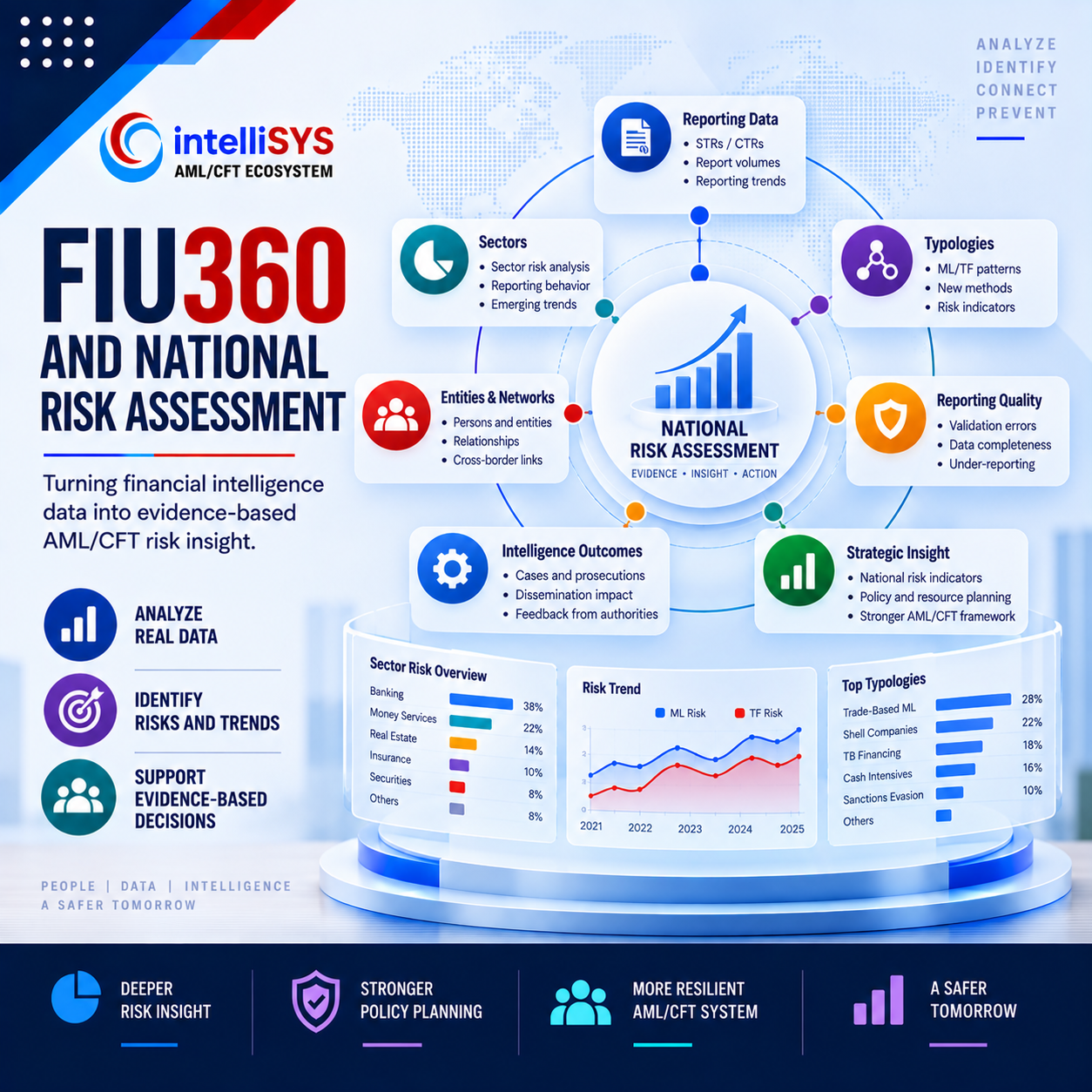
A National Risk Assessment helps a country understand its money laundering and terrorist financing threats, vulnerabilities, and overall risk exposure.
The findings can influence national AML/CFT policy, supervisory priorities, enforcement resources, reporting obligations, sector guidance, and institutional planning.
A weak assessment may rely heavily on assumptions or limited statistics.
A stronger assessment uses evidence from across the AML/CFT system.
FIU data is particularly valuable because it reflects what reporting entities are seeing, what analysts are identifying, and what intelligence is being produced from real financial activity.
FIUs sit at the center of the AML/CFT information environment.
They receive suspicious transaction reports, currency transaction reports, electronic transfer information, and other disclosures depending on national requirements.
They may also access external information such as company registries, population records, customs data, tax information, sanctions lists, law enforcement intelligence, and other authorized sources.
This gives the FIU a broad view of financial risk.
FIU360 helps organize that information into a structured environment where it can support both operational analysis and national-level risk understanding.
Report volume is useful, but it does not explain risk on its own.
A sector that submits many reports may have strong detection capability, high inherent risk, defensive reporting, or a combination of these factors.
A sector that submits few reports may genuinely have limited exposure—or it may be under-reporting.
National Risk Assessment therefore requires deeper analysis.
FIU360 can help assess report volumes together with report quality, sector exposure, typologies, case development, enrichment results, dissemination outcomes, and feedback.
This provides a more meaningful view of risk.
Different sectors face different AML/CFT threats.
Banks may be exposed to complex cross-border transfers. Money service businesses may face remittance and cash-related risks. Real estate may be vulnerable to ownership concealment and high-value asset purchases. Professional service providers may be exposed to misuse of legal entities or trusts.
FIU360 can help analyze reporting behavior and intelligence outcomes by sector.
This may reveal which sectors generate the most reports, which produce higher-risk cases, which show repeated reporting weaknesses, and which typologies appear most frequently.
These insights can support the sector-risk component of the National Risk Assessment.
Low reporting can itself be a risk indicator.
If a sector considered high risk under the national AML/CFT framework submits almost no suspicious reports, the issue should be examined.
Possible explanations may include limited awareness, weak internal controls, ineffective monitoring, insufficient supervision, or misunderstanding of reporting obligations.
FIU360 dashboards and statistics can help identify these patterns.
The FIU can then compare reporting behavior with known sector exposure and provide evidence to National Risk Assessment teams and supervisory authorities.
The quality of submitted reports also matters.
Repeated missing fields, weak narratives, incomplete identifiers, unclear transaction details, and frequent correction requests may indicate weaknesses in reporting entity controls.
FIU360 can help track validation problems and reporting quality trends.
These trends can contribute to understanding sector vulnerability.
A sector may appear active because it submits many reports, but the underlying reporting quality may still be poor.
National Risk Assessment should consider both reporting quantity and reporting effectiveness.
Typologies describe how financial crime is being carried out.
FIU cases may reveal patterns involving shell companies, trade-based money laundering, corruption proceeds, fraud, cash-intensive businesses, sanctions evasion, terrorist financing, complex ownership structures, or cross-border networks.
FIU360 can help analysts identify recurring patterns across reports and cases.
These typologies can then support threat analysis within the National Risk Assessment.
Instead of relying only on general international typologies, the country can use evidence from its own financial intelligence environment.
Risk may also vary geographically.
Certain regions may show higher concentrations of suspicious transactions, cross-border transfers, cash activity, trade flows, or specific criminal typologies.
FIU360 can help analysts examine geographic patterns across reports, subjects, transactions, and cases.
This may reveal particular corridors, border regions, jurisdictions, or commercial centers requiring additional attention.
Geographic intelligence can help the National Risk Assessment move from broad national conclusions to more precise risk understanding.
Money laundering and terrorist financing often cross jurisdictions.
Funds may move through foreign accounts, offshore companies, trade routes, intermediaries, or international payment channels.
FIU360 can help identify recurring foreign jurisdictions, transaction corridors, counterparties, and cross-border typologies.
This information can support assessment of external threats.
It may also help authorities understand where stronger international cooperation, correspondent banking controls, customs coordination, or targeted supervision is required.
Different financial products and services can carry different risk.
Wire transfers, cash transactions, trade finance, correspondent banking, remittance services, digital payments, business accounts, prepaid products, or virtual asset-related activity may show different patterns.
FIU360 can help analyze how suspicious activity relates to financial products and channels.
This helps identify which services appear most frequently in high-risk intelligence.
The information can then support sector risk analysis and supervisory prioritization.
Legal entities can be misused to hide ownership, move funds, hold assets, or create layers between criminal proceeds and beneficial owners.
FIU360 subject data management and enrichment capabilities can help analysts identify recurring company structures, shared directors, related entities, common addresses, and beneficial ownership concerns.
At National Risk Assessment level, these patterns can reveal structural vulnerabilities.
For example, repeated intelligence involving shell companies or nominee directors may indicate the need for stronger beneficial ownership controls or supervisory attention.
Operational cases can therefore provide evidence for national policy decisions.
Sanctions screening and related intelligence can also contribute to national risk understanding.
Repeated exposure to designated persons, entities, intermediaries, or sanctions-evasion structures may indicate weaknesses in particular sectors or transaction channels.
FIU360 can help connect sanctions alerts with subjects, cases, enrichment data, and transaction activity.
This gives analysts a better understanding of how sanctions-related risk appears within the financial system.
Such evidence may support broader national risk analysis where relevant.
Cases contain more analytical value than raw reporting statistics.
A case may show which subjects were involved, which typology was identified, what external data supported the analysis, which authority received the intelligence, and what feedback was later provided.
FIU360 case management helps preserve this context.
National Risk Assessment teams can use aggregated and appropriately governed case information to understand which threats are producing the most significant intelligence.
This helps distinguish frequent low-level activity from lower-volume but high-impact risks.
An FIU may receive thousands of reports, but only some develop into intelligence suitable for dissemination.
Dissemination data can therefore provide another important perspective.
FIU360 can help track which cases were disseminated, which competent authorities received them, and what types of risk they involved.
This can help identify which sectors, typologies, and subjects are producing the most actionable financial intelligence.
For a National Risk Assessment, this provides evidence about both threat and institutional response.
Feedback helps the FIU understand what happened after dissemination.
Law enforcement may confirm that intelligence supported an investigation. A regulator may use information in supervisory work. Another agency may request additional data.
FIU360 feedback management can help preserve these outcomes.
When aggregated appropriately, feedback provides useful evidence about which financial intelligence risks are translating into operational activity.
This strengthens both National Risk Assessment analysis and broader AML/CFT effectiveness measurement.
Financial intelligence is only one part of the national risk picture.
Law enforcement agencies may hold data on prosecutions, investigations, criminal networks, predicate offences, asset seizures, and emerging crime patterns.
FIU information becomes more powerful when combined with these broader national insights.
FIU360 can support structured information sharing and cooperation with competent authorities, while platforms such as LEA360 can support the investigation side.
Together, these sources can give National Risk Assessment teams a more complete understanding of threats and vulnerabilities.
National Risk Assessment should not be a data collection exercise.
Statistics must be interpreted.
A rise in STRs may indicate higher crime activity, improved awareness, regulatory changes, or defensive reporting.
A decrease may indicate lower exposure—or weaker detection.
Strategic intelligence helps explain what the numbers mean.
FIU360 supports analysts with structured data, statistics, dashboards, case information, and typology analysis, while professional judgment remains essential for interpretation.
Preparing National Risk Assessment evidence can require significant data collection.
FIU360 BI dashboards and reporting capabilities can help reduce this burden.
Management and strategic analysts can review report volumes, sector trends, case activity, dissemination, feedback, risk indicators, and other operational measures.
Dashboards can also help identify changes across time.
This is valuable because National Risk Assessment should not only describe the current position.
It should also identify how the risk environment is changing.
Risk evolves.
A sector that presented limited concern five years ago may become more important due to technological change, new payment channels, economic developments, regulatory gaps, or criminal adaptation.
FIU360 helps preserve historical reports, cases, subjects, and operational statistics.
This supports longitudinal analysis.
Analysts can compare current patterns with previous periods and identify whether particular risks are increasing, decreasing, or changing in character.
Historical evidence makes risk assessment more credible.
National Risk Assessment findings should influence supervision.
If FIU data shows significant risk in a particular sector, supervisory authorities may need to increase inspections, update guidance, improve controls, or engage reporting entities more closely.
FIU360 can provide evidence that supports these decisions.
Reporting behavior, validation errors, typologies, high-risk cases, and intelligence outcomes can all contribute to supervisory understanding.
This creates a stronger connection between financial intelligence and risk-based supervision.
Risk assessment should also influence policy.
If FIU intelligence repeatedly identifies weaknesses involving beneficial ownership, cross-border transactions, trade activity, specific sectors, or information access, authorities may need to consider policy or regulatory changes.
FIU360 helps provide the operational evidence behind these decisions.
The FIU becomes more than a recipient of reports.
It becomes an important source of national AML/CFT insight.
This is one of the key benefits of developing a mature strategic intelligence capability.
AML/CFT resources are limited.
Authorities need to decide where analysts, supervisors, investigators, technology investment, training, and enforcement capacity should be concentrated.
National Risk Assessment helps guide these decisions.
FIU360 data can provide evidence about where the greatest reporting volumes, analytical demands, typologies, high-risk cases, and cooperation requirements exist.
This supports more informed resource allocation.
Risk-based allocation is stronger when it is supported by real operational intelligence.
A country’s previous risk assessment identifies real estate as a relatively high-risk sector.
FIU360 data shows that suspicious reporting from the sector remains extremely low.
The FIU also identifies several cases where real estate appears indirectly through bank reports.
This combination suggests a possible vulnerability in sector detection and reporting.
National Risk Assessment teams can use this evidence to review the sector’s residual risk and recommend stronger supervision, outreach, or reporting guidance.
FIU analysts begin to identify repeated transactions involving the same group of foreign jurisdictions and legal entity structures.
The cases involve different reporting institutions, but FIU360 strategic analysis reveals similar patterns.
The FIU develops a typology and provides aggregated data to the National Risk Assessment process.
The finding may influence the assessment of cross-border threat exposure and lead to stronger monitoring or international cooperation priorities.
FIU360 statistics show that one reporting sector submits a large volume of STRs but also generates a high number of validation errors and correction requests.
Very few of the reports lead to significant case development.
This may indicate weak reporting quality.
The National Risk Assessment can consider this as a vulnerability in preventive measures rather than treating high reporting volume as proof of effectiveness.
This gives assessors a more realistic picture.
Over several years, FIU360 data shows that a specific fraud typology consistently generates high-risk cases and law enforcement investigations.
Feedback confirms that FIU intelligence in these cases is regularly used operationally.
This suggests the threat deserves greater attention in the National Risk Assessment.
The country can then consider whether investigative resources, reporting guidance, supervisory controls, or prevention measures should be strengthened.
National Risk Assessment is closely connected to the risk-based AML/CFT framework.
Authorities need to understand risks and demonstrate that policies, supervision, preventive measures, FIU activity, and law enforcement responses are aligned with those risks.
FIU360 helps preserve the operational data needed to support this evidence.
Reporting trends, strategic intelligence, case outcomes, dissemination, feedback, and supervisory insights can all contribute.
This helps countries move from descriptive risk assessment toward evidence-based risk management.
National Risk Assessment conclusions are only as reliable as the data supporting them.
If FIU records are incomplete, duplicated, inconsistent, or poorly classified, strategic analysis becomes more difficult.
FIU360 subject management, validation, data integration, and structured workflows help improve the quality of the underlying information.
This strengthens both operational analysis and national-level assessment.
Good risk intelligence begins with good data.
National Risk Assessment requires aggregation and analysis, but sensitive FIU information must remain protected.
Case-specific intelligence, reporting entity data, personal information, law enforcement information, and international exchanges may have strict confidentiality requirements.
FIU360 supports role-based access, auditability, case security, and controlled information handling.
The FIU can contribute meaningful risk insight without exposing information beyond what is legally authorized.
Strong governance should remain central to the assessment process.
National Risk Assessment is often conducted periodically.
But national risks change between formal assessment cycles.
A mature FIU should continuously monitor its data for emerging threats and vulnerabilities.
FIU360 strategic intelligence, dashboards, statistics, and case information can support ongoing risk monitoring.
This allows the country to identify important changes before the next formal assessment begins.
Risk assessment becomes an ongoing capability rather than a one-time project.
The National Risk Assessment should also influence the FIU.
If the assessment identifies particular sectors, typologies, jurisdictions, products, or threats as priorities, the FIU can adjust its own processes.
This may include risk scoring, case prioritization, analyst training, reporting entity guidance, dashboard monitoring, or data integration priorities.
FIU360 can help translate national risk findings into operational workflows.
This closes the loop between national assessment and daily financial intelligence work.
FIU360 is powerful for National Risk Assessment support because it connects the underlying components of financial intelligence.
Reporting entities, reports, subjects, transactions, enrichment results, cases, typologies, disseminations, feedback, dashboards, and statistics can all contribute to the risk picture.
The platform helps move the FIU beyond manually compiling fragmented figures.
It provides a structured environment for producing evidence-based strategic intelligence.
For countries seeking more reliable AML/CFT risk understanding, this is a major advantage.
Technology alone does not produce a strong National Risk Assessment.
FIUs need good data, strategic analysis methodology, trained analysts, relevant dashboards, reporting sector understanding, effective inter-agency cooperation, and clear governance.
IntelliSYS supports FIUs through FIU360 configuration, strategic intelligence capability development, dashboards, data integration, reporting entity onboarding, training, mentoring, workflow design, and AML/CFT consulting.
This helps FIUs strengthen their contribution to the wider national risk assessment process.
The objective is to turn operational financial intelligence into useful evidence for national AML/CFT decision-making.
A strong National Risk Assessment should reflect what is actually happening inside the financial system.
FIUs hold critical evidence about reporting behavior, suspicious activity, criminal typologies, sector vulnerabilities, cross-border flows, case outcomes, and intelligence effectiveness.
FIU360 helps organize this evidence and transform it into strategic insight.
By connecting reports, subjects, cases, enrichment, sector data, dissemination, feedback, dashboards, and historical trends, FIU360 helps FIUs make a stronger contribution to National Risk Assessment and national AML/CFT planning.
For countries seeking a more evidence-based understanding of money laundering and terrorist financing risk, financial intelligence should be a central part of the assessment process.
Contact IntelliSYS to discuss how FIU360 can support strategic intelligence, National Risk Assessment data, and evidence-based AML/CFT risk analysis.