
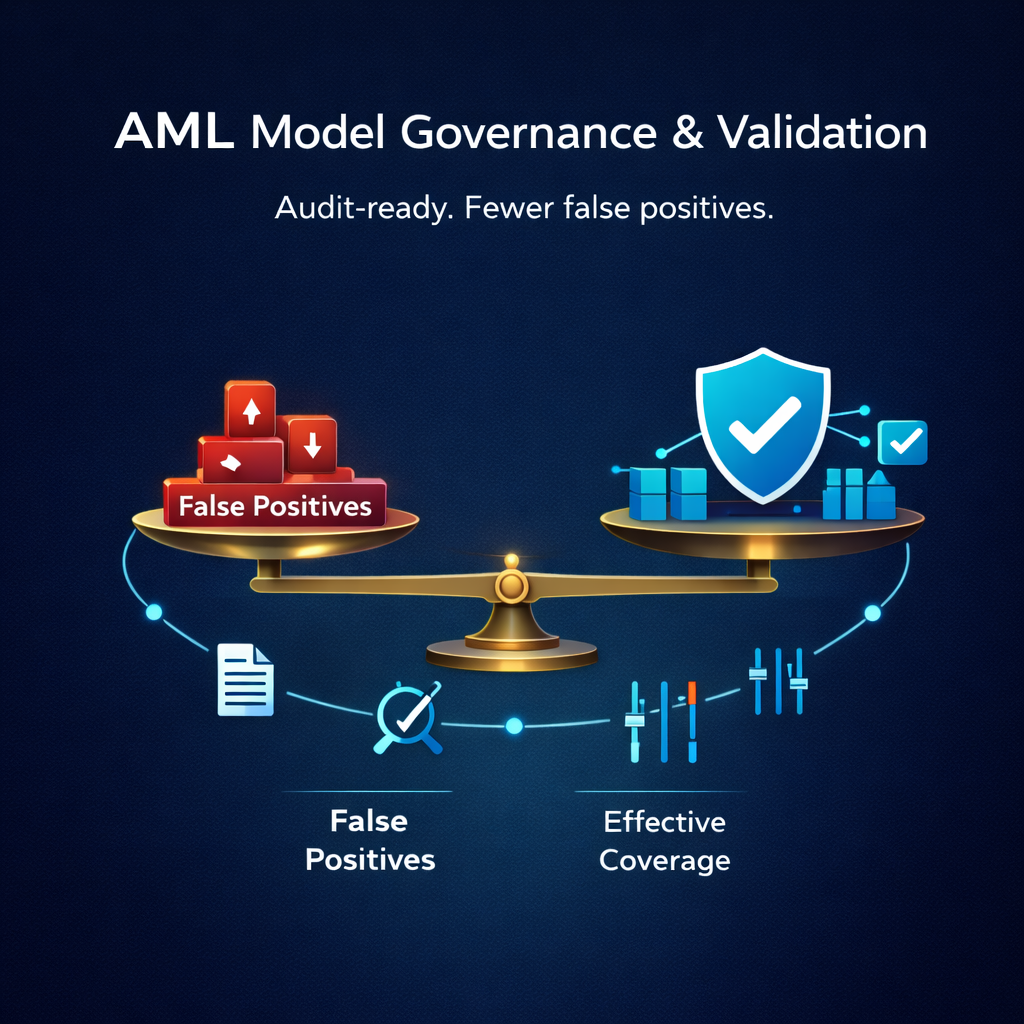
As AML teams modernize transaction monitoring, customer risk scoring, sanctions screening, and behavioral analytics, many institutions discover the same uncomfortable truth: better detection is not the same as defensible compliance. Regulators and internal audit functions increasingly focus on whether automated controls are governed, validated, and monitored—not merely whether they “seem to work.” This is where model governance becomes a strategic capability. Done well, it reduces operational drag (false positives, rework, inconsistent decisions) while strengthening regulatory outcomes (traceability, consistency, and demonstrable effectiveness). Done poorly, it creates fragile controls that break under examination—especially when AI/ML techniques are involved. This article provides a practical, audit-ready framework to govern and validate AML models across the full lifecycle—aligned with widely used supervisory expectations such as SR 11-7 model risk management principles , the FATF risk-based approach , and data quality / lineage disciplines reflected in Basel BCBS 239 .
Many organizations limit the term “model” to machine learning. In governance, that definition is too narrow. In AML, “models” typically include:
Even when the control is “just rules,” it still produces decisions with compliance impact. That means it needs documented design, testing, monitoring, change control, and independent review—the core pillars regulators expect in model risk management .
Internal link suggestion: If your institution is deploying AI-driven monitoring, see IntelliSYS’ coverage of AI-powered transaction monitoring and the need to balance innovation and compliance.
A common failure mode is “shared ownership,” where no one owns the end-to-end risk. A clean governance operating model typically includes:
First line: Model owners (Compliance / FCC / Financial Crime)
Second line: Independent validation (Model Risk / Operational Risk / Compliance Testing)
Third line: Internal audit
A key principle borrowed from SR 11-7 is effective challenge—independent reviewers must have both access and capability to challenge model design and performance .
Audit readiness is about evidence: can a reviewer reconstruct what the model did, why it did it, and how you know it remains fit for purpose?
At minimum, maintain:
BCBS 239-type data disciplines matter here: accurate risk decisions require demonstrably reliable data pipelines and lineage.
Internal link suggestion: Tie this to IntelliSYS’ view on integrated AML architecture and breaking down data silos.
Validation is not a checkbox. For AML controls, strong validation answers four questions:
Validation should combine technical metrics with operational reality:
For AI components, add:
Even the best-designed model can fail in practice. Outcomes testing asks: Does it drive effective detection and reporting? This aligns with FATF’s risk-based approach and the expectation that controls reflect risk, not just policy.
Internal link suggestion: IntelliSYS’ next-generation risk scoring article is a good bridge to how dynamic models should be tested and controlled.
AML teams tune constantly: new typologies, new products, seasonal volume spikes, new regulatory expectations. The biggest governance risk is “silent drift”—where settings evolve without evidence.
A defensible tuning cycle includes:
This is where institutions often win quick value: disciplined calibration can reduce false positives without sacrificing coverage—especially in screening and rule-based monitoring environments.
Internal link suggestion: IntelliSYS has detailed how AI-driven sanctions screening reduces false positives, but the same governance discipline applies: thresholds and matching logic must be controlled and auditable.
Most institutions rely on vendors for sanctions screening, monitoring platforms, case management, or analytics. Governance does not transfer to the vendor.
Minimum expectations:
For regulated entities, vendor dependence is often scrutinized as an operational risk and governance issue—particularly when updates are frequent or opaque. EU institutions also increasingly frame this through broader ICT and governance expectations.
Scenario: A bank deploys new segmentation in transaction monitoring. Alert volumes drop 35%—a perceived win. Two months later, an internal review finds that cross-border wire typologies are under-detected for certain customer types due to a mis-specified peer group baseline.
What failed?
How governance fixes it
This is the core message for executives: governance is not bureaucracy—it is risk containment that prevents “improvement” from becoming hidden degradation.
Internal link suggestion: Behavioral analytics is powerful, but it must be monitored for drift and operational impact over time.
If you want a pragmatic starting point, confirm you can evidence the following for each AML model/control:
Modern AML programs increasingly depend on automation and analytics to keep up with volume, velocity, and evolving typologies. But as models become more complex, governance and validation become the differentiator between scalable compliance and fragile controls.
The most resilient institutions treat AML models like critical risk infrastructure: well-documented, independently tested, continuously monitored, and improved through controlled change. That approach supports a true risk-based program and builds confidence with regulators, auditors, and the business.
AML innovation only delivers value when it is audit-ready. This guide explains how to govern and validate AML models—covering ownership, documentation, independent challenge, data lineage, performance testing, tuning discipline, and ongoing monitoring. Using SR 11-7 principles, FATF risk-based expectations, and BCBS 239-style data controls, institutions can reduce false positives while protecting detection coverage and regulatory defensibility.