
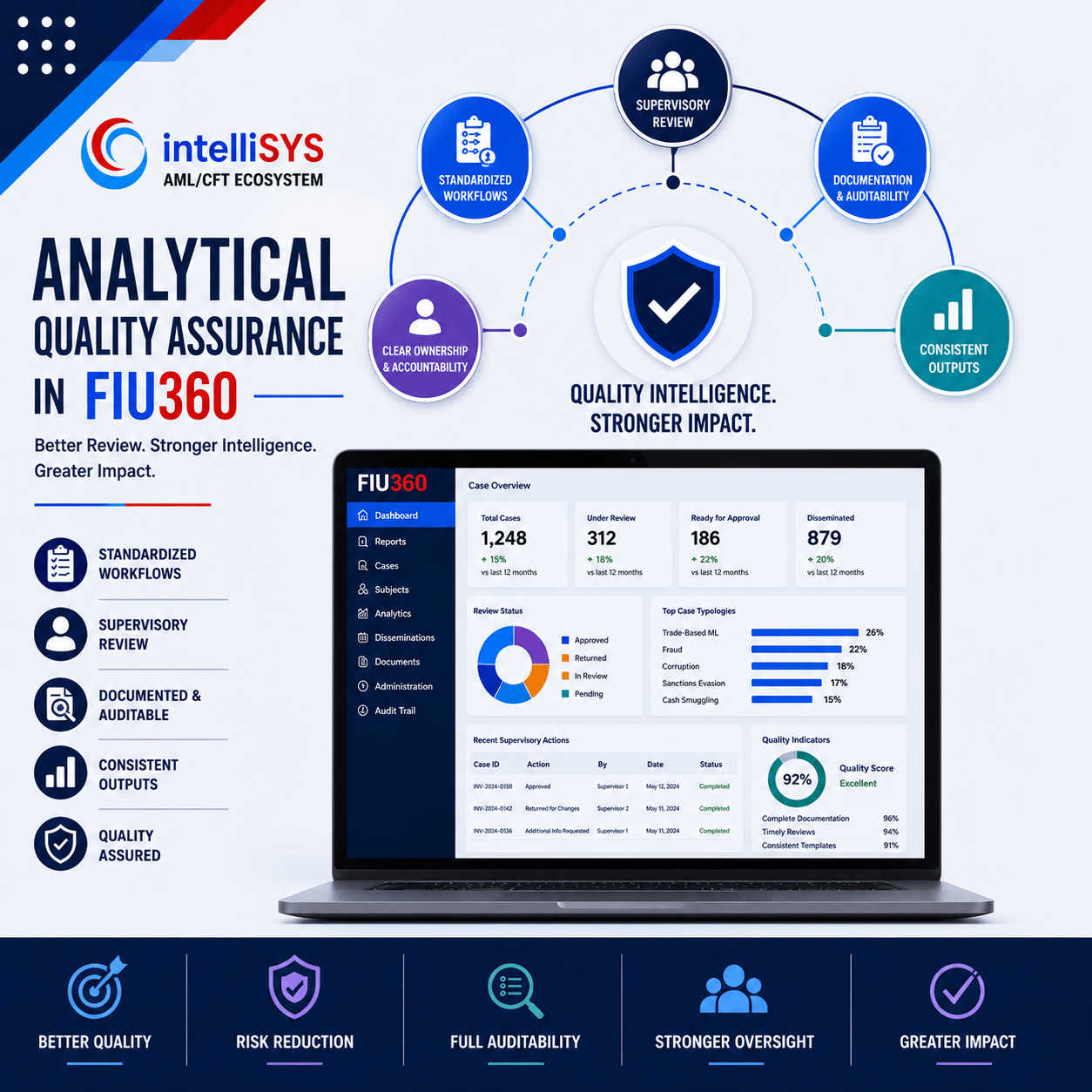
Financial Intelligence Units are judged not only by the number of reports they receive.They are judged by the quality of the intelligence they produce.A strong FIU must be able to assess reports, enrich data, identify risk, develop cases, prepare clear intelligence products, protect sensitive information, and disseminate useful outputs to competent authorities.This requires analytical quality assurance.Without quality assurance, intelligence work can become inconsistent. Analysts may apply different review standards. Supervisors may lack visibility. Dissemination packages may vary in quality. Case decisions may be difficult to trace.FIU360 helps FIUs standardize analytical review, supervisory oversight, workflow control, documentation, auditability, and intelligence output quality.
Financial intelligence is sensitive and consequential.
An FIU dissemination may support a criminal investigation, regulatory action, sanctions review, asset tracing, international cooperation, or strategic risk assessment.
If the intelligence product is incomplete, unclear, unsupported, or poorly structured, the receiving authority may struggle to use it.
Quality assurance helps reduce that risk.
It ensures that intelligence products are reviewed, supported by evidence, aligned with procedures, and prepared in a consistent format.
For modern FIUs, analytical quality assurance is not optional.
It is part of operational effectiveness.
In some FIUs, review depends heavily on informal habits.
An analyst prepares a case note. A supervisor reviews it by email. Documents are stored in folders. Comments are exchanged manually. Dissemination decisions are recorded in separate files.
This can work in simple cases, but it becomes weak at scale.
As report volumes increase and cases become more complex, informal review creates risk.
The FIU may not know which version was approved, which documents were considered, who reviewed the analysis, why a case was escalated, or why a dissemination decision was made.
FIU360 helps move quality assurance into a structured workflow.
Quality assurance begins with workflow standardization.
Analysts should not have to invent a process for every case.
FIU360 supports configurable workflows that can guide reports and cases through defined stages such as validation, triage, enrichment, analysis, supervisory review, dissemination, feedback, and closure.
This helps the FIU create consistency.
Different case types may still require different workflows, but each workflow can be structured, measured, and reviewed.
Standardization does not remove analyst judgment.
It gives analyst judgment a controlled operating environment.
Every case needs clear ownership.
If several analysts review the same matter without defined responsibilities, work can be duplicated or missed.
FIU360 helps assign cases, tasks, responsibilities, and deadlines.
This gives analysts clarity over what they need to do and gives supervisors visibility over who is responsible for each stage.
Clear ownership supports better accountability.
It also helps prevent cases from remaining inactive because no user is clearly responsible for the next action.
Supervisory review should be part of the case workflow, not an afterthought.
FIU360 can support review steps where supervisors examine the analyst’s findings, supporting documents, risk assessment, visualizations, enrichment results, and proposed dissemination action.
This helps improve intelligence product quality before external sharing.
A supervisor may approve the analysis, request additional work, adjust the dissemination recommendation, or return the case for clarification.
When review is built into the system, the FIU gains a clearer record of decisions and quality control.
Different analysts may have different experience levels, writing styles, and analytical approaches.
Some may produce detailed narratives. Others may focus on transaction data. Some may use visualization extensively. Others may rely more on documents and enrichment results.
Variation is natural, but uncontrolled variation can weaken institutional quality.
FIU360 helps standardize case structures, workflows, templates, review steps, and supporting documentation.
This helps the FIU produce more consistent intelligence products across teams.
Consistency is especially important when intelligence is disseminated to law enforcement, regulators, counterpart FIUs, or other competent authorities.
A supervisor cannot review quality properly if the case material is scattered.
FIU360 case binders help consolidate relevant reports, subjects, entities, accounts, transactions, documents, enrichment results, notes, visualizations, and decisions inside the case environment.
This gives supervisors and analysts a more complete view.
Instead of searching across emails, folders, and spreadsheets, users can review the case record in one controlled location.
A complete case binder supports better quality assurance because the reviewer can see both the conclusion and the supporting material.
Documents often support analytical conclusions.
A company registry extract, bank statement, customs document, law enforcement response, scanned ID, spreadsheet, or analyst note may be central to a case.
If documents are unmanaged, quality review becomes difficult.
FIU360 document management helps attach, search, tag, version, and control documents inside the case environment.
This supports stronger review.
A supervisor can check whether the right documents were considered, whether the latest version was used, and whether supporting files are linked to the intelligence product.
Intelligence reports often go through several drafts.
An analyst may prepare an initial version. A supervisor may request changes. A senior reviewer may adjust the dissemination language. Supporting attachments may be added later.
Without version control, confusion can occur.
FIU360 helps manage documents and case records in a controlled way so users can reduce reliance on unmanaged drafts.
This supports clearer quality assurance.
The FIU can better understand which version was reviewed, which version was approved, and which version was disseminated.
Quality intelligence must be supported by evidence.
An analyst should not only state that a subject appears suspicious. The case should show why.
The supporting evidence may include transaction patterns, subject history, enrichment results, ownership links, sanctions indicators, document findings, previous reports, or law enforcement context.
FIU360 helps analysts connect evidence to the case.
This allows supervisors to review whether the analytical conclusion is properly supported.
Evidence-based analysis strengthens the credibility of the FIU’s intelligence products.
Data enrichment can significantly improve analytical quality.
However, enrichment results must be interpreted and connected to the case.
FIU360 allows analysts to bring external and internal data into the intelligence workflow and link it to persons, entities, accounts, documents, and cases.
This helps supervisors review how enrichment influenced the analysis.
For example, if company registry data reveals a shared director across several suspicious companies, that link should be visible in the case record.
Quality assurance depends on this traceability.
FIUs need to prioritize high-risk matters.
However, prioritization decisions should be reviewable.
If a report is escalated, closed, placed on hold, or converted into a case, the reasoning should be clear.
FIU360 workflows and case records can help document these decisions.
Supervisors can review whether the analyst considered relevant risk indicators, previous reports, enrichment results, sanctions exposure, typology indicators, or other case factors.
This helps ensure that prioritization is not arbitrary.
It also supports better resource allocation.
Dissemination is a major decision.
Before intelligence is sent to another authority, the FIU should ensure that the product is clear, relevant, supported, properly classified, and sent to the correct recipient.
FIU360 supports structured dissemination workflows.
The intelligence package can include narrative analysis, subject profiles, transaction summaries, visualizations, documents, attachments, and supporting context.
A review step before dissemination helps ensure that the package is complete and appropriate.
This improves the usefulness of FIU intelligence.
An intelligence product should be understandable.
A receiving authority should be able to identify the subjects, understand the suspicious activity, see the financial pattern, review the supporting evidence, and determine possible next steps.
FIU360 helps by organizing case information and supporting structured intelligence packages.
Analysts can use case data, visualizations, documents, and transaction summaries to produce clearer narratives.
Quality assurance should check not only whether the facts are present, but also whether the intelligence is communicated effectively.
A technically correct report may still be weak if it is difficult to use.
An intelligence product should be understandable.
A receiving authority should be able to identify the subjects, understand the suspicious activity, see the financial pattern, review the supporting evidence, and determine possible next steps.
FIU360 helps by organizing case information and supporting structured intelligence packages.
Analysts can use case data, visualizations, documents, and transaction summaries to produce clearer narratives.
Quality assurance should check not only whether the facts are present, but also whether the intelligence is communicated effectively.
A technically correct report may still be weak if it is difficult to use.
Quality assurance requires traceability.
The FIU should know who created a case, who reviewed it, who changed records, who approved dissemination, and when decisions occurred.
FIU360 supports audit logging and workflow records.
This creates accountability.
If questions arise later, the FIU can review the system record instead of relying on memory or informal notes.
Audit trails strengthen governance and protect the integrity of the intelligence process.
Some cases require enhanced control.
Cases involving corruption, politically exposed persons, terrorism financing, sanctions exposure, organized crime, or active law enforcement cooperation may need restricted access and senior review.
FIU360 supports access control and case-level security measures.
This allows the FIU to protect sensitive cases while still maintaining structured review.
Sensitive intelligence should not bypass quality assurance.
It should go through controlled, authorized, and auditable review steps.
Quality assurance is not only case-by-case.
Management also needs visibility over the quality of operations.
FIU360 dashboards and statistics can help supervisors monitor workloads, workflow delays, pending reviews, case statuses, dissemination volumes, feedback, and operational bottlenecks.
This helps management identify where quality risks may be emerging.
For example, if many cases remain pending review for too long, the FIU may need to adjust staffing, workflow rules, or supervisory capacity.
Dashboards help quality assurance become a management function, not only an analyst-level activity.
Feedback from recipients is one of the strongest quality indicators.
If law enforcement regularly requests clarification, the FIU may need to improve its intelligence reports.
If disseminations lead to useful investigations, the FIU can identify which analytical practices are working well.
FIU360 feedback tracking helps the FIU learn from external use of its intelligence.
This supports continuous improvement.
Quality assurance should not end when the product is disseminated.
It should continue through feedback and outcome review.
Templates help standardize intelligence outputs.
A good template can guide analysts to include essential information such as subject details, transaction summary, suspicion indicators, enrichment results, network analysis, supporting documents, recommended actions, and dissemination classification.
FIU360 can support structured output processes that help analysts prepare more consistent intelligence packages.
Templates should not make intelligence mechanical.
They should provide a framework that ensures important elements are not missed.
Quality assurance becomes easier when intelligence products follow a clear structure.
Quality assurance is also a training mechanism.
When supervisors review cases and provide structured feedback, analysts improve.
They learn how to strengthen narratives, support conclusions, use enrichment results, prepare better visualizations, and produce more useful disseminations.
FIU360 helps preserve review comments, workflow decisions, and case records.
This allows quality review to become part of institutional learning.
Over time, the FIU can improve analyst capability and consistency.
New analysts often need guidance.
They may understand AML/CFT theory but still need practical experience with report review, enrichment, case development, risk assessment, visualization, and dissemination.
A structured platform helps them learn the FIU’s operating model.
FIU360 workflows, templates, case binders, and review steps provide a clearer path for new analysts.
Supervisors can review work more easily and provide targeted guidance.
This improves onboarding and reduces reliance on informal training.
Poor quality control creates rework.
A supervisor may return a case several times. A dissemination recipient may request missing information. Analysts may need to search for documents again. Case notes may need to be rewritten.
FIU360 helps reduce rework by organizing case materials, supporting structured workflows, and enabling earlier review.
When information is complete, linked, and visible, analysts and supervisors can resolve issues before dissemination.
This saves time and improves operational efficiency.
FATF mutual evaluations focus on effectiveness.
FIUs must show that they produce useful financial intelligence, cooperate with competent authorities, manage sensitive data, and support investigations.
Analytical quality assurance helps demonstrate effectiveness.
FIU360 supports this by creating records of report handling, case review, dissemination, feedback, audit trails, and operational statistics.
The FIU can show not only that it processed reports, but that it managed intelligence through structured and supervised workflows.
This strengthens institutional readiness.
An analyst prepares a dissemination package involving suspicious cross-border transfers.
The first draft includes transaction data but does not clearly explain the ownership links between related companies.
During FIU360 supervisory review, the supervisor requests additional company registry enrichment and a network visualization.
The analyst updates the case, adds the supporting documents, includes the visual relationship map, and revises the narrative.
The final dissemination package is clearer and more useful.
This is quality assurance in practice.
FIU management reviews dashboard data and notices that many cases are delayed at supervisory review.
The issue is not analyst productivity. It is review capacity.
The FIU adjusts its workflow, assigns additional senior reviewers, and creates priority rules for high-risk cases.
This improves throughput without weakening quality.
FIU360 dashboards help management identify the bottleneck and act on it.
Law enforcement provides feedback that several FIU disseminations were useful but lacked concise transaction summaries.
The FIU reviews the feedback inside FIU360 and updates its dissemination template.
Analysts are trained to include a short transaction pattern summary in future intelligence products.
Over time, recipient feedback improves.
This shows how feedback can strengthen intelligence quality.
An FIU handles a case involving suspected corruption and politically exposed persons.
The case is restricted to a limited group of authorized users.
FIU360 records access, workflow actions, review decisions, documents, enrichment results, and dissemination steps.
Senior review is required before any external sharing.
This protects the case while maintaining quality assurance and traceability.
Quality assurance should not turn intelligence into a rigid checklist.
Financial crime cases differ.
Some require deep network analysis. Others require rapid escalation. Some are document-heavy. Others depend on transaction patterns or strategic context.
FIU360 helps standardize the process without eliminating analytical flexibility.
The FIU can define workflows, templates, and review controls while still allowing analysts to apply professional judgment.
The goal is controlled intelligence work, not mechanical reporting.
FIU360 is powerful for analytical quality assurance because it connects the key elements of FIU work.
Reports, subjects, transactions, enrichment results, documents, visualizations, workflows, reviews, cases, disseminations, feedback, dashboards, and audit trails are managed inside one environment.
This gives analysts and supervisors a clearer basis for review.
It also gives management better visibility over quality and performance.
Quality assurance becomes part of daily operations rather than a separate manual process.
Improving analytical quality requires both system configuration and operational expertise.
The FIU must define review stages, case types, templates, workflow rules, security levels, dissemination standards, feedback mechanisms, and supervisor responsibilities.
IntelliSYS supports FIUs through FIU360 configuration, workflow design, SOP alignment, training, mentoring, dashboard setup, and operational consulting.
This helps ensure that quality assurance is practical and aligned with the FIU’s real operating model.
The objective is to help FIUs produce clearer, more consistent, more useful, and more traceable intelligence outputs.
Financial intelligence must be accurate, clear, supported, secure, and useful.
Without analytical quality assurance, FIUs risk inconsistent case handling, weak dissemination products, unclear review records, and limited institutional learning.
FIU360 helps FIUs strengthen quality assurance through workflow control, supervisory review, case binders, document management, enrichment links, visualization, templates, dashboards, feedback, security, and audit trails.
For FIUs seeking to improve intelligence product quality, supervision, accountability, and mutual evaluation readiness, analytical quality assurance should be treated as a core modernization capability.
Contact IntelliSYS to discuss how FIU360 can support analytical quality assurance, supervisory review, and intelligence product standardization in your FIU environment.