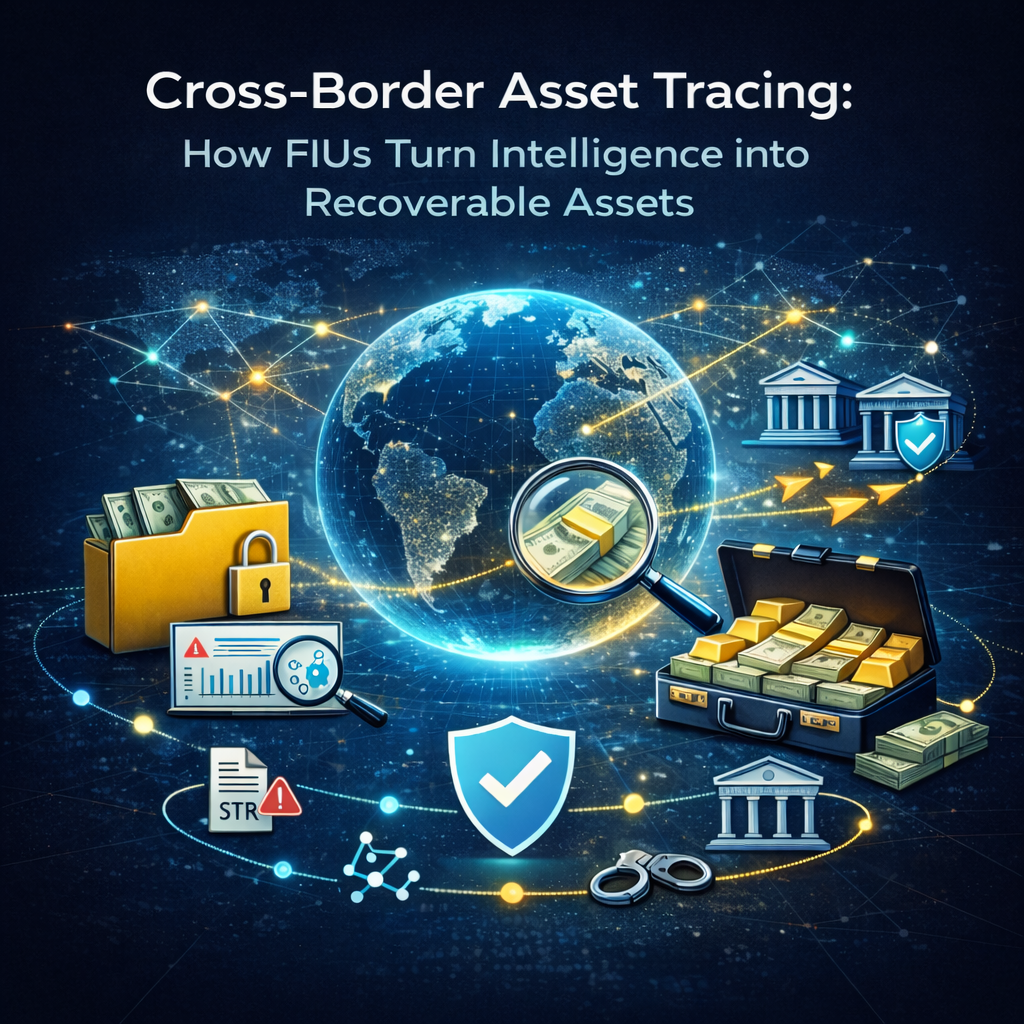
Financial crime has evolved into a highly internationalized ecosystem. Criminal networks move funds through multiple jurisdictions within minutes, using shell companies, correspondent banking channels, trade transactions, and increasingly digital assets. For Financial Intelligence Units (FIUs), this means that effective asset recovery is rarely a domestic exercise. Instead, success depends on the ability to trace assets across borders quickly and convert intelligence into actionable enforcement outcomes. The Egmont Group, which connects more than 160 FIUs globally, was created precisely to address this challenge. Through secure information exchange, operational cooperation, and standardized intelligence sharing mechanisms, the Egmont network enables FIUs to follow illicit financial flows even when they pass through complex international structures. However, tracing assets internationally is not just about exchanging information. It requires structured workflows, high-quality financial intelligence, integrated analytical tools, and strong cooperation between FIUs, law enforcement agencies (LEAs), prosecutors, and reporting entities. This article examines how modern FIUs can improve cross-border asset tracing by strengthening intelligence processes, enhancing cooperation mechanisms, and deploying advanced analytics to ensure that financial intelligence leads to real asset recovery outcomes rather than investigative dead ends.
Financial crime investigations increasingly involve multiple jurisdictions, multiple financial institutions, and layered ownership structures. Criminals exploit the differences between regulatory frameworks, banking secrecy laws, and investigative capabilities across countries.
Common cross-border laundering techniques include:
Layered bank transfers across correspondent banking networks
Use of offshore shell companies to obscure beneficial ownership
Trade-based money laundering (TBML) through manipulated invoices
Rapid asset conversion into cryptocurrencies or luxury goods
Use of nominee directors and trustees
By the time an STR reaches the FIU, the funds may have already passed through several countries.
This creates three core challenges:
Funds can move across jurisdictions faster than investigative processes can respond.
FIUs often lack direct access to foreign financial data.
Each jurisdiction has different legal requirements for freezing or seizing assets.
Without strong international cooperation, investigations stall at these points.
The Egmont Group of Financial Intelligence Units provides the primary infrastructure for global FIU cooperation. Its secure communication platform allows FIUs to exchange financial intelligence rapidly and confidentially.
Through this network, FIUs can request:
Bank account details
Transaction histories
Beneficial ownership information
Corporate registry data
Links to other investigations
These exchanges are conducted under Egmont principles of confidentiality, reciprocity, and proper use of intelligence.
The value of this system lies in its ability to provide investigative leads that law enforcement can develop into formal evidence.
For example:
A European FIU identifies suspicious transfers linked to procurement fraud.
Funds are traced to accounts in another jurisdiction.
A request is sent through the Egmont Secure Web.
The receiving FIU confirms additional accounts linked to the same network.
Domestic authorities initiate freezing and seizure proceedings.
Without this intelligence exchange, investigators might never identify the cross-border link.
Even with international cooperation mechanisms, FIUs must first build a clear financial intelligence picture domestically before engaging foreign counterparts.
Effective asset tracing depends on access to multiple data sources.
Key intelligence inputs include:
STRs remain the primary trigger for financial investigations. High-quality STRs provide:
transaction timelines
counterparty details
behavioral anomalies
When enriched with additional intelligence, STRs often reveal international connections.
Complex corporate structures frequently conceal the true owners of illicit funds.
Access to beneficial ownership databases allows FIUs to identify:
ultimate controlling persons
linked corporate entities
nominee arrangements
This information is crucial when tracing funds through offshore entities.
Property registries, vehicle registries, and company filings help identify non-bank assets acquired with illicit proceeds.
These assets are often easier to seize than cash.
Modern FIUs rely on analytical tools that can integrate multiple data streams to detect patterns across large datasets.
Graph analytics, network analysis, and machine learning can reveal connections that traditional investigation methods might miss.
As financial transactions increase in volume and complexity, manual analysis is no longer sufficient.
Advanced analytical technologies are now essential for effective asset tracing.
Link analysis tools map relationships between:
individuals
bank accounts
companies
transactions
These visual networks help analysts identify central nodes within criminal networks.
Machine learning models can detect unusual transaction behavior patterns that indicate potential laundering activity.
Examples include:
circular transfers between related accounts
structuring patterns designed to avoid reporting thresholds
rapid cross-border transaction chains
With the rise of digital assets, FIUs increasingly use blockchain analytics tools to trace crypto transactions across wallets and exchanges.
These tools can identify:
exchange entry points
wallet clustering patterns
links to darknet markets or ransomware operations
Financial intelligence alone does not recover assets. To achieve tangible outcomes, FIUs must ensure that intelligence flows smoothly into law enforcement investigations and judicial processes.
This requires structured operational cooperation.
In complex cases, FIUs often collaborate with law enforcement from the early stages of analysis.
Joint investigation teams can accelerate:
evidence collection
witness interviews
international legal assistance requests
Financial investigations should run alongside criminal investigations rather than after them.
This approach increases the likelihood that assets will be identified before they disappear.
Once assets are identified, authorities may apply provisional measures such as:
freezing bank accounts
seizing property
restricting transfers
These actions preserve assets while investigations proceed.
The final stage involves confiscation through court proceedings and, in some cases, asset repatriation to victim jurisdictions.
Effective FIU intelligence significantly increases the success rate of these outcomes.
Financial institutions play a critical role in detecting and reporting suspicious activity.
Strong cooperation between FIUs and reporting entities improves both detection quality and investigation speed.
Public-private partnerships (PPPs) enable:
real-time intelligence sharing
improved STR quality
early identification of emerging criminal typologies
For example, banks may provide additional transaction context that helps FIUs trace funds more accurately across borders.
This collaborative approach significantly strengthens the financial intelligence ecosystem.
Cross-border asset tracing represents one of the most complex challenges in financial crime investigations. Criminal networks deliberately exploit international financial systems to obscure the origin and ownership of illicit funds.
Financial Intelligence Units are uniquely positioned to address this challenge by combining financial intelligence, advanced analytics, and international cooperation.
Through mechanisms such as the Egmont Group, FIUs can exchange intelligence rapidly, uncover hidden financial networks, and support law enforcement agencies in securing and confiscating criminal assets.
However, achieving meaningful results requires more than information exchange. FIUs must invest in data integration, analytical technologies, operational partnerships, and structured investigative workflows that convert intelligence into enforcement outcomes.
When these elements work together effectively, FIUs become a central pillar of global efforts to combat money laundering, disrupt organized crime networks, and recover assets for victims and governments.