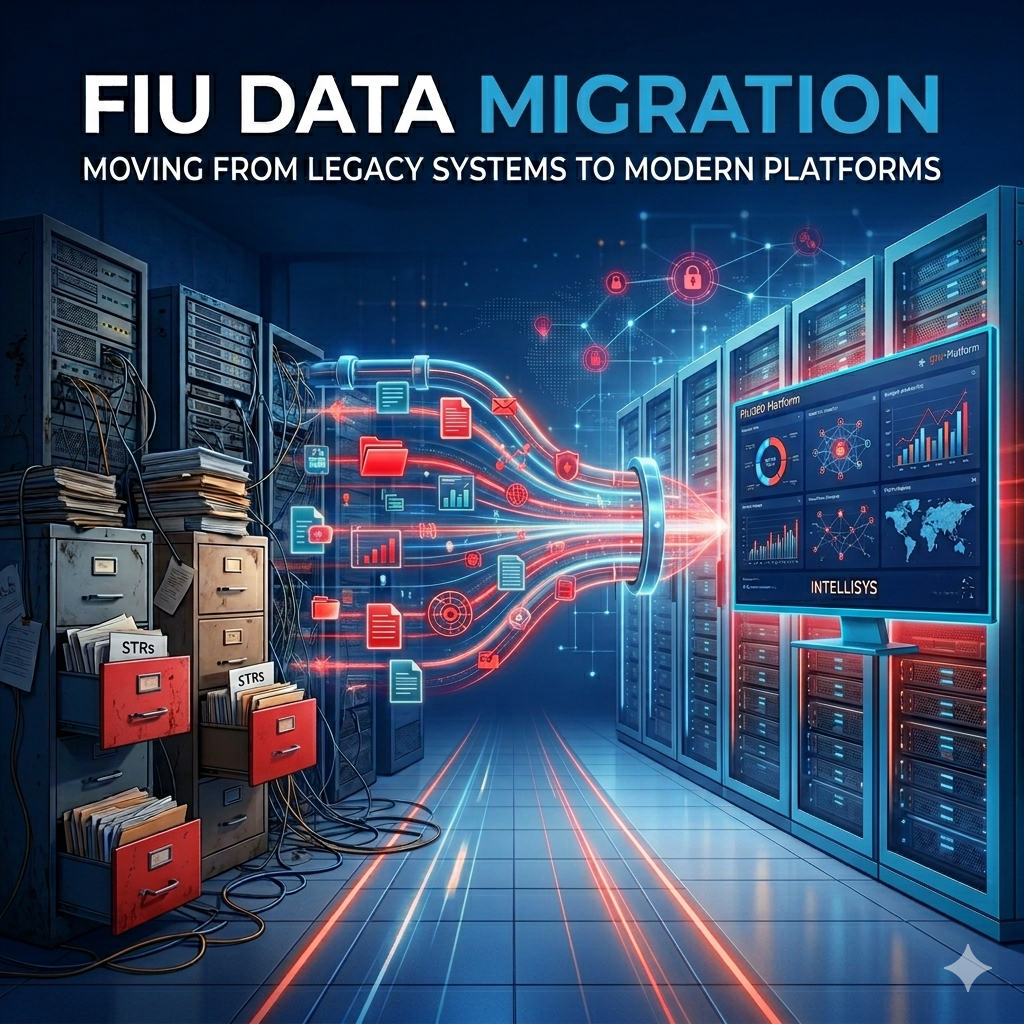
Financial Intelligence Units often operate with years of historical reports, case files, entity records, attachments, audit logs, and intelligence products stored across legacy systems. These systems may still support daily operations, but they can become difficult to scale, integrate, secure, and maintain. FIU data migration is a critical step in modernizing financial intelligence operations. It allows FIUs to move from outdated platforms to modern intelligence environments while preserving sensitive AML/CFT data, operational continuity, and institutional knowledge.
FIU modernization is not only about implementing a new platform. It is also about protecting the intelligence value already stored in existing systems.
Historical data can contain important links between suspicious transaction reports, reporting entities, persons, companies, bank accounts, addresses, documents, and previous investigations. If this information is migrated poorly, analysts may lose context that is essential for future analysis.
A successful migration ensures that old data remains searchable, reliable, secure, and useful inside the new financial intelligence platform.
Many legacy FIU systems were designed for earlier operational requirements. They may have supported basic report collection, case registration, or document storage, but they were not always built for modern analytics, workflow automation, large-scale integration, or advanced access control.
Over time, these systems become harder to manage. Data structures may be inconsistent, documentation may be incomplete, and custom modifications may make upgrades difficult. In some cases, key operational knowledge may exist only with a small number of technical users or long-serving staff.
This creates risk during modernization. FIUs need to move forward without losing the value of years of financial intelligence work.
Many legacy FIU systems were designed for earlier operational requirements. They may have supported basic report collection, case registration, or document storage, but they were not always built for modern analytics, workflow automation, large-scale integration, or advanced access control.
Over time, these systems become harder to manage. Data structures may be inconsistent, documentation may be incomplete, and custom modifications may make upgrades difficult. In some cases, key operational knowledge may exist only with a small number of technical users or long-serving staff.
This creates risk during modernization. FIUs need to move forward without losing the value of years of financial intelligence work.
FIU data migration is the controlled process of extracting, cleaning, transforming, validating, and loading data from an existing environment into a new financial intelligence platform.
This may include suspicious transaction reports, suspicious activity reports, accountable institution records, case files, analyst notes, attachments, workflow history, user records, audit logs, reference data, typologies, and dissemination records.
The goal is not simply to copy data from one database to another. The goal is to preserve meaning, relationships, security rules, and operational usability.
A migration project must answer several practical questions. What data should be migrated? What data should be archived? Which records need cleansing? Which relationships must be preserved? Which audit records are legally required? Which users should access historical data in the new platform?
Financial intelligence data is highly connected. A report may be linked to a case, a case may be linked to multiple entities, and those entities may be connected to other reports, transactions, or disseminations.
If these relationships are broken during migration, the data may remain technically present but analytically weaker. Analysts need to understand how records relate to each other, not only view isolated documents.
Preserving context means maintaining links between reports, cases, entities, documents, comments, decisions, and dissemination history.
FIU data is among the most sensitive information handled by public-sector institutions. Migration must therefore be designed around confidentiality, integrity, and access control.
Sensitive records should be protected during extraction, transfer, transformation, testing, and loading. Access to migration environments should be restricted, monitored, and documented.
Security is not only a production concern. It must apply throughout the entire migration lifecycle.
FIUs must be able to demonstrate how data was handled, especially when moving from one operational platform to another.
A proper migration process should document source records, transformation rules, validation results, exceptions, approval decisions, and final loading outcomes. This helps prove that the migration was controlled and that historical records were not altered without traceability.
Auditability is essential for governance, quality assurance, and long-term confidence in the new system.
Legacy systems often contain duplicate records, incomplete fields, inconsistent naming, outdated codes, and historical formatting issues. Migration provides an opportunity to improve data quality, but it must be handled carefully.
Data cleansing should be governed by clear rules. Some fields can be standardized, while others must remain unchanged for legal or evidential reasons. The FIU should define which data can be transformed, which data must be preserved exactly, and which exceptions require manual review.
FIU data migration can fail when it is treated as a purely technical database task. In reality, it is an operational, legal, security, and intelligence project.
Common risks include incomplete extraction, broken record relationships, missing attachments, inconsistent entity matching, poor handling of historical workflows, weak validation, and insufficient user acceptance testing.
Another major risk is underestimating legacy complexity. Older systems may contain undocumented fields, custom business rules, manual workarounds, or archived records that are still important for intelligence analysis.
A careful discovery phase reduces these risks before migration begins.
Consider an FIU moving from a legacy reporting system to a modern financial intelligence platform. The legacy system contains thousands or millions of suspicious transaction reports, many of which are linked to cases, reporting entities, attachments, analyst notes, and dissemination records.
A weak migration would simply move the report records and ignore the surrounding context. Analysts would then lose important historical links.
A strong migration maps each report to its related entities, documents, case history, review status, and previous actions. Once loaded into the new platform, analysts can search historical reports, identify repeat subjects, compare old and new disclosures, and use past intelligence to support current investigations.
The difference is significant. The first approach preserves data. The second preserves intelligence.
The first phase is understanding the current environment. This includes reviewing source systems, databases, file repositories, user roles, data formats, workflows, integrations, and reporting requirements.
The FIU should also identify which data is active, which data is historical, which data is legally required, and which data may be archived separately.
The next step is mapping old data structures to the new platform. This includes fields, tables, documents, relationships, codes, statuses, workflows, and audit records.
Transformation rules should be documented clearly. For example, old case statuses may need to be converted into a new workflow model, or legacy institution codes may need to be mapped to updated reference data.
Data preparation may involve removing duplicates, standardizing values, correcting formatting issues, and resolving incomplete records. However, cleansing must be governed carefully to avoid changing the legal meaning of historical records.
Any automated cleansing should be tested and reviewed before production migration.
A test migration helps identify issues before the final cutover. It allows technical teams and business users to review migrated records, validate relationships, check attachments, verify search results, and confirm that workflows behave correctly.
This phase is critical because users can identify practical issues that database checks may miss.
The final migration should be planned around operational continuity. FIUs cannot afford uncontrolled downtime or loss of access to critical intelligence.
The cutover plan should define freeze periods, backup procedures, rollback options, user communication, final validation, and post-migration support.
After migration, the FIU should validate data completeness, record accuracy, user access, audit logs, search behavior, reports, and key operational workflows.
This ensures that the new platform is not only technically available but operationally ready.
FIU digital transformation depends on the ability to use data effectively. A new platform can provide better workflows, analytics, reporting, and integration, but these benefits are limited if historical intelligence is incomplete or inaccessible.
Well-executed migration allows FIUs to combine historical knowledge with modern capabilities. Analysts can use past records to identify repeat behavior, detect entity links, enrich current reports, and support strategic analysis.
This is especially valuable for complex financial crime patterns that develop over months or years.
Migration is often the foundation for broader integration. Once data is structured inside a modern platform, the FIU can connect more effectively with reporting entities, law enforcement agencies, registries, sanctions databases, and other authorized sources.
This creates a stronger financial intelligence environment. Historical data, new reports, external enrichment, and active investigations can support each other inside a controlled workflow.
The result is better visibility, faster analysis, and stronger intelligence products.
Data migration should not automatically preserve every old access model. Legacy permissions may be outdated, inconsistent, or too broad for the new environment.
Before going live, FIUs should review user roles, access levels, data classifications, and segregation of duties. Sensitive historical records may require special controls, especially if they involve ongoing investigations, protected sources, or restricted dissemination.
The new platform should enforce access based on operational need, legal authority, and security classification.
IntelliSYS specializes in financial intelligence, AML/CFT technology, secure system integration, workflow automation, and modernization projects for government and regulated environments.
For FIU data migration, IntelliSYS can support discovery, data mapping, migration planning, transformation design, validation, secure transfer, platform loading, user testing, and post-migration support.
Through solutions such as FIU360, IntelliSYS helps FIUs move from fragmented or legacy environments toward modern financial intelligence platforms that support case management, report handling, analytics, secure workflows, auditability, and operational modernization.
The objective is not only to migrate records. The objective is to protect the intelligence value of historical data and make it usable in a modern FIU operating model.
FIU data migration is one of the most important stages of financial intelligence modernization. It determines whether historical intelligence remains usable, searchable, secure, and connected in the new environment.
A successful migration preserves more than data. It preserves context, relationships, evidence, audit history, and institutional knowledge.
If your organization is planning to modernize a legacy FIU system, migrate AML/CFT records, or implement a modern financial intelligence platform, IntelliSYS can help design and execute a secure migration strategy tailored to your operational requirements.
Contact IntelliSYS to discuss your FIU data migration project or request a consultation.