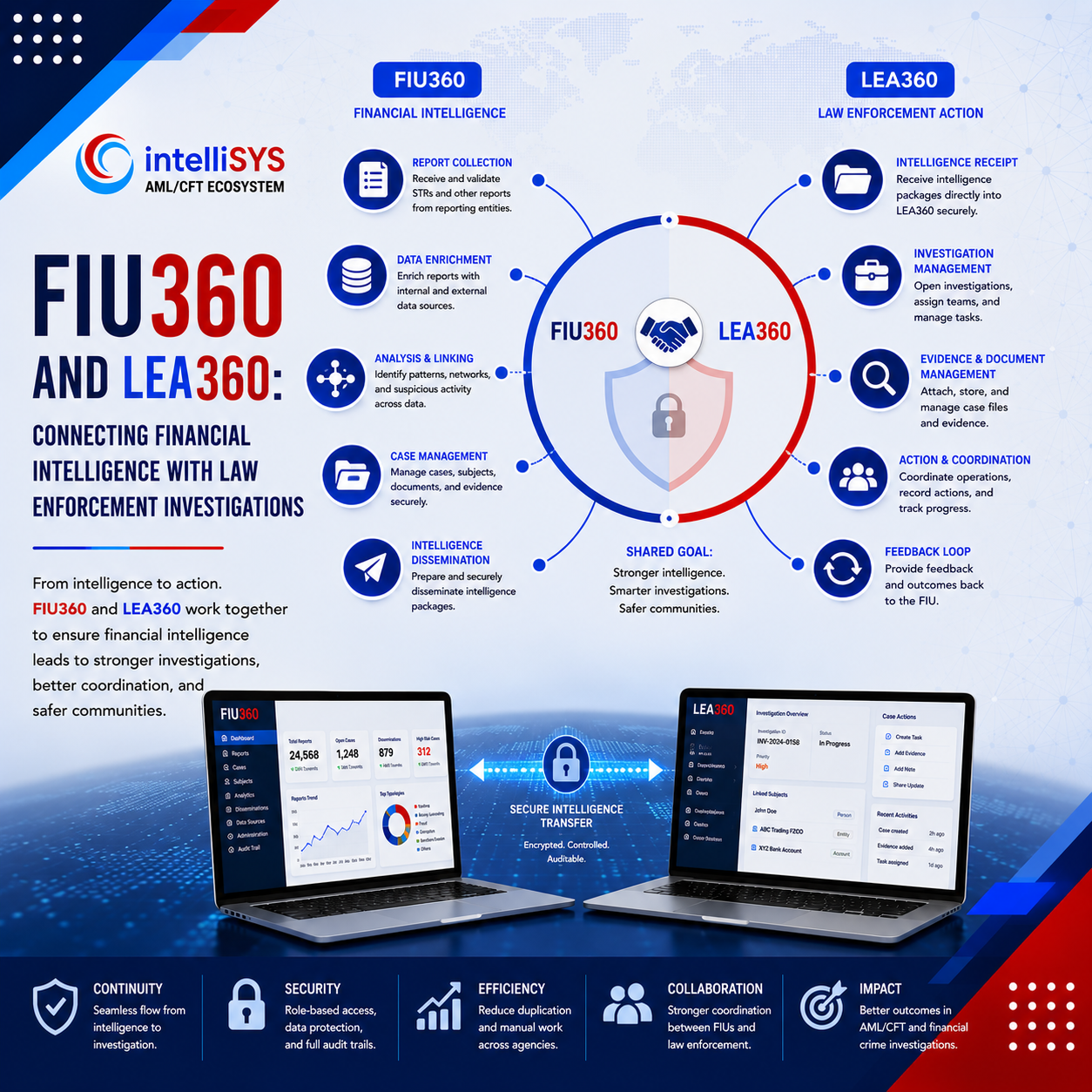
Financial intelligence creates value when it leads to action. A Financial Intelligence Unit may receive suspicious transaction reports, enrich data, identify networks, prepare intelligence packages, and disseminate findings to competent authorities. But the process should not stop at dissemination. Law enforcement agencies need to receive that intelligence, understand it, convert it into investigation activity, manage evidence, assign tasks, coordinate teams, and provide feedback. This is where FIU360 and LEA360 work together. FIU360 supports the financial intelligence lifecycle inside the FIU. LEA360 supports investigation management and criminal intelligence-led law enforcement after intelligence is received. Together, they help connect analysis with action.
Many AML/CFT ecosystems face a common problem.
The FIU produces intelligence, but the receiving authority manages the investigation in a separate environment. Intelligence packages may be sent by email, stored in folders, printed, copied into documents, or tracked manually.
This creates operational gaps.
The investigation team may not receive the full context. Follow-up actions may be difficult to track. Feedback to the FIU may be delayed. Case history may become fragmented. Sensitive information may be exposed to unnecessary risk.
A stronger model connects FIU intelligence with structured investigation management.
FIU360 and LEA360 support this connected model.
FIU360 is designed to support the FIU lifecycle.
It helps FIUs manage reporting entity registration, report collection, data validation, enrichment, subject management, analysis, case management, visualization, document handling, dissemination, feedback, dashboards, security, and auditability.
This allows the FIU to move from raw reports to structured intelligence.
An intelligence package may include a narrative report, subject profiles, transaction summaries, ownership links, visual diagrams, supporting documents, and recommended follow-up points.
FIU360 helps prepare and manage that package inside a secure and auditable environment.
LEA360 supports law enforcement agencies in managing investigations and criminal intelligence.
After receiving financial intelligence, investigators need to create or update investigation files, assign officers, manage tasks, attach documents, record actions, link subjects, track progress, and support supervisory review.
LEA360 provides a structured environment for this work.
It helps agencies move away from disconnected emails, spreadsheets, and informal case tracking.
The objective is to help law enforcement turn intelligence into organized investigation activity.
Dissemination is the bridge between FIU360 and LEA360.
Inside FIU360, the FIU prepares and sends intelligence to the appropriate authority. The package may contain financial analysis, entities, transactions, documents, network diagrams, and supporting context.
Inside LEA360, that intelligence can become the basis of an investigation.
The receiving agency can open a case, assign responsibilities, add new evidence, track investigative steps, and manage operational decisions.
This creates continuity.
The intelligence does not remain a static document. It becomes part of an active investigation workflow.
Dissemination is the bridge between FIU360 and LEA360.
Inside FIU360, the FIU prepares and sends intelligence to the appropriate authority. The package may contain financial analysis, entities, transactions, documents, network diagrams, and supporting context.
Inside LEA360, that intelligence can become the basis of an investigation.
The receiving agency can open a case, assign responsibilities, add new evidence, track investigative steps, and manage operational decisions.
This creates continuity.
The intelligence does not remain a static document. It becomes part of an active investigation workflow.
Financial crime cases often involve complex networks.
A single intelligence package may include multiple persons, companies, accounts, addresses, beneficial owners, transaction counterparties, and related reports.
If this information is re-entered manually into a law enforcement system, errors may occur.
If it is stored only as an attachment, investigators may not be able to use the structured relationships effectively.
A connected approach preserves context.
FIU360 creates the intelligence record. LEA360 helps law enforcement use that record in investigation management.
This reduces duplication and supports better operational continuity.
Intelligence-led law enforcement depends on structured information.
Investigators need to understand relationships, risks, priorities, and evidence before deciding what action to take.
FIU360 helps generate financial intelligence from reports, enriched data, and analytical workflows.
LEA360 helps transform that intelligence into investigation activity.
Together, they support a more intelligence-led approach to financial crime, corruption, sanctions evasion, terrorist financing, fraud, organized crime, and other complex threats.
The result is a stronger connection between financial analysis and law enforcement action.
Subjects may appear across both FIU and law enforcement work.
A person may be reported in an STR, enriched through national data sources, linked to a legal entity, included in a dissemination package, and later investigated by law enforcement.
A company may appear in several reports, be visualized inside FIU360, and then become part of an investigation file in LEA360.
The ability to manage subjects across the lifecycle is important.
It helps both institutions maintain clearer records of people, entities, accounts, addresses, documents, and relationships.
This supports better cooperation and reduces the risk of losing important context between institutions.
Financial intelligence often reveals relationships that are not visible in traditional criminal investigations.
Transactions may show links between companies, accounts, intermediaries, foreign counterparties, and beneficial owners.
Law enforcement intelligence may show different information, such as associates, communications, locations, prior investigations, assets, or criminal indicators.
When FIU360 and LEA360 support connected workflows, financial networks and criminal networks can be understood together.
This gives investigators a richer picture.
Financial data can support criminal intelligence, and criminal intelligence can help interpret financial activity.
FIU360 and LEA360 support different but connected case environments.
In FIU360, the case focuses on financial intelligence analysis and dissemination.
In LEA360, the case focuses on investigation management and operational follow-up.
Both environments need structure, access control, documents, tasks, notes, review, auditability, and status tracking.
The connection between them helps each institution perform its role while maintaining continuity across the AML/CFT chain.
The FIU does not become the law enforcement agency. The law enforcement agency does not become the FIU.
Each institution keeps its role, while the workflow between them becomes stronger.
Financial intelligence and criminal investigation data are highly sensitive.
They may include personal data, suspicious transaction reports, criminal intelligence, witness information, law enforcement actions, sanctions indicators, corruption-related material, and international cooperation records.
A connected FIU-law enforcement model must therefore be secure.
FIU360 and LEA360 support controlled access, role-based permissions, auditability, and secure case handling.
This helps ensure that sensitive intelligence is shared and used through authorized processes.
Security is essential because cooperation should not mean uncontrolled access.
When intelligence moves from an FIU to law enforcement, the process must be traceable.
The FIU should know what was disseminated, when it was sent, which authority received it, and what supporting materials were included.
The law enforcement agency should know how the intelligence was used, which investigation it supported, who reviewed it, and what actions followed.
Auditability protects both institutions.
It supports accountability, governance, quality assurance, and mutual evaluation readiness.
FIU360 and LEA360 help create this traceable operational chain.
Feedback is one of the most important parts of the FIU-law enforcement relationship.
Without feedback, the FIU may not know whether its intelligence was useful.
Did the intelligence open a new investigation?
Was it added to an existing case?
Did it support asset tracing?
Did investigators need more information?
Was the case closed?
Did the intelligence lead to enforcement action?
LEA360 can help law enforcement manage investigation progress, while FIU360 can help the FIU track feedback.
This closes the intelligence loop.
Feedback also helps the FIU improve future intelligence products.
When feedback is structured, the FIU can learn which intelligence products are most useful.
For example, investigators may find that network diagrams are valuable, but transaction tables need clearer summaries. They may request more information on beneficial ownership, supporting documents, or suggested investigative leads.
This feedback helps the FIU improve dissemination quality.
FIU360 supports preparation and tracking of intelligence packages.
LEA360 supports the investigation environment where those packages are used.
Together, they create a stronger basis for continuous improvement.
Financial crime investigations often involve more than one authority.
The FIU may cooperate with law enforcement, prosecutors, regulators, tax authorities, customs, anti-corruption agencies, border control, and international counterparts.
LEA360 can support structured investigation management where multiple authorized parties may contribute according to role and mandate.
FIU360 can support secure dissemination and feedback.
This helps reduce fragmentation across agencies.
The goal is not open sharing without control. The goal is structured, authorized, and traceable cooperation.
A bank submits an STR involving unusual cross-border transfers by a legal entity.
Inside FIU360, analysts validate the report, enrich the company with registry data, identify related directors, review historical reports, visualize money flows, and prepare an intelligence package.
The FIU disseminates the package to law enforcement.
Inside LEA360, the receiving agency opens an investigation, assigns officers, attaches the FIU intelligence, adds field information, records actions, and tracks progress.
The financial intelligence becomes an organized investigation.
An FIU identifies suspicious transfers involving companies connected through hidden ownership structures.
FIU360 helps analysts link companies, directors, shareholders, addresses, documents, and transactions.
The case is disseminated to an anti-corruption or law enforcement authority.
LEA360 helps investigators manage interviews, evidence, asset tracing, agency coordination, and case development.
The connection between FIU360 and LEA360 helps preserve the financial analysis while supporting operational investigation.
This is especially useful in complex corruption or procurement-related cases.
An FIU identifies potential sanctions evasion involving several companies, intermediaries, and foreign counterparties.
FIU360 helps screen subjects, enrich ownership data, visualize relationships, manage the case, and disseminate intelligence securely.
LEA360 helps the receiving authority manage the investigation, assign tasks, coordinate with relevant agencies, and document follow-up actions.
This creates a structured workflow from sanctions alert to financial intelligence to investigation.
For sensitive sanctions cases, traceability and access control are especially important.
Law enforcement receives several FIU disseminations over a year.
Using LEA360, the agency tracks which disseminations supported investigations and which required additional clarification.
The FIU receives structured feedback through the cooperation process.
Inside FIU360, the FIU reviews feedback trends and updates its intelligence templates, visualization standards, and dissemination practices.
This improves the quality of future intelligence products.
The system learns from operational use.
Fragmented technology weakens the AML/CFT chain.
If reporting, FIU analysis, dissemination, investigation, and feedback are all handled in separate unconnected tools, the system becomes slower and less reliable.
FIU360 and LEA360 help reduce this fragmentation.
They support different institutional functions while allowing the broader workflow to remain connected.
This does not mean that every agency loses independence.
It means that the intelligence chain becomes more structured, secure, and traceable.
FATF mutual evaluations focus heavily on effectiveness.
A country must show that suspicious activity is reported, analyzed, disseminated, investigated, and used by competent authorities.
FIU360 and LEA360 help create stronger operational evidence across this chain.
FIU360 can show reporting, analysis, dissemination, feedback, and statistics.
LEA360 can support investigation management, action tracking, case progress, and law enforcement use of intelligence.
Together, they help demonstrate that financial intelligence is not only produced, but also acted upon.
Financial crime cases may remain relevant for years.
A subject investigated today may appear in future FIU reports. A company in an old case may connect to a new typology. A law enforcement investigation may produce information useful to the FIU later.
Structured systems help preserve institutional memory.
FIU360 keeps financial intelligence records organized. LEA360 keeps investigation records organized.
This helps institutions retain knowledge even when staff change or cases evolve.
Long-term memory is essential for complex financial crime work.
A connected model should preserve institutional roles.
The FIU collects, analyzes, enriches, and disseminates financial intelligence according to its mandate.
Law enforcement investigates suspected criminal activity according to its authority.
FIU360 and LEA360 support this separation while improving cooperation.
The systems help each institution do its own job better.
The value comes from structured handover, secure information flow, feedback, and case continuity.
FIU360 and LEA360 are powerful together because they connect two critical stages of AML/CFT effectiveness.
FIU360 helps transform reports into financial intelligence.
LEA360 helps transform intelligence into investigation management.
This supports the full journey from suspicious activity to operational action.
It also helps improve security, governance, auditability, feedback, and institutional learning.
For countries seeking stronger AML/CFT outcomes, this connection is essential.
Connecting FIU and law enforcement workflows requires more than technical integration.
Institutions must define legal authorities, access rules, dissemination procedures, feedback mechanisms, case handover processes, security classifications, user roles, and operational responsibilities.
IntelliSYS supports this through FIU360 and LEA360 implementation, workflow design, integration planning, training, consulting, and operational support.
This helps ensure that cooperation is structured, practical, and aligned with national AML/CFT requirements.
The objective is to strengthen the connection between intelligence and action.
Financial intelligence has limited value if it does not support investigation, disruption, enforcement, supervision, or policy action.
FIU360 helps FIUs create high-quality financial intelligence.
LEA360 helps law enforcement agencies manage the investigations that follow.
Together, they connect reporting, analysis, dissemination, investigation, feedback, and institutional learning.
For national AML/CFT systems seeking stronger effectiveness, the connection between FIU360 and LEA360 is a major operational advantage.
Contact IntelliSYS to discuss how FIU360 and LEA360 can help connect your FIU’s financial intelligence with structured law enforcement investigation workflows.