
Financial Intelligence Units do not work only with structured reports and transaction records. They also handle scanned documents, spreadsheets, correspondence, intelligence notes, legal records, identity documents, company documents, charts, presentations, attachments, and supporting files from multiple sources. These files often contain important intelligence. However, if they are stored in emails, shared folders, local drives, or disconnected systems, they become difficult to search, control, audit, and connect to cases. FIU360 document management helps FIUs bring unstructured information into the financial intelligence environment so that documents remain searchable, traceable, secure, and connected to the wider case context.
A suspicious transaction report may provide structured fields such as customer name, transaction amount, account number, and suspicion narrative.
But many important details may exist outside those fields.
A spreadsheet may show transaction history. A company document may reveal ownership. A scanned record may show a signature or address. A correspondence file may explain why additional information was requested. A law enforcement response may add new context to the case.
If these documents are not managed properly, analysts may miss important information.
A modern FIU needs a document management capability that treats unstructured files as part of the intelligence record, not as separate attachments stored outside the system.
Many FIUs still manage documents through shared folders, email attachments, personal drives, or manually named files.
This approach may work at a small scale, but it creates serious operational problems.
Files may be duplicated. Important documents may be stored in the wrong folder. Analysts may not know which version is final. Sensitive material may be visible to unauthorized users. Supervisors may struggle to review what was used in the analysis. Audit trails may be incomplete.
The problem becomes larger when cases involve many subjects, documents, agencies, reporting entities, and external data sources.
A strong FIU document management model should keep documents inside the controlled intelligence environment.
Unstructured information is often treated as secondary material.
In reality, it can be central to intelligence analysis.
A document may contain names, addresses, dates, transaction references, company numbers, invoice details, phone numbers, account identifiers, or links to other subjects.
If this information remains hidden inside attachments, the FIU loses analytical value.
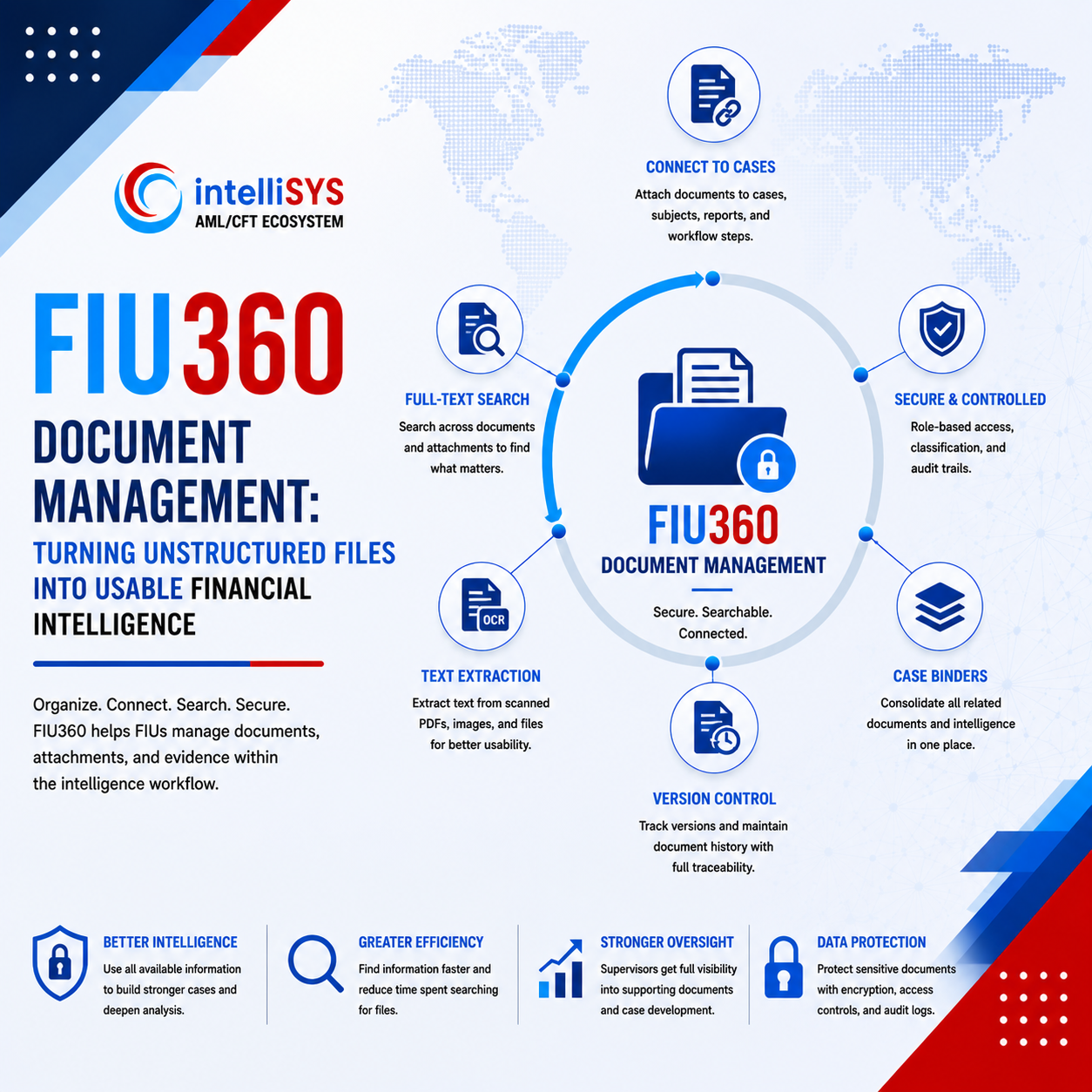
FIU360 helps bring unstructured information closer to the analytical workflow by allowing documents to be attached, searched, tagged, versioned, and connected to cases, subjects, and reports.
This makes documents part of the intelligence picture.
Documents should not exist in isolation.
They should be connected to the relevant report, case, subject, transaction, entity, or workflow step.
FIU360 document management helps analysts attach documents directly to the intelligence environment. This means that supporting material can remain linked to the case where it is used.
For example, a case involving a legal entity may include company registry documents, bank statements, suspicious transaction reports, analyst notes, law enforcement correspondence, and visualization exports.
When these documents are connected to the case, analysts and supervisors can review the full context in one place.
This improves continuity and reduces the risk of missing supporting material.
FIU360 case management can consolidate related data, documents, and entities into a structured case binder.
Document management is an important part of this binder.
The binder may include reports, persons, entities, accounts, transactions, visualizations, enrichment results, analyst notes, and supporting files.
This helps the FIU preserve the intelligence record as a complete package.
Instead of reconstructing the case from scattered folders and emails, analysts can work from a controlled case environment where documents are linked to the relevant intelligence objects.
Documents are useful only if analysts can find what they need.
A scanned document, PDF, spreadsheet, or text file may contain critical information, but manual review can be slow.
FIU360 document management supports text extraction and search capabilities so that analysts can locate relevant content more efficiently.
This is especially useful when working with large volumes of attachments.
An analyst may need to search for a name, company number, address, account number, phone number, or transaction reference across case documents.
Searchable documents reduce manual review time and improve analytical efficiency.
Full-text search allows analysts to identify relevant documents based on content, not only file names.
This is important because file names may be incomplete, inconsistent, or unclear.
A document named “attachment 3” may contain a critical company name. A scanned letter may contain a related address. A spreadsheet may include a transaction reference that links to another case.
When the system supports full-text search, analysts can discover information that might otherwise remain hidden.
This strengthens the FIU’s ability to connect documents with subjects and cases.
Document management is not only about storing files. It is also about organizing them.
FIU360 supports meta-tagging so that documents can be classified and retrieved more effectively.
A document may be tagged by type, source, subject, case relevance, confidentiality level, date, report type, agency, or analytical theme.
This helps analysts manage large document collections.
Tags also help supervisors and case officers understand what documents are included in a case and why they matter.
Better organization leads to faster review and stronger case development.
Version control is critical in FIU work.
Analysts may revise reports, update intelligence notes, edit supporting documents, or prepare several versions of an intelligence package before dissemination.
Without version control, it can become difficult to know which file is current.
This creates risk.
An outdated document may be used in analysis. A draft may be sent instead of the final version. A supervisor may review the wrong file.
FIU360 document management supports versioning and change tracking so that document history remains clearer and more controlled.
FIU cases often involve more than one person.
An analyst may prepare a draft. A supervisor may review it. Another specialist may add technical input. A case officer may update the final package before dissemination.
If collaboration happens through email attachments, version confusion can occur quickly.
FIU360 supports collaborative handling of office documents inside the intelligence environment.
This helps users work on documents while keeping them connected to the case and controlled through system permissions.
Collaboration becomes more structured and less dependent on unmanaged file exchange.
FIU documents may contain highly sensitive information.
This may include personal data, bank records, STR narratives, investigation material, law enforcement responses, sanctions indicators, corruption-related evidence, or terrorist financing intelligence.
A document management system for FIUs must therefore support access control.
FIU360 connects document management with the broader platform security model, including role-based access, case restrictions, security classifications, and audit logging.
This helps ensure that sensitive documents are visible only to authorized users.
Document security should follow the same discipline as case security.
Sensitive attachments can create serious operational risk if handled incorrectly.
A file attached to the wrong email, stored in an open folder, or shared with an unauthorized user can compromise confidentiality.
FIU360 helps reduce this risk by keeping attachments inside the controlled platform environment.
Documents can be attached to the correct case, subject, or report and governed by access permissions.
This helps the FIU reduce dependency on unsecured file sharing and uncontrolled storage practices.
A modern FIU must be able to trace how sensitive documents were handled.
Who uploaded the document?
Who accessed it?
Who edited it?
Which version was used?
Was it included in a dissemination package?
Was it linked to a case or subject?
FIU360 supports auditability across the platform, helping the FIU maintain records of user actions and document handling.
This strengthens governance.
If a question arises later about a specific document, the FIU can review the system record instead of relying on memory or informal notes.
Documents often form part of the final intelligence package.
A dissemination package may include a narrative report, charts, visualizations, subject profiles, transaction summaries, supporting documents, and attachments.
FIU360 document management helps analysts keep these materials organized and connected to the case before dissemination.
This improves the quality of the final intelligence product.
The recipient authority receives not only the analytical conclusion, but also the supporting material needed to understand and act on the intelligence.
Data enrichment often produces documents or supporting records from external sources.
A company registry query may return incorporation documents. A customs source may produce trade records. A law enforcement source may provide a response document. Open-source research may produce supporting files or references.
These materials should not remain disconnected from the case.
FIU360 helps bring enriched documents into the intelligence workflow.
When enrichment outputs are stored and linked correctly, analysts can use them more effectively during case development and dissemination.
Documents may contain hidden links.
A contract may mention a company not listed in the original report. A scanned document may contain an address shared by multiple entities. A spreadsheet may include account numbers or phone numbers that connect to other cases.
When documents are searchable and connected to subjects, they support link analysis.
FIU360 helps analysts treat documents as sources of relationship discovery, not only as attachments.
This can improve the FIU’s ability to uncover hidden networks.
Consider an FIU case involving a company with suspicious cross-border transfers.
The analyst receives the STR, company registry documents, bank statements, a spreadsheet of transactions, correspondence from the reporting institution, and a law enforcement response.
In a weak environment, these documents may be stored across emails and folders.
With FIU360, they can be attached to the case, tagged by document type, searched by content, versioned where required, and controlled by case access permissions.
The case officer can review all supporting material from the case binder.
This creates a more complete and reliable intelligence record.
An analyst searches across case documents for a phone number that appeared in a separate report.
The search identifies the same number inside a scanned document attached to another case. That document also references a company not included in the original report.
This creates a new analytical lead.
The analyst can now review whether the phone number, company, and related subjects connect to a broader network.
This shows why document search is important.
Intelligence value may exist inside documents that would otherwise remain unread or disconnected.
Before disseminating intelligence to law enforcement, an analyst must prepare a complete package.
The package includes the narrative report, a network diagram, company registry records, relevant transaction spreadsheets, and supporting correspondence.
With FIU360 document management, the analyst can select the required documents from the case environment and ensure they are connected to the final dissemination package.
This reduces the risk of missing important attachments.
It also helps maintain traceability over what was shared and why.
Analysts should focus on intelligence, not file administration.
When documents are scattered across emails, local drives, and shared folders, analysts waste time searching, renaming, copying, checking versions, and confirming whether a file is complete.
FIU360 reduces this burden by centralizing document handling inside the intelligence workflow.
This allows analysts to spend more time reviewing content, identifying relationships, and developing intelligence.
Better document management supports better analyst productivity.
Supervisors need access to the material supporting an analyst’s conclusions.
If documents are scattered, review becomes difficult.
FIU360 helps supervisors review case documents, versions, attachments, and supporting material from within the controlled case environment.
This improves quality assurance.
A supervisor can assess whether the analysis is properly supported, whether key documents were considered, and whether the final package is ready for dissemination.
Document management therefore supports both analysis and supervision.
FIU cases may remain relevant for years.
A subject may appear in a future report. A company may connect to a later case. A document may become important during a future investigation or strategic analysis project.
If historical documents are stored poorly, institutional memory weakens.
FIU360 helps preserve documents as part of the official intelligence record.
This allows future analysts to access relevant historical material, subject to authorization and retention rules.
Strong document management helps the FIU maintain continuity over time.
Document management must also support governance.
FIUs need clear rules for what documents are stored, how they are classified, who can access them, how long they are retained, and when they can be archived or deleted.
FIU360’s controlled environment helps support these governance practices.
This is important because financial intelligence data is sensitive and may be subject to legal, regulatory, and institutional retention requirements.
A strong FIU platform should help documents remain managed according to policy, not left in uncontrolled storage locations.
FIUs may receive large volumes of files.
Not every document has the same intelligence value.
A good document management process should help analysts organize documents by relevance, type, source, and case relationship.
Meta-tags, search, case links, and version control help reduce document overload.
The goal is not to store files for the sake of storage. The goal is to make relevant documents easier to use in analysis, case management, and dissemination.
FIU360 document management is powerful because it connects unstructured files to the wider intelligence lifecycle.
Documents can support intake, enrichment, analysis, case management, visualization, dissemination, supervision, auditability, and institutional memory.
This integration matters.
A document is not only a file. It may be evidence, context, a source of relationships, or a supporting element in an intelligence package.
FIU360 helps FIUs treat documents as part of financial intelligence, not as disconnected attachments.
Effective document management requires configuration, governance, and training.
An FIU may need to define document types, tags, access rules, versioning practices, case attachment procedures, dissemination rules, retention policies, and user responsibilities.
IntelliSYS supports FIUs by configuring FIU360 document management according to institutional procedures and operational needs.
This may include mapping document workflows, integrating document handling with case management, defining security rules, and training analysts and supervisors.
The objective is to create a practical document environment that supports FIU work without adding unnecessary complexity.
Financial intelligence does not exist only in structured fields. It also exists in documents, attachments, notes, spreadsheets, correspondence, scanned records, and supporting files.
If these materials are unmanaged, the FIU risks losing context, weakening auditability, and slowing analysis.
FIU360 helps FIUs manage unstructured information securely and effectively through document attachment, text extraction, full-text search, meta-tags, versioning, collaborative editing, access control, and case integration.
For FIUs seeking to improve case quality, analyst productivity, dissemination readiness, and institutional memory, document management should be treated as a core modernization capability.
Contact IntelliSYS to discuss how FIU360 document management can support your FIU’s document handling, case development, and intelligence dissemination requirements.