
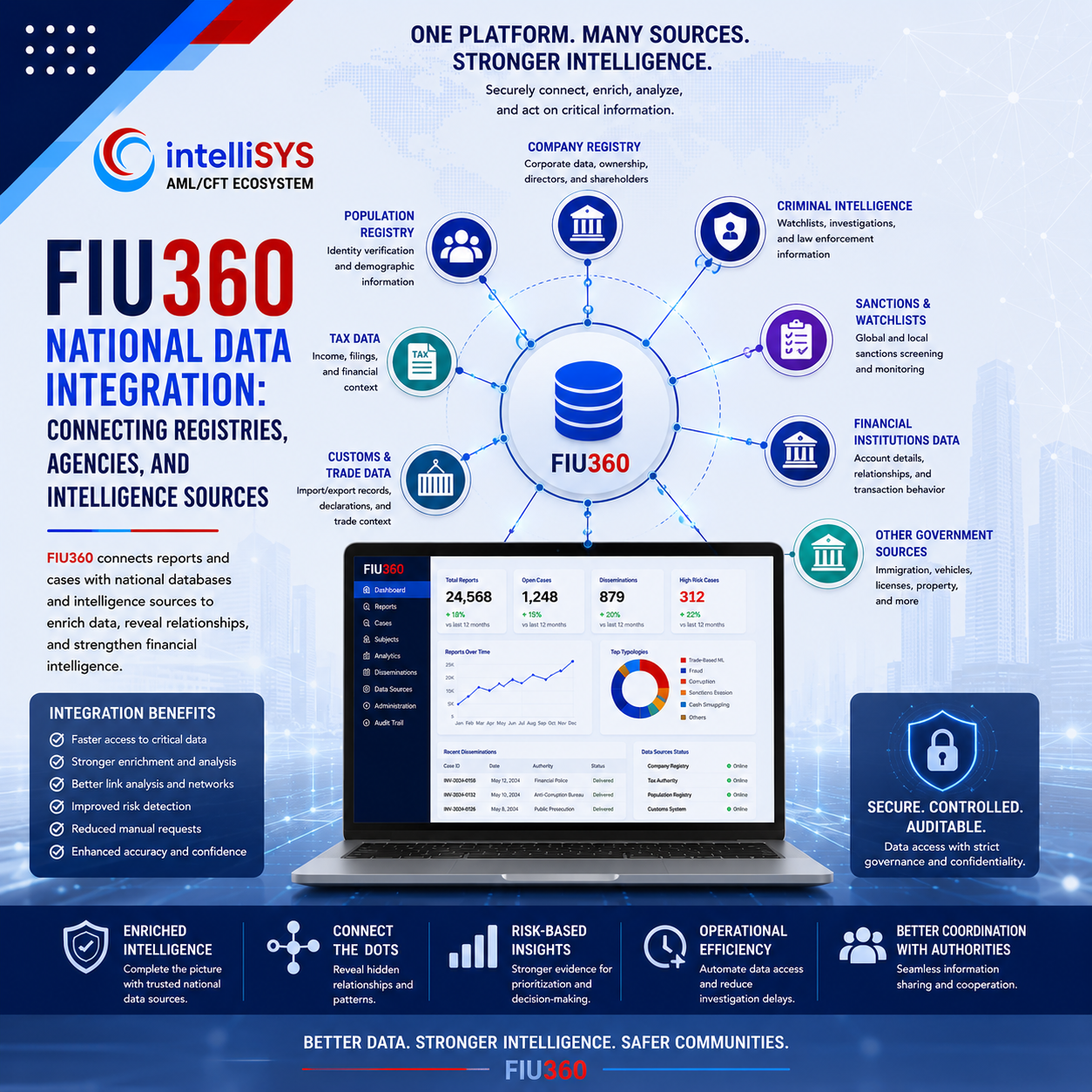
Financial intelligence depends on context. A suspicious transaction report may show who sent money, who received it, when the transaction happened, and why the reporting institution considered it suspicious. But that report is only the starting point. To understand the full picture, analysts often need company records, population data, tax information, customs data, sanctions indicators, criminal intelligence, immigration records, vehicle ownership, phone information, and previous FIU records. Without integration, analysts must request this information manually. With FIU360 national data integration, FIUs can connect reports and cases with authorized data sources more efficiently, securely, and intelligently.
An FIU cannot produce strong intelligence from incomplete information.
Reports submitted by accountable institutions may contain useful data, but they usually do not include everything an analyst needs.
A company may need to be checked against a company registry.
A person may need identity verification.
A transaction may need customs or tax context.
A subject may need to be checked against previous FIU records.
A counterparty may need screening against sanctions or criminal intelligence sources.
Data integration helps analysts move from report review to complete intelligence analysis.
It turns separate information sources into a connected analytical environment.
Many FIUs still rely on manual request-and-response processes.
An analyst may send an email, letter, or formal request to another agency and wait for a response. The response may arrive days or weeks later. It may come in a PDF, spreadsheet, scanned document, or unstructured message.
This creates delay.
It also creates administrative work. Analysts must track requests, follow up, copy information, attach documents, and manually connect the results to the case.
Manual processes also increase confidentiality risk because more people may become aware of the FIU’s interest in a subject.
FIU360 data integration helps reduce this dependency on slow and fragmented information collection.
A report becomes more valuable when it is enriched.
For example, a suspicious company may initially appear as a single legal entity in a bank report.
After enrichment, the analyst may identify directors, shareholders, related companies, addresses, previous reports, tax indicators, customs activity, sanctions exposure, or law enforcement links.
This changes the intelligence picture.
The analyst is no longer reviewing only the report submitted by one institution.
The analyst is reviewing the subject in a wider national context.
That is the purpose of data integration.
Company registry data is critical for financial intelligence.
Many money laundering and corruption cases involve legal entities, shell companies, nominee directors, complex ownership structures, or related businesses.
FIU360 can support integration with company registries so analysts can access information about legal entities, directors, shareholders, registration numbers, addresses, and related company records.
This helps analysts examine ownership and control.
It also supports link analysis, beneficial ownership review, and network mapping.
When company data is connected to FIU reports, legal entities become easier to understand and compare across cases.
Identity data helps analysts verify persons involved in reports and cases.
A suspicious report may include a name, date of birth, nationality, address, or identification number. These details may be incomplete or inconsistent.
Integration with population or identity sources can help validate whether the person exists, whether identifiers match, and whether the subject connects to other records.
This reduces uncertainty.
It also supports better subject matching across reports.
If the same person appears under slightly different names or spellings, stronger identity data can help analysts detect the connection.
Tax information can help analysts understand whether reported financial activity is consistent with declared income, business activity, or known economic profile.
For example, a person or company may receive large transfers that do not appear consistent with tax records. A business may show financial activity that does not match its declared operations.
FIU360 integration with authorized tax sources can help analysts add this context where legally permitted.
This supports stronger assessment of suspicious activity.
Tax data should be handled carefully because it is highly sensitive, but when properly governed, it can significantly improve financial intelligence.
Trade-based money laundering is difficult to detect without trade context.
A suspicious transaction may appear to involve import-export activity, but the financial flow may not match the movement of goods.
Customs data can help analysts review invoices, declarations, goods descriptions, shipment routes, import values, export values, and trade counterparties.
FIU360 integration with customs sources can support cases involving trade finance, invoice manipulation, over-invoicing, under-invoicing, false descriptions, or unusual trade routes.
This is especially important for jurisdictions with significant cross-border trade exposure.
Some cases require movement and travel context.
Immigration or border data may help analysts understand whether a person entered or left the country, whether travel patterns align with financial activity, or whether cross-border movement supports a wider investigation.
This can be useful in cases involving cash couriers, organized crime, terrorism financing, corruption, or international networks.
FIU360 can support integration with authorized border or immigration sources where permitted by law.
This helps analysts connect financial movement with physical movement.
Asset registries can help analysts understand ownership and lifestyle indicators.
Vehicle registries, land registries, property records, or other asset databases may reveal assets connected to a subject, company, family member, or related entity.
This can support asset tracing and illicit enrichment analysis.
For example, a subject may have limited declared income but own high-value vehicles or properties through related parties.
FIU360 data integration can help analysts bring these indicators into the case environment.
This strengthens the financial profile of the subject.
Financial intelligence is stronger when connected to criminal intelligence.
A subject in a suspicious report may already be linked to fraud, corruption, drug trafficking, human trafficking, organized crime, sanctions evasion, or terrorist financing investigations.
Integration with authorized law enforcement or criminal intelligence sources can help analysts identify these links.
This does not mean uncontrolled access.
It means structured, authorized, and logged access according to institutional agreements and legal powers.
When handled correctly, this integration can help FIUs prioritize higher-risk cases and prepare stronger intelligence packages.
Sanctions screening is an essential part of modern FIU work.
Reports and subjects may need to be checked against UN, regional, national, and other relevant sanctions lists or watchlists.
FIU360 can support sanctions and watchlist matching as part of the wider intelligence workflow.
A potential match can be reviewed, enriched, linked to subjects, escalated into a case, and disseminated if required.
This helps FIUs move from basic screening to intelligence-led sanctions risk management.
Open-source intelligence can add useful context.
Public corporate information, adverse media, public procurement records, websites, social media, court records, and leaked or public datasets may support analysis when used lawfully and carefully.
FIU360 can help analysts incorporate relevant external information into cases and subject profiles.
This supports a wider view of the subject.
However, open-source material must be assessed for reliability, relevance, and legal use.
Technology can help collect and organize information, but analysts must judge its intelligence value.
Some FIUs may choose automated enrichment for specific report types or subjects.
For example, when a report is received, the system may automatically query selected data sources to retrieve basic company, identity, sanctions, or historical FIU information.
This gives analysts immediate context.
Automated enrichment is useful when the FIU needs speed and when the required data sources are stable, authorized, and reliable.
It can reduce waiting time and help analysts start from a more complete case view.
However, automation should be governed by clear rules.
Not every source needs to be queried for every report.
In some cases, analysts should decide when to enrich.
A report may not require deeper data collection until the analyst has reviewed the initial information. Some sources may be sensitive, costly, or legally restricted.
User-triggered enrichment allows analysts to request specific data when needed.
This provides more control.
The analyst can decide which source is relevant to the case and document why the request was made.
FIU360 can support this model by allowing enrichment to be part of the analytical workflow.
Many FIUs need a mixed model.
Basic enrichment may happen automatically, while deeper or more sensitive queries remain user-triggered.
For example, the system may automatically check internal history and sanctions lists, while tax, customs, criminal intelligence, or immigration queries require analyst action or supervisory approval.
This approach balances speed with control.
It helps the FIU collect useful baseline information quickly while protecting sensitive sources from unnecessary use.
FIU360 can support this type of flexible enrichment strategy.
Enrichment is only useful if the results are connected to the intelligence record.
If external data arrives as separate documents or disconnected responses, analysts still need to interpret and link it manually.
FIU360 helps connect enrichment results to persons, legal entities, accounts, addresses, transactions, documents, and cases.
This supports subject management and link analysis.
A director retrieved from a company registry may connect to another company. An address from an identity source may appear in previous reports. A customs record may connect to a transaction pattern.
These links create intelligence value.
Entity resolution is the process of determining whether two records refer to the same person, company, account, or subject.
This is difficult when data comes from different institutions using different formats, spellings, identifiers, or languages.
FIU360 data integration helps analysts compare identifiers across sources.
Names, registration numbers, identity numbers, dates of birth, addresses, phone numbers, account numbers, and related parties can support better matching.
Entity resolution is critical because financial crime networks often hide behind inconsistent or fragmented information.
Better matching leads to better intelligence.
Duplicate records weaken analysis.
The same person or company may appear under different spellings, incomplete details, or separate report submissions.
If duplicates are not managed, analysts may miss links between reports and cases.
Data integration can help reduce this problem by providing stronger identifiers from trusted sources.
FIU360 subject management can help analysts consolidate and connect related records.
This improves search, link analysis, visualization, risk scoring, and case development.
A cleaner subject database supports stronger long-term FIU capability.
Integrated data helps reveal networks.
A report may contain one company and two transactions. Enrichment may reveal directors, shareholders, addresses, related companies, customs activity, previous reports, and sanctions exposure.
When these elements are linked, analysts can visualize the network.
FIU360 supports this movement from isolated records to connected intelligence.
Network analysis helps analysts identify hidden relationships, central actors, repeated intermediaries, and possible criminal structures.
This is one of the most valuable outcomes of national data integration.
Data integration helps FIUs prioritize risk.
A report may appear low risk until enrichment reveals that the subject is linked to a high-risk company, previous disseminations, sanctions exposure, criminal intelligence, unusual trade records, or politically exposed persons.
FIU360 can help bring these indicators into the analytical workflow.
This supports more informed triage and case prioritization.
Risk-based analysis depends on having enough context to assess risk properly.
Integration gives analysts that context.
Manual enrichment consumes analyst time.
Analysts may spend hours searching databases, sending requests, copying responses, and organizing documents before analysis begins.
FIU360 data integration helps reduce repetitive administrative work.
By retrieving and linking information more efficiently, the platform allows analysts to spend more time interpreting the data.
This improves productivity.
It also helps the FIU use scarce analytical resources more effectively.
Manual requests can create leakage risk.
If an analyst sends a request to another agency and several people handle it, more individuals may become aware that the FIU is interested in a subject.
In sensitive cases, this can create operational risk.
System-to-system integration can reduce unnecessary human exposure at the data source.
Requests and responses can be controlled, logged, and routed through secure technical channels.
This helps protect confidentiality while still giving analysts the information they need.
Data integration must be governed carefully.
The FIU should only access data sources it is legally authorized to use. It should define who can query each source, for what purpose, under which workflow, and with what logging requirements.
FIU360 implementation can support access rules, security controls, audit trails, and workflow permissions.
This helps ensure that integration supports lawful and accountable intelligence work.
Data integration should never mean uncontrolled data access.
It should mean structured, authorized, and traceable information use.
Integrated data access must be auditable.
The FIU should know who queried a source, which subject was queried, when the request was made, what response was received, and how the result was used.
This protects both the FIU and the source agency.
FIU360 auditability helps preserve a record of data access and analytical activity.
This is important for governance, internal control, security review, and mutual evaluation readiness.
If integrated data supports a case or dissemination, the FIU should be able to trace its use.
Connections between systems must be secure.
Data moving between FIU360 and external sources may include sensitive personal, financial, tax, customs, law enforcement, or intelligence information.
Integration channels should use secure communication, controlled endpoints, authentication, authorization, encryption, logging, and network segmentation.
Security must be designed from the beginning.
A poorly secured integration can create more risk than value.
FIU360 integration planning supports secure and controlled connectivity.
An FIU receives an STR involving a company with unusual foreign transfers.
The report includes the company name and account details, but limited ownership information.
Through FIU360 integration with the company registry, the analyst retrieves directors, shareholders, registration details, and related entities.
The enrichment shows that one director is linked to several companies already appearing in previous reports.
The analyst can now review the case as part of a broader network rather than an isolated report.
A report involves payments described as import-related.
The analyst reviews customs data through an authorized integration.
The customs records show that the declared goods and transaction values do not align with the payment pattern.
This may indicate trade-based money laundering risk.
The analyst can link customs information to the case and examine related companies, routes, counterparties, and invoices.
This helps move the case toward a more complete intelligence assessment.
A company does not directly match a sanctions list.
However, enrichment shows that one of its related owners is connected to a designated subject through another legal entity.
The analyst uses FIU360 subject management and visualization to map the ownership structure.
The case is escalated for further review.
This scenario shows why direct name matching is not enough.
Integrated data helps identify indirect exposure.
A person reported in an STR also appears in an authorized criminal intelligence source.
The report alone may not have appeared urgent.
With the additional context, the case becomes higher priority.
The analyst can enrich the subject profile, link the source information to the case, restrict access if necessary, and prepare a more informed intelligence package.
This helps the FIU focus attention where the risk is higher.
Integrated data should support case development.
FIU360 allows enriched information to become part of the case environment.
This means analysts can connect external records with reports, subjects, documents, visualizations, notes, workflow decisions, and dissemination packages.
This creates stronger continuity.
The enrichment result does not remain a temporary lookup.
It becomes part of the controlled intelligence record.
When a case is disseminated, integrated data may provide important supporting context.
A dissemination package may include company registry results, tax indicators, customs findings, sanctions links, identity verification, criminal intelligence references, or open-source material.
FIU360 helps analysts organize this supporting information before dissemination.
This improves the usefulness of intelligence products sent to law enforcement, regulators, supervisors, or other competent authorities.
Integrated data helps the recipient understand why the FIU reached its assessment.
Integrated data does not only support individual cases.
It can also support strategic intelligence.
Over time, enriched information can help the FIU identify typologies, sector risks, trade corridors, repeated intermediaries, ownership patterns, reporting weaknesses, and emerging threats.
FIU360 dashboards and analytical capabilities can help transform operational data into strategic insight.
This supports national risk assessment, policy development, supervisory outreach, and reporting entity guidance.
The more connected the data, the stronger the strategic view.
Data integration must be purposeful.
Connecting every possible source without clear rules can overwhelm analysts and create unnecessary complexity.
The FIU should define which sources are relevant, when they should be used, and how results should be interpreted.
FIU360 helps organize integrated data, but the FIU still needs governance and analytical discipline.
The objective is not to collect more information for its own sake.
The objective is to collect the right information at the right time to support better intelligence.
FIU360 data integration is powerful because it connects reports with the wider national information environment.
It helps analysts validate subjects, enrich cases, identify hidden links, prioritize risk, support investigations, and build stronger intelligence packages.
It also reduces manual workload and supports secure, auditable information access.
Most importantly, it helps FIUs move from isolated reports to connected intelligence.
That is the foundation of modern financial intelligence work.
Data integration requires business, legal, technical, and security planning.
The FIU must define data sources, access rules, query triggers, user permissions, logging requirements, data mapping, security controls, and workflow integration.
IntelliSYS supports FIUs through FIU360 configuration, integration design, data acquisition architecture, security planning, workflow setup, training, and operational consulting.
This helps ensure that integrations are not built as disconnected technical links.
They are designed to support real FIU analysis, case management, dissemination, and governance.
A suspicious report is only the beginning of the intelligence process.
To understand real risk, FIUs need to connect that report with national registries, government databases, sanctions lists, criminal intelligence sources, customs records, tax information, identity data, and previous FIU records.
FIU360 helps FIUs build this connected environment through secure, structured, and auditable data integration.
By supporting automated, user-triggered, and mixed enrichment models, FIU360 helps analysts reduce manual work, discover hidden relationships, validate subjects, prioritize risk, and produce stronger intelligence.
For FIUs seeking to modernize financial intelligence operations, national data integration is not optional.
It is a core capability.
Contact IntelliSYS to discuss how FIU360 can support secure data integration, enrichment workflows, and connected financial intelligence operations.