
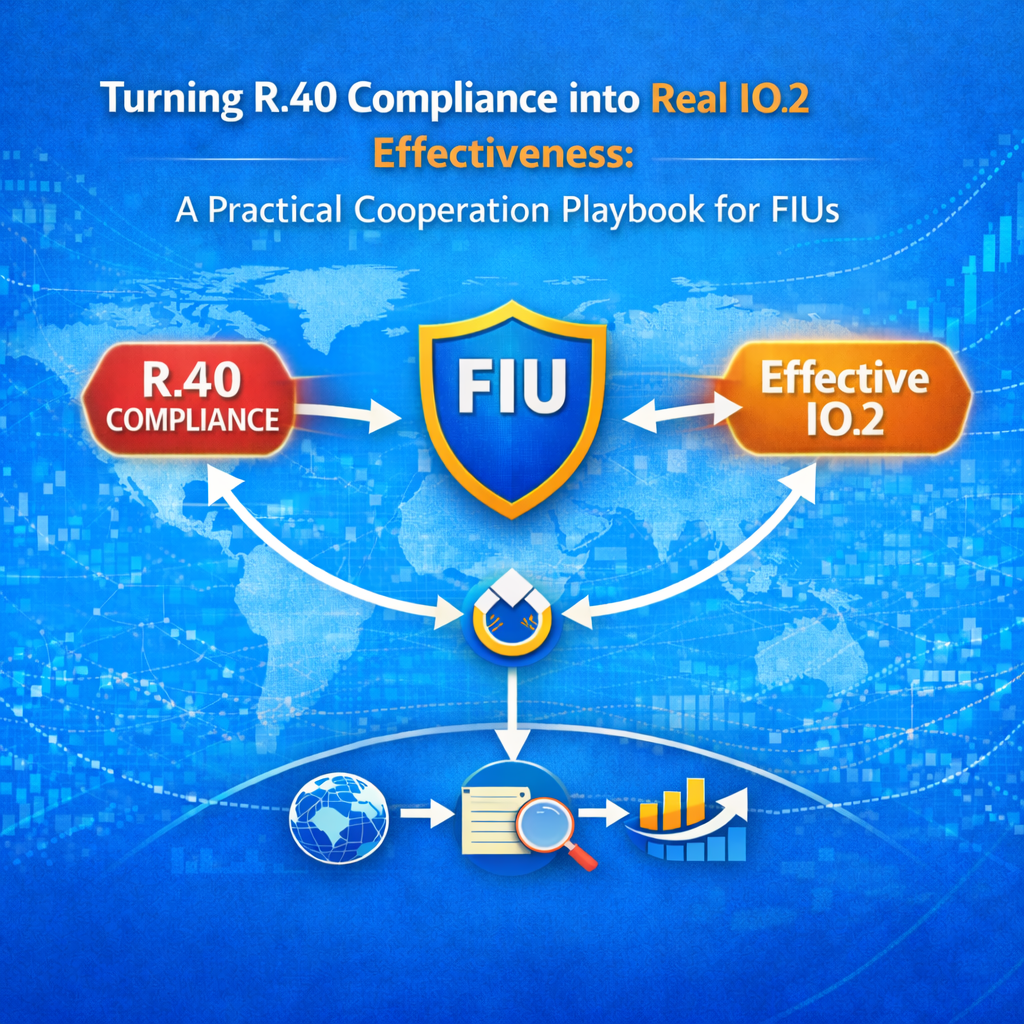
On paper, Europe II performs strongly on Recommendation 40 (R.40 – International Cooperation). Egmont’s horizontal analysis shows that 87% of jurisdictions are Compliant or Largely Compliant, 13% are Partially Compliant, and none are non-compliant. At the same time, Immediate Outcome 2 (IO.2 – international cooperation), while generally better rated than IO.6, is still only “largely achieved”: 61% of jurisdictions have Substantial effectiveness, 35% Moderate, and 4% High; no jurisdiction is rated Low. The message is clear: • Legal frameworks for cooperation are mostly in place. • Operational performance is still uneven. Delays in responding to requests, limited spontaneous cooperation, dependence on other authorities for data and the absence of formalised feedback mechanisms continue to constrain effectiveness – even where R.40 looks green. This blog sets out a practical playbook for FIUs and policymakers who want to convert R.40 compliance into fast, proactive and outcome-oriented cooperation that lifts IO.2 ratings.
FATF Recommendation 40 sets the technical expectations for international cooperation:
Immediate Outcome 2 tests whether that framework actually works in practice. Assessors look at how FIUs:
Put simply:
R.40 asks: “Can you cooperate?”
IO.2 asks: “Do you actually cooperate effectively – and fast?”
The Europe II analysis shows that many jurisdictions can answer the first question positively, but still struggle with the second.
Egmont’s typology of Partially Compliant R.40 jurisdictions highlights the operational weaknesses that matter most for IO.2.
Common deficiencies include:
Egmont notes that these jurisdictions still benefit from adequate legal frameworks, Egmont membership and the principle of availability, but timeliness, access and efficiency are not where they need to be.
Even some Compliant and Largely Compliant systems display softer versions of the same issues: cooperation exists, but is too slow, too formal and insufficiently proactive to drive strong IO.2 ratings.
On the IO.2 side, the Europe II picture is encouraging but not perfect:
However, for Moderate-effectiveness countries, Egmont lists recurring weaknesses that mirror the R.40 issues:
In short, IO.2 weaknesses are rarely about legal impossibility; they are about speed, proactivity, governance and process design.
Egmont’s description of Substantial and High IO.2 systems provides a useful blueprint. These FIUs typically combine:
In Compliant R.40 jurisdictions specifically, FIUs can:
These are the characteristics IO.2 assessors look for when differentiating between “Moderate”, “Substantial” and “High”.
Translating Egmont’s recommendations into a practical agenda, FIUs and policy leads can focus on five levers.
Egmont recommends that Partially Compliant jurisdictions enable FIUs to request information directly from financial intermediaries on behalf of foreign counterparts, even when no STR exists.
In practice, that means:
This change alone can significantly reduce delays and dependence on other authorities, especially in complex, cross-border cases.
For IO.2, timeliness is as important as content. Jurisdictions should:
This makes timeliness visible and manageable, rather than a vague aspiration.
Egmont clearly associates high IO.2 performance with proactive, spontaneous cooperation, not just answering incoming requests.
FIUs can operationalize this by:
Egmont flags reliance on other domestic authorities for information gathering as a key drag on R.40 performance, causing delays and uncertainty.
Mitigations include:
The goal is an operating model where the FIU can move quickly without waiting for multiple administrative layers.
Lack of formal feedback mechanisms appears repeatedly in the R.40 analysis.
Practical steps:
This turns bilateral relationships into a systematic learning channel.
Egmont’s broader conclusion stresses that many challenges are systemic – including “MOU or formal request dependence in international cooperation”, which slows interaction when proactive or spontaneous exchange is needed.
From a technology standpoint, FIUs can:
For IntelliSYS and FIU360, this is a natural positioning point: helping FIUs operationalize R.40 and IO.2 requirements in a single architecture, rather than layering manual practices on top of basic messaging tools.
Egmont’s Europe II horizontal analysis shows that most jurisdictions are technically compliant with Recommendation 40 and achieve at least Moderate IO.2 effectiveness. However, delays, restricted access, limited spontaneous cooperation and weak feedback mechanisms continue to constrain real-world performance. High-performing FIUs expand their authority, industrialize timeliness, reduce reliance on other authorities, normalize spontaneous exchanges and digitize cooperation workflows—turning legal compliance into fast, proactive and results-driven international cooperation.