National AML/CFT Coordination: The Common Denominator of High IO.6 Ratings

When jurisdictions analyze Immediate Outcome 6 (IO.6), they tend to focus on the FIU itself: STRs, analysts, IT systems, case statistics. Egmont’s Europe II horizontal analysis of IO.2, IO.6, R.29 and R.40 shows a broader picture: national cooperation and coordination across all competent authorities are critical determinants of IO.6 effectiveness. The report covers 23 FIUs in the Europe II Regional Group, analyzing mutual evaluations under the FATF methodology and extracting recurring strengths, weaknesses and recommended actions for IO.2, IO.6, R.29 and R.40. One of its clearest findings: robust national cooperation and coordination is present in virtually every high-performing IO.6 jurisdiction and missing in many moderate ones.
National AML/CFT Coordination

What Egmont means by “National Cooperation & Coordination”

Egmont defines National Cooperation & Coordination as the structured and ongoing collaboration between FIUs, law-enforcement agencies (LEAs), prosecutors, supervisors and other competent authorities to ensure effective detection, investigation and prevention of ML/TF.

Key elements of this definition:

  • Timely and secure exchange of financial intelligence
  • Coordinated operational activities and joint task forces
  • Institutional mechanisms (e.g. MOUs, committees, working groups) that facilitate communication
  • Clear procedures for referrals, notifications and multi-agency case management

Critically, Egmont stresses that effectiveness depends not on the existence of committees and MOUs, but on how actively they are used in practice. Where coordination is weak or underutilised, systems “hinder the full exploitation of financial intelligence”.

The numbers: why coordination is a “key horizontal factor”

The horizontal analysis shows a striking pattern when it looks at how often National Cooperation & Coordination is cited as a strength in IO.6 assessments:

  • High effectiveness (HE): 100% of jurisdictions – always a strength
  • Substantial effectiveness (SE): 100% (5/5) – always a strength
  • Moderate effectiveness (ME): only 47% (7/15) – strength in less than half
  • Low effectiveness (LE): interestingly, 100% (2/2) – identified as a strength on paper, but with other critical weaknesses

Egmont concludes:

“National Cooperation & Coordination emerges as a key horizontal factor in IO.6 evaluations. Its absence as a strength in many ME jurisdictions reflects limited institutional collaboration and reduced capacity to exploit financial intelligence fully.”

In other words, you rarely see high IO.6 ratings without strong national coordination, and you frequently see moderate ratings where coordination is weak or only partially functional.

How weak coordination shows up in practice

In moderate-effectiveness jurisdictions, the report notes that mechanisms for cooperation are often underdeveloped or not fully deployed:

Typical symptoms:

  • Committees exist but meet infrequently, with limited operational follow-up.
  • FIUs, LEAs and supervisors work in silos, with ad-hoc information sharing.
  • No standard templates or protocols for case referrals, feedback or joint investigations.
  • Parallel investigations proceed with minimal FIU involvement, even where financial intelligence would add value.

The result is an AML/CFT system that looks coordinated on an organogram, but fails to convert financial intelligence into joined-up enforcement and preventive action.

What strong coordination looks like in SE/HE systems

By contrast, in Substantial and High-effectiveness jurisdictions, National Cooperation & Coordination is consistently identified as a strength. Egmont describes several recurring features:

  • Strong cooperation and information exchange between FIUs, LEAs, prosecution offices, supervisors and other domestic authorities, supported by MOUs and good practices.
  • Intensive communication, including face-to-face meetings, ensuring confidentiality and thorough case discussions.
  • Institutional mechanisms (e.g. task forces, joint units, formalised working groups) that ensure timely and confidential exchange of financial intelligence.

These aren’t cosmetic governance structures; they are operational mechanisms that connect FIU outputs to real-world outcomes—investigations, prosecutions and confiscations.

Why coordination is so tightly linked to IO.6

Egmont’s conclusion section generalises this point: legal frameworks are not enough. Sustained, impactful effectiveness depends on institutional capacity, sound governance and inter-agency coordination.

Three channels explain the IO.6 link:

  1. FIU outputs embedded in LEA and prosecutorial workflows
    IO.6 focuses heavily on whether financial intelligence is used by competent authorities. Coordination structures are how FIU products become a standard step in investigative and prosecutorial workflows, not an optional add-on.
  2. Risk-based prioritisation and triage
    Joint bodies help set shared priorities for sectors, typologies and cases. This supports IO.6 expectations around risk-based deployment of resources and clear case selection.
  3. Feedback loops across the system
    Coordination fora provide structured channels for LEAs and supervisors to give feedback on STR quality, FIU products and cooperation bottlenecks—informing continuous improvement in STR regimes, analysis and dissemination.

From an effectiveness perspective, good coordination turns a set of separate institutions into a single AML/CFT system.

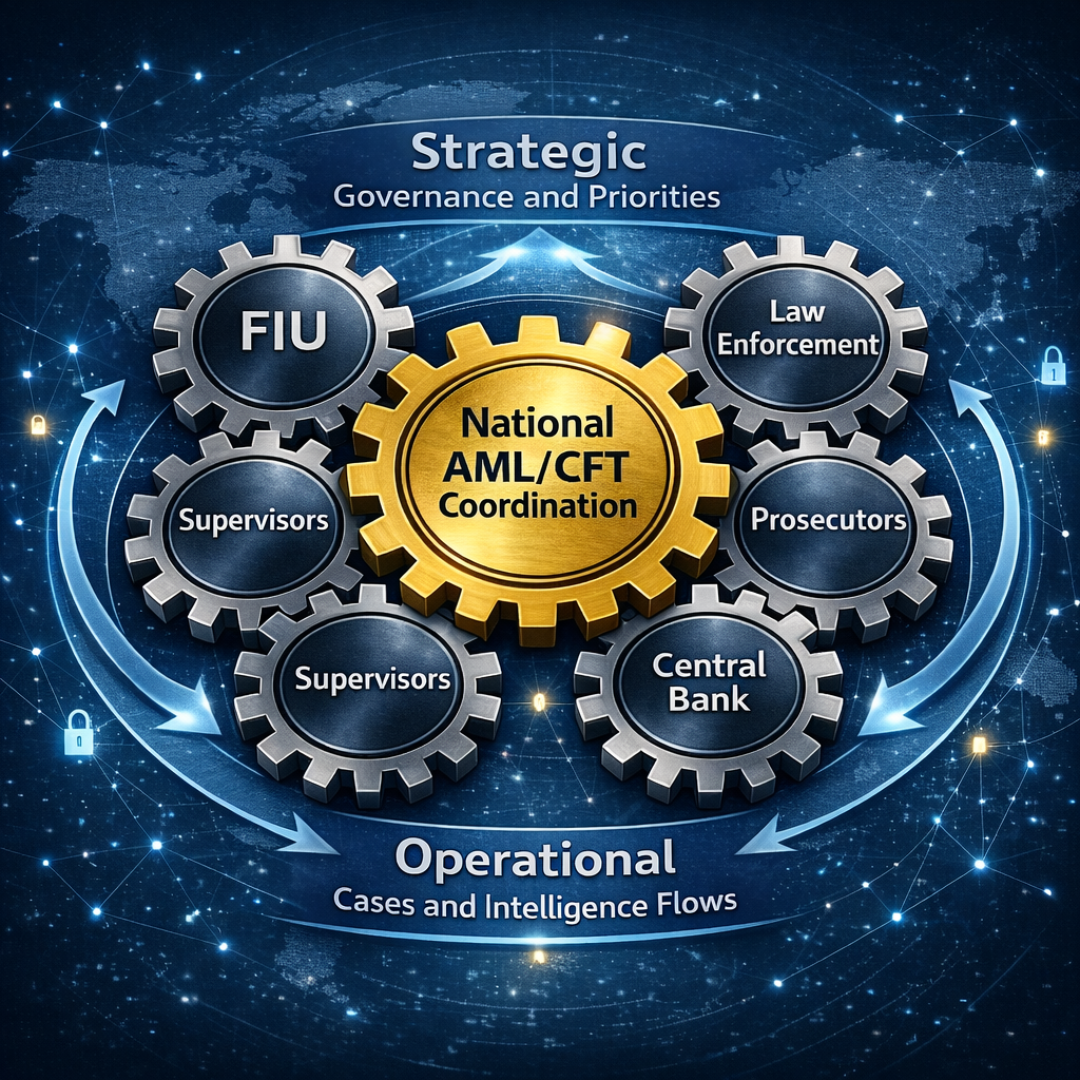
Three layers of national coordination

For FIU directors and NFPs (national coordinators), it is useful to conceptualise national cooperation in three layers:

  1. Strategic layer – governance and priorities
    • National AML/CFT committees or councils setting system-wide priorities and monitoring performance.
    • Integration of FIU strategic analysis into National Risk Assessments (NRA), policy and supervision.
  2. Tactical layer – programmes and campaigns
    • Thematic task forces (e.g. high-risk sectors, professional enablers, cross-border fraud) that translate strategy into multi-agency workplans.
    • Alignment of supervisory campaigns, FIU strategic projects and LEA priorities around the same risk themes.
  3. Operational layer – cases and intelligence flows
    • Standard operating procedures for FIU → LEA referrals, joint case conferences and feedback.
    • Coordinated handling of foreign requests, including domestic coordination between FIU, central authority and LEAs.

Egmont’s recommended actions under “Institutionalise National Cooperation” align closely with this layered model.

Egmont’s concrete recommendations on national cooperation

The report’s “Recommendations and Way Forward” chapter translates the high-level message into specific actions:

  1. Institutionalise National Cooperation
    • Create standing coordination bodies (e.g. taskforces) across FIU, LEA, supervisors and prosecutors
    • Formalise operational processes that integrate outputs from counterpart agencies
    • Codify case referral and feedback protocols
    • Conduct joint scenario exercises and case reviews

From an implementation perspective, this can be structured as:

  1. Standing coordination bodies
  • A national AML/CFT committee with clear terms of reference, chaired at an appropriate senior level.
  • Sub-groups for operational coordination (FIU + LEAs + prosecutors) and preventive coordination (FIU + supervisors + policy).
  1. Formalised operational processes
  • Written SOPs describing:
    • how FIU disseminations are routed and prioritised by LEAs;
    • how LEAs request further information from FIU;
    • how outcomes (investigations, prosecutions, confiscations) are reported back.
  1. Standardised case referral & feedback
  • Templates for FIU → LEA referrals (content, risk flags, recommended follow-up).
  • Short feedback forms from LEAs back to FIU on utility and outcome—feeding into IO.6 evidence.
  1. Joint exercises and reviews
  • Periodic table-top exercises simulating complex ML/TF cases to test coordination.
  • Joint after-action reviews of significant cases to refine typologies, reporting guidance and SOPs.

Technology as a coordination catalyst: role of FIU360-type platforms

Egmont also points to the need for modern technical platforms and interoperability, including secure communication systems and shared repositories, as part of the broader reform agenda.

For FIUs, this means moving beyond email and ad-hoc document sharing to platform-based coordination. A FIU360-type architecture can support national cooperation by:

  • Providing a single, secure environment for:
    • FIU case management;
    • structured disseminations to LEAs and prosecutors;
    • feedback capture and audit trails.
  • Enabling role-based access for different authorities, with clear segregation between STR source data and case-level intelligence.
  • Embedding joint workflows (e.g. referral status, task assignment, comments) so that FIUs and LEAs are effectively working on the same case record, not on parallel, unconnected systems.
  • Generating KPI dashboards at national-coordination level: conversion of FIU disseminations to investigations, cross-agency turnaround times, thematic workload, etc.—the kind of data Mutual Evaluation teams expect to see.

In short, technology becomes the backbone for coordination, not just a STR inbox.

Implementation priorities for FIUs and national coordinators

Based on Egmont’s findings, a pragmatic agenda for jurisdictions wanting to lift IO.6 through coordination would include:

  1. Diagnose current coordination maturity
    • Map all national AML/CFT bodies and working groups.
    • Assess frequency, participation quality, and operational follow-up.
  2. Upgrade mandates and structures
    • Ensure national committees have explicit responsibility for integrating FIU intelligence into system-wide decisions (policy, supervision, LEA priorities).
  3. Embed FIU outputs in LEA and prosecutorial workflows
    • Require that major ML/TF investigations explicitly review FIU holdings and disseminations.
    • Track usage as a KPI.
  4. Digitise coordination
    • Move case-level cooperation onto secure platforms such as FIU360, with clear roles and audit logs.
  5. Document improvements for evaluation
    • Capture case examples, metrics and governance changes to demonstrate to assessors how cooperation has been institutionalised.

Conclusion

Egmont’s Europe II horizontal analysis identifies national cooperation and coordination as a key horizontal factor for IO.6: it is a strength in all Substantial and High-effectiveness jurisdictions, but appears far less often in Moderate systems. Effective AML/CFT frameworks use standing coordination bodies, formalised SOPs, feedback loops and secure platforms to connect FIUs, LEAs, supervisors and prosecutors—turning financial intelligence into a genuinely system-wide capability.

Contact IntelliSYS – Your Partner in Advanced Intelligence Solutions