
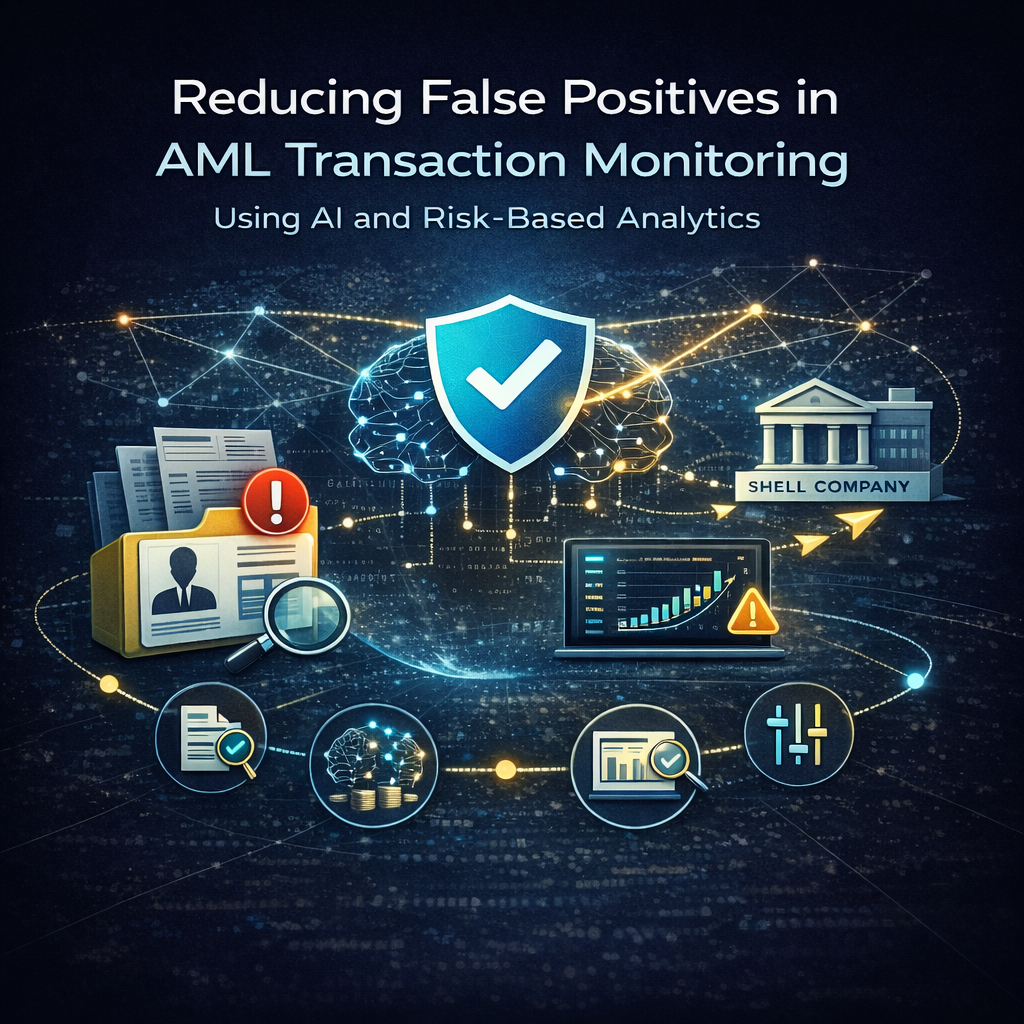
Financial institutions around the world face an escalating challenge in Anti-Money Laundering (AML) compliance: the overwhelming number of alerts generated by traditional transaction monitoring systems. These systems often rely on static rules and thresholds that flag suspicious activity but fail to distinguish between legitimate behavior and true financial crime risk. As a result, banks and financial institutions experience extremely high false-positive rates, sometimes exceeding 90%. Compliance teams must manually review thousands of alerts that ultimately prove to be legitimate transactions. This creates operational inefficiencies, increases compliance costs, and diverts investigative resources away from high-risk cases. At the same time, regulators expect institutions to maintain strong financial crime controls aligned with FATF recommendations and risk-based AML frameworks. Institutions must therefore find ways to enhance detection capabilities while maintaining regulatory compliance and audit transparency. Advances in artificial intelligence (AI), machine learning, and risk-based analytics provide a powerful opportunity to modernize transaction monitoring systems. When implemented correctly, these technologies can significantly reduce false positives while improving the identification of genuine suspicious activity. This article explores how AI-driven AML monitoring systems are transforming financial crime detection, enabling financial institutions and Financial Intelligence Units (FIUs) to focus their resources on the most critical threats.This is where model governance becomes a strategic capability. Done well, it reduces operational drag (false positives, rework, inconsistent decisions) while strengthening regulatory outcomes (traceability, consistency, and demonstrable effectiveness). Done poorly, it creates fragile controls that break under examination—especially when AI/ML techniques are involved. This article provides a practical, audit-ready framework to govern and validate AML models across the full lifecycle—aligned with widely used supervisory expectations such as SR 11-7 model risk management principles , the FATF risk-based approach , and data quality / lineage disciplines reflected in Basel BCBS 239 .
Most legacy AML transaction monitoring systems rely on rule-based detection engines. These systems flag transactions that meet predefined criteria such as:
transactions exceeding specific monetary thresholds
rapid movement of funds between accounts
transactions involving high-risk jurisdictions
structuring patterns designed to avoid reporting limits
While these rules are effective in identifying potential suspicious activity, they often lack the contextual intelligence needed to evaluate legitimate customer behavior.
For example:
A corporate client that regularly transfers large sums internationally may trigger multiple alerts simply due to transaction size, even though the activity is consistent with the customer’s business operations.
Without contextual risk analysis, rule-based systems generate alerts for both legitimate and suspicious transactions, resulting in alert fatigue within compliance teams.
The consequences include:
slower investigation times
increased operational costs
reduced effectiveness of AML programs
High false-positive rates create significant operational burdens for financial institutions and regulators.
AML analysts must review large volumes of alerts manually. Each alert requires:
transaction analysis
customer profile review
supporting documentation checks
risk assessment
When most alerts prove to be legitimate, analysts spend valuable time on low-risk cases.
Large financial institutions often maintain entire teams dedicated solely to alert investigation.
Industry estimates suggest that banks collectively spend billions of dollars annually on AML compliance operations, much of it addressing false alerts.
When analysts face excessive alert volumes, truly suspicious activity can be overlooked.
This creates the risk that sophisticated financial crime networks may evade detection while investigators focus on routine alerts.
Modern AML strategies increasingly rely on risk-based monitoring models rather than purely rule-based systems.
A risk-based approach evaluates transactions within the context of multiple risk indicators.
Key risk factors include:
Customer characteristics such as occupation, geography, and transaction patterns influence risk scoring.
For example:
politically exposed persons (PEPs)
customers operating in high-risk industries
clients with complex corporate ownership structures
These profiles help prioritize monitoring resources.
Risk-based systems evaluate whether transactions align with expected customer behavior.
A transaction may appear suspicious in isolation but become less concerning when viewed within historical activity patterns.
Transactions can also be evaluated based on relationships between counterparties.
Network analysis can reveal clusters of accounts that exhibit coordinated behavior indicative of money laundering networks.
Artificial intelligence and machine learning technologies introduce advanced analytical capabilities that significantly enhance transaction monitoring.
Machine learning models can analyze historical transaction data to identify patterns associated with suspicious activity.
Unlike static rules, these models continuously learn and adapt to new behaviors.
AI systems calculate risk scores based on multiple variables simultaneously, including:
transaction history
account relationships
geographic risk indicators
behavioral deviations
This multi-dimensional analysis improves detection accuracy.
Instead of generating alerts for every rule trigger, AI systems rank alerts according to probability of suspicious activity.
Compliance analysts can then focus on the highest-risk cases.
Machine learning models improve over time by incorporating feedback from investigators.
When analysts classify alerts as true or false positives, the system adjusts its detection algorithms accordingly.
While AI technologies offer significant benefits, successful implementation requires careful integration within existing compliance frameworks.
AI models rely on large datasets to train detection algorithms.
Institutions must ensure access to:
transaction data
customer information
sanctions screening results
external risk indicators
Data integration across systems is critical.
Regulators expect financial institutions to maintain transparency in automated decision-making processes.
This requires:
model documentation
performance validation
periodic model review
explain ability mechanisms
Strong governance frameworks ensure AI tools remain compliant with regulatory expectations.
AI systems should augment, not replace, human investigators.
Compliance analysts remain responsible for final decisions regarding suspicious activity reporting and case escalation.
Human expertise is essential to interpret complex financial crime scenarios.
The evolution of financial crime detection is accelerating as financial systems become more digital and interconnected.
Several emerging technologies are expected to shape the future of AML monitoring.
Graph analytics platforms allow investigators to visualize relationships across large datasets, helping uncover hidden financial crime networks.
Advances in processing technology enable near real-time monitoring of transactions, allowing institutions to detect suspicious activity before funds are transferred internationally.
Public-private partnerships and information-sharing initiatives allow financial institutions and FIUs to collaborate more effectively in detecting emerging financial crime patterns.
As cryptocurrencies become more widely used, AML systems are increasingly integrating blockchain analytics tools to monitor digital asset transactions.
Reducing false positives in AML transaction monitoring has become a strategic priority for financial institutions and regulators. Legacy rule-based monitoring systems are no longer sufficient to manage the complexity and scale of modern financial transactions.
Artificial intelligence and risk-based analytics offer powerful solutions that improve detection accuracy while reducing unnecessary alerts. By integrating advanced technologies with strong governance frameworks and human expertise, financial institutions can significantly enhance their AML compliance capabilities.
For Financial Intelligence Units, banks, and fintech organizations, the future of financial crime detection lies in intelligent monitoring systems that combine automation, analytics, and collaborative intelligence sharing.
Adopting these technologies not only improves operational efficiency but also strengthens global efforts to detect, disrupt, and prevent financial crime.