
Financial Intelligence Units receive large volumes of reports from accountable institutions. These may include suspicious transaction reports, suspicious activity reports, currency transaction reports, electronic funds transfer reports, terrorist financing reports, and other regulatory disclosures. Not every report carries the same level of risk. Some reports may involve low-value or routine activity. Others may involve organized crime indicators, corruption exposure, terrorist financing concerns, sanctions risk, politically exposed persons, complex ownership structures, or suspicious cross-border flows. For this reason, FIUs need more than report collection. They need a structured way to prioritize what matters most. This is where risk-based prioritization with FIU360 becomes important.
FIUs operate under pressure. Reporting volumes continue to grow, financial crime typologies evolve, and analysts are expected to produce timely, accurate, and actionable intelligence.
Without a risk-based approach, analysts may spend too much time on lower-value reports while higher-risk cases wait in the queue.
This creates operational risk.
A strong FIU must be able to identify which reports, entities, accounts, persons, transactions, and cases require urgent attention. It must also be able to explain why certain matters were prioritized.
Risk-based prioritization helps the FIU allocate analytical resources more effectively.
It supports better decision-making, stronger supervision, and more consistent treatment of incoming intelligence.
In many FIUs, prioritization still depends heavily on manual review.
An analyst or supervisor may scan the report narrative, review basic transaction data, consider the reporting sector, and decide whether the matter should be escalated.
This process can work in low-volume environments, but it becomes difficult as reporting increases.
Manual prioritization can also be inconsistent. Different analysts may interpret risk differently. Some may focus on transaction value. Others may focus on customer profile, geography, report type, sector exposure, or previous history.
Without a structured scoring model, the FIU may struggle to apply the risk-based approach consistently.
A modern FIU platform should support human judgment with structured risk indicators, automated scoring, and workflow integration.
Risk-based prioritization means ranking reports, subjects, and cases according to their potential risk and intelligence value.
It does not mean ignoring lower-risk reports. It means helping the FIU decide what should be reviewed first, what requires escalation, and what may need further enrichment or supervisory attention.
In FIU operations, risk-based prioritization may apply to:
Incoming reports
Persons and legal entities
Accounts and transactions
Reporting entities
Case files
Typologies and risk indicators
Sectors and geographic exposure
Dissemination priorities
The objective is to move from a first-in, first-out model to a more intelligence-led model.
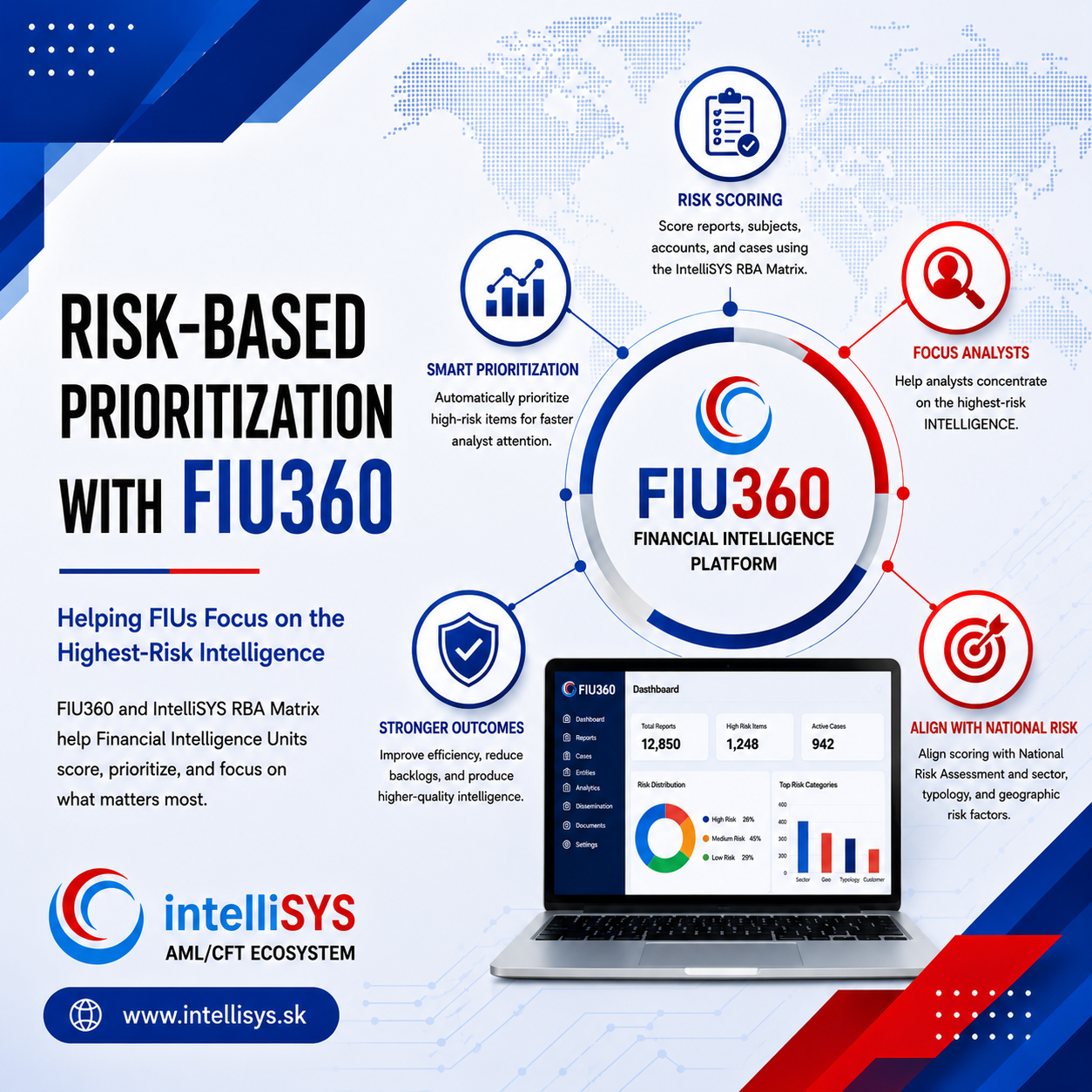
FIU360 supports the risk-based approach by connecting data intake, enrichment, subject management, analysis, case management, workflow automation, and dashboards in one platform.
This matters because risk cannot be understood from one field alone.
A transaction amount may be high, but the real risk may depend on the customer profile, source of funds, reporting entity, jurisdiction, ownership structure, sanctions exposure, previous reports, related subjects, or external intelligence.
FIU360 helps bring these elements together.
By combining structured reports with enriched data, subject relationships, workflow rules, and analytical outputs, the platform gives FIUs a stronger foundation for prioritization.
A basic scoring model may look at a small number of variables. This may be useful as a starting point, but it is often not enough for complex AML/CFT environments.
Financial crime risk is usually created by combinations of indicators.
For example, a legal entity may be higher risk because of its sector, ownership structure, transaction behavior, geography, reporting history, link to other subjects, or connection to National Risk Assessment findings.
The IntelliSYS RBA Matrix is designed to support more advanced risk scoring. It can consider a wide range of variables and combinations to calculate risk for reports, persons, entities, accounts, and other relevant subjects.
This gives FIUs a more detailed and adaptable approach to prioritization.
Every country has its own AML/CFT risk profile.
Some jurisdictions may face higher risks from corruption, cash-intensive businesses, real estate abuse, trade-based money laundering, cross-border remittances, organized crime, terrorist financing, virtual assets, or politically exposed persons.
A useful risk scoring model should reflect the national context.
The IntelliSYS RBA Matrix can be aligned with National Risk Assessment findings, helping FIUs prioritize according to the risks that matter most in their jurisdiction.
This is important because risk scoring should not be generic.
A model that works for one country may not reflect the operational priorities of another. FIU360 supports a more configurable approach that can be adapted to local requirements.
One of the most practical uses of risk scoring is prioritizing incoming reports.
When a suspicious transaction report is submitted, FIU360 can help assess risk using available report data, business rules, subject information, and enrichment results.
A report involving a politically exposed person, a high-risk jurisdiction, unusual transaction behavior, or a subject linked to previous cases may require faster review.
A report with lower indicators may still be retained and analyzed, but it may not require the same urgency.
This allows the FIU to organize analyst workloads more intelligently.
The objective is to ensure that high-risk matters do not get buried inside large volumes of routine submissions.
Risk does not only exist at report level.
A person may become higher risk because they appear across several reports. A company may become higher risk because it has complex ownership links. An account may become higher risk because of transaction behavior. A phone number, address, or related entity may connect multiple suspicious activities.
FIU360’s subject data management capabilities help analysts work with these different subject types inside the intelligence database.
When risk scoring is applied across subjects, the FIU can detect patterns that may not be visible from one report alone.
This supports stronger intelligence development and better network analysis.
Data enrichment improves risk scoring by adding context.
A report may appear low risk based only on the submitted financial data. However, enrichment may reveal that the subject is linked to other companies, previous reports, sanctions exposure, criminal intelligence indicators, customs records, or suspicious addresses.
This additional context can change the risk assessment.
FIU360 data enrichment can connect reports with relevant external and internal sources. When this enriched information is integrated into the analytical workflow, the FIU can make more informed prioritization decisions.
Risk scoring becomes stronger when it is supported by richer data.
Data enrichment improves risk scoring by adding context.
A report may appear low risk based only on the submitted financial data. However, enrichment may reveal that the subject is linked to other companies, previous reports, sanctions exposure, criminal intelligence indicators, customs records, or suspicious addresses.
This additional context can change the risk assessment.
FIU360 data enrichment can connect reports with relevant external and internal sources. When this enriched information is integrated into the analytical workflow, the FIU can make more informed prioritization decisions.
Risk scoring becomes stronger when it is supported by richer data.
Risk-based prioritization should not remain only as a score on a screen. It should influence operational workflow.
FIU360 includes process management capabilities that allow FIUs to define workflows for report types, case types, reviews, approvals, escalations, and actions.
This means that higher-risk reports can be routed differently from lower-risk reports.
For example, a high-risk report may be assigned to a senior analyst, escalated to a supervisor, enriched automatically, or placed into a priority case workflow. A lower-risk report may follow a standard review path.
This helps turn risk scoring into practical operational action.
Supervisors need visibility over how work is prioritized.
They need to know which reports are high risk, which analysts are assigned, which cases are delayed, and whether escalation rules are being followed.
FIU360 supports oversight through dashboards, workflow tracking, statistics, and reporting services.
This helps supervisors monitor risk-based workloads and intervene when necessary.
For example, a dashboard may show the number of high-risk reports pending review, the average processing time for priority cases, or the distribution of workload across analysts.
This turns prioritization into a measurable management process.
Risk-based prioritization helps analysts manage workload, but it should not remove human control.
Analysts still need to review context, assess quality, understand typologies, and decide whether a report should become a case, be enriched further, or be disseminated.
The role of FIU360 is to support that judgment.
By organizing reports and subjects according to risk, the system helps analysts focus attention where it is most needed. It reduces repetitive sorting and manual triage, while keeping analysts responsible for interpretation and decision-making.
This balance is essential for professional FIU work.
One of the benefits of structured risk scoring is consistency.
If prioritization depends only on individual judgment, different analysts may reach different conclusions based on the same information.
A configured RBA Matrix helps the FIU apply common risk logic across reports, subjects, and cases.
This does not eliminate professional judgment. Instead, it creates a common baseline.
Analysts can still override, explain, or refine assessments where justified. However, the FIU benefits from a more standardized approach to initial risk classification.
This supports fairness, accountability, and operational quality.
Once a matter becomes a case, risk continues to matter.
High-risk cases may require tighter access control, more frequent supervisory review, faster deadlines, additional enrichment, or stronger dissemination controls.
FIU360 case management supports different case types, workflows, security levels, linked subjects, documents, and case officer assignments.
This allows the FIU to manage cases according to their sensitivity and operational priority.
A corruption-related case, terrorist financing case, sanctions-related case, or organized crime case may require a different workflow from a routine intelligence review.
Risk-based case management helps the FIU handle these differences in a structured way.
Risk scoring is also useful beyond individual reports and cases.
Over time, the FIU can analyze risk patterns across sectors, reporting entities, typologies, jurisdictions, legal entity types, transaction channels, and subject profiles.
This supports strategic intelligence.
For example, the FIU may identify that certain sectors produce higher-risk reports, that specific geographic corridors appear repeatedly, or that certain entity structures are commonly associated with suspicious activity.
These insights can support outreach, supervision, policy recommendations, typology reports, and National Risk Assessment updates.
FIU360’s statistics and BI dashboards can help turn operational risk data into strategic understanding.
Risk scoring is also useful beyond individual reports and cases.
Over time, the FIU can analyze risk patterns across sectors, reporting entities, typologies, jurisdictions, legal entity types, transaction channels, and subject profiles.
This supports strategic intelligence.
For example, the FIU may identify that certain sectors produce higher-risk reports, that specific geographic corridors appear repeatedly, or that certain entity structures are commonly associated with suspicious activity.
These insights can support outreach, supervision, policy recommendations, typology reports, and National Risk Assessment updates.
FIU360’s statistics and BI dashboards can help turn operational risk data into strategic understanding.
Consider an FIU receiving two suspicious transaction reports on the same day.
The first report involves a small transaction with limited supporting indicators. The second involves a legal entity connected to multiple foreign transfers, shared addresses with other companies, a director linked to previous reports, and a possible sanctions exposure indicator.
A first-in, first-out process may treat both reports similarly.
A risk-based process does not.
With FIU360 and an RBA Matrix, the second report can receive a higher risk score, be routed for priority review, trigger enrichment, and move into a more urgent analytical workflow.
The analyst still reviews the details, but the system helps ensure that the higher-risk matter receives attention earlier.
A person may appear in one report as a customer, another report as a beneficial owner, and another as a transaction counterparty.
Each report may not appear urgent on its own.
However, when FIU360 links the subject across records and applies risk indicators, the FIU may identify a repeated pattern.
This can change the analytical view.
Instead of treating each report separately, analysts can review the subject as part of a larger intelligence profile.
This is where subject management, enrichment, risk scoring, and visualization become especially powerful together.
Risk scores are useful, but they must be used carefully.
A score should support analysis, not replace it.
There may be cases where a lower-scoring report contains important intelligence value. There may also be cases where a high score is driven by indicators that need further verification.
For this reason, FIUs should treat risk scoring as a decision-support mechanism.
FIU360 supports risk-based prioritization while keeping analysts and supervisors central to the process.
The system helps organize and highlight risk. Human expertise remains responsible for interpretation and action.
A risk-based approach must be explainable.
Supervisors and auditors should be able to understand why a report was classified as high risk, what indicators were used, and what actions followed.
FIU360 supports governance through audit trails, workflow records, case notes, dashboards, and controlled system activity.
This helps FIUs document how prioritization decisions were made.
Explainability is especially important where intelligence may support law enforcement referrals, regulatory action, international cooperation, or sensitive cases.
FIU360’s risk-based capability is powerful because it connects scoring to the broader FIU workflow.
It is not only a standalone risk number.
It can support report prioritization, subject risk assessment, case routing, workflow escalation, supervisory oversight, dashboard reporting, strategic analysis, and resource allocation.
This makes the risk-based approach operational.
For FIUs handling large reporting volumes and complex financial crime threats, this capability helps move from manual triage to structured intelligence prioritization.
Risk scoring must be configured carefully.
An FIU needs to define relevant indicators, scoring logic, weighting, national risk factors, report types, subject types, escalation rules, and governance procedures.
IntelliSYS supports this process through FIU360 implementation, AML/CFT consulting, workflow configuration, data integration, training, and operational support.
This helps ensure that the RBA Matrix reflects the FIU’s national context and operational priorities.
The goal is not to create a generic score. The goal is to build a practical risk-based model that helps the FIU focus on the highest-value intelligence.
FIUs cannot treat every report, subject, and case with the same level of urgency. Modern financial intelligence requires a structured, risk-based approach.
FIU360, supported by IntelliSYS RBA Matrix capabilities, helps FIUs prioritize reports, persons, entities, accounts, transactions, and cases according to risk and intelligence value.
By combining risk scoring with data enrichment, subject management, workflow automation, case management, dashboards, and governance, FIU360 helps FIUs focus analytical resources where they are needed most.
For FIUs seeking to improve operational efficiency, strengthen AML/CFT prioritization, and build a more intelligence-led operating model, risk-based prioritization should be a core modernization priority.
Contact IntelliSYS to discuss how FIU360 and IntelliSYS RBA Matrix can support your FIU’s risk-based approach or request a tailored demonstration.