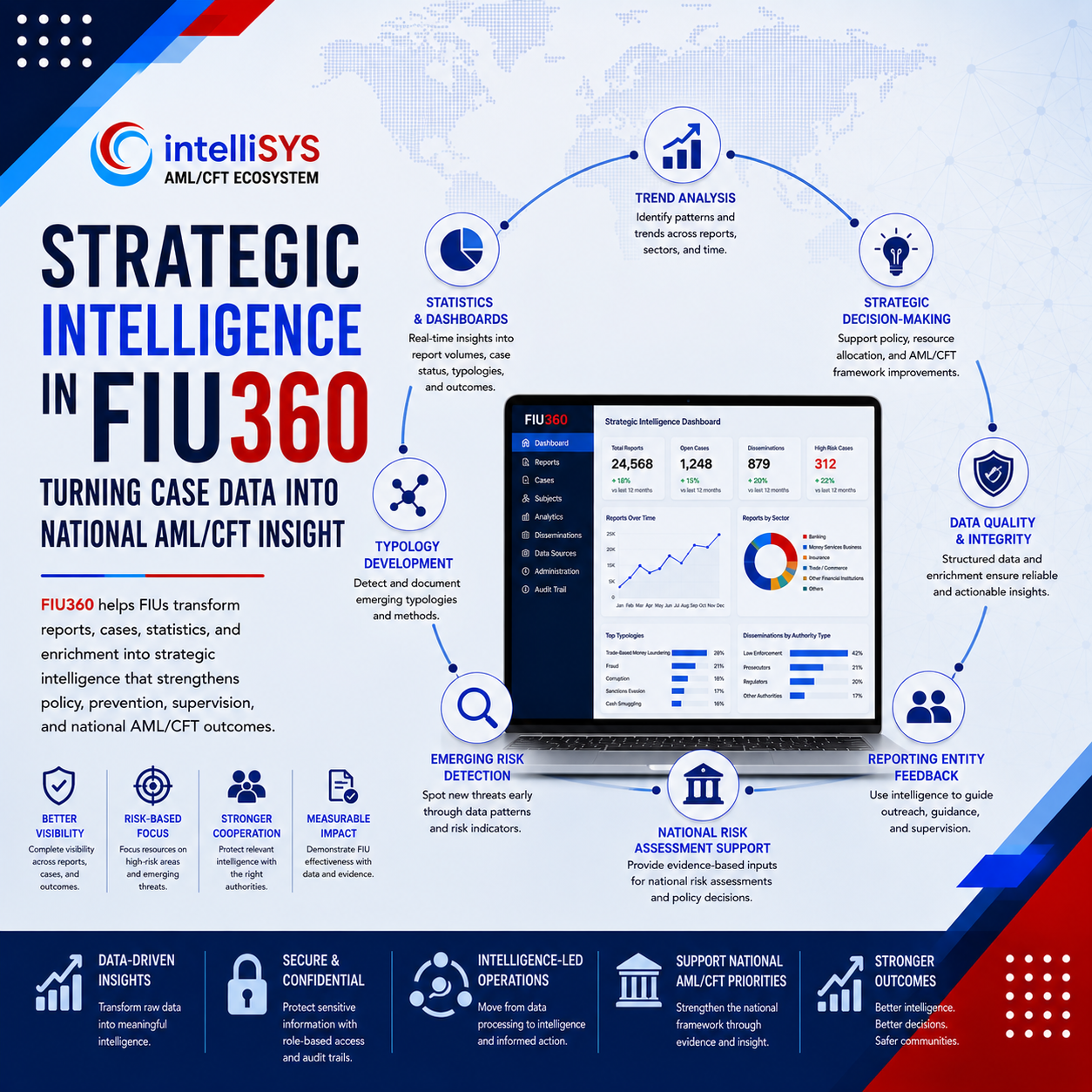
Financial Intelligence Units do more than analyze individual suspicious reports. They also need to understand wider patterns. Which sectors are reporting effectively? Which typologies are increasing? Which products or channels are being abused? Which regions, entities, or transaction patterns show growing risk? Which cases reveal weaknesses in the national AML/CFT framework? These questions require strategic intelligence. FIU360 helps FIUs move beyond case-by-case analysis by turning structured reports, enriched data, cases, statistics, dashboards, and typology indicators into wider AML/CFT insight.
Operational intelligence focuses on specific cases, subjects, networks, and transactions.
It helps answer questions such as who is involved, how funds moved, which entities are connected, and whether intelligence should be disseminated to law enforcement or another competent authority.
Strategic intelligence has a broader purpose.
It helps the FIU understand trends, sectors, typologies, vulnerabilities, reporting behavior, and emerging risks across time.
Both forms of intelligence are important.
Operational intelligence supports immediate action. Strategic intelligence supports policy, supervision, prevention, national risk assessment, resource allocation, and long-term AML/CFT planning.
Financial crime changes constantly.
Criminal networks adapt to new controls, new payment channels, new business sectors, new technologies, and new regulatory gaps.
If an FIU only reviews individual cases, it may miss broader patterns.
Strategic intelligence helps the FIU identify what is changing across the reporting ecosystem.
It can reveal increases in certain typologies, weak reporting from specific sectors, recurring vulnerabilities, repeated use of legal entities, emerging sanctions evasion methods, or unusual transaction corridors.
This allows the FIU to support national AML/CFT decision-making with evidence.
Every report submitted to an FIU contains potential strategic value.
A single STR may support an operational case. Hundreds or thousands of reports may reveal a national pattern.
FIU360 helps FIUs structure incoming data so that it can be used for both operational and strategic purposes.
Report types, reporting sectors, transaction details, subject information, suspicion indicators, case outcomes, enrichment results, and dissemination records can all contribute to a broader intelligence picture.
This is important because strategic intelligence depends on reliable data.
If report data is fragmented or inconsistent, trend analysis becomes weaker.
Statistics are not only for annual reporting.
They can help FIUs understand how the AML/CFT system is performing.
FIU360 supports statistics and management reporting that can show report volumes, reporting sectors, case statuses, validation issues, dissemination activity, feedback, workload, and operational trends.
This data can support strategic questions.
For example, if one sector submits very few reports despite high national risk exposure, the FIU may identify a reporting weakness.
If another sector submits many low-quality reports, the FIU may need targeted outreach or guidance.
Statistics become useful when they lead to operational and policy action.
Typologies help FIUs describe how financial crime is being committed.
They may involve trade-based money laundering, shell companies, cash-intensive businesses, crypto-related movement, corruption proceeds, terrorist financing indicators, sanctions evasion, fraud proceeds, or misuse of non-profit organizations.
FIU360 helps analysts identify recurring patterns across reports and cases.
When analysts can compare structured data, linked subjects, transaction behavior, documents, and case outcomes, they can identify methods that repeat across the system.
These typologies can then support alerts, guidance, reporting entity outreach, supervision, and national risk assessment work.
Some risks develop gradually.
A new payment channel may begin to appear in reports. A particular corridor may show unusual movement. A sector may begin showing repeated suspicious indicators. A new company formation pattern may appear across unrelated cases.
Strategic intelligence helps detect these early signals.
FIU360 dashboards, statistics, case data, and analytical tools can help FIUs monitor changes over time.
This gives the institution a stronger ability to identify emerging threats before they become fully established.
Early detection is one of the most valuable outputs of strategic intelligence.
National Risk Assessments require evidence.
They need data on threats, vulnerabilities, reporting sectors, typologies, geographic exposure, product risks, institutional weaknesses, and effectiveness indicators.
FIU360 can support this process by helping the FIU produce structured information from reports, cases, disseminations, feedback, and trend analysis.
This does not replace national assessment methodology.
It strengthens the evidence base.
When the FIU can provide reliable data and analysis, national authorities can make better decisions about supervision, policy, resourcing, and priority risks.
Different sectors present different AML/CFT risks.
Banks, money service businesses, insurance companies, securities firms, real estate professionals, casinos, dealers in precious metals and stones, lawyers, accountants, and trust and company service providers may all show different reporting patterns.
FIU360 can help compare reporting behavior across sectors.
This can reveal whether a sector is under-reporting, over-reporting, submitting low-quality reports, or showing specific typologies.
Sector-level intelligence is useful for supervisors and policy makers.
It helps them understand where guidance, outreach, inspections, or regulatory attention may be needed.
Strategic intelligence is not only about criminals.
It is also about the quality of the reporting ecosystem.
FIU360 can help identify reporting quality trends such as missing fields, rejected reports, repeated validation errors, weak narratives, incomplete identifiers, or inconsistent transaction data.
These issues affect FIU effectiveness.
If a reporting entity or sector repeatedly submits poor-quality information, the FIU may need to provide feedback, training, or guidance.
Improving reporting quality strengthens the entire AML/CFT chain.
Strategic analysis can show where that improvement is needed most.
Geography can play an important role in financial intelligence.
Reports may show concentration in certain regions, borders, cities, trade corridors, or foreign jurisdictions.
FIU360 can help analyze geographic patterns across reports, transactions, subjects, and cases.
This may support understanding of cross-border movement, regional vulnerabilities, high-risk corridors, or concentration of suspicious activity.
Geographic intelligence can help FIUs support national planning, supervisory focus, and inter-agency cooperation.
It can also help identify areas where additional outreach or investigation support may be needed.
Financial crime often exploits specific products or channels.
These may include wire transfers, cash deposits, prepaid instruments, trade finance, correspondent banking, digital payments, virtual assets, remittance channels, or business accounts.
FIU360 can help analyze suspicious activity by product type, channel, transaction method, and reporting source.
This supports stronger understanding of how financial products are being misused.
Product and channel analysis can help authorities update risk indicators, reporting guidance, supervisory priorities, and detection rules.
It also helps FIUs understand how criminal behavior adapts over time.
Operational cases often reveal individual networks.
Strategic analysis can compare networks across multiple cases.
FIU360 link analysis and visualization can help analysts identify recurring subjects, shared addresses, repeated intermediaries, common directors, connected companies, or repeated transaction counterparties across different reports.
This can reveal wider criminal structures.
A subject that appears minor in one case may become important when viewed across several cases.
Network-level strategic analysis helps FIUs detect relationships that are not visible through individual report review.
Feedback from law enforcement and other competent authorities is valuable.
It helps the FIU understand whether its intelligence was useful, whether cases led to investigations, whether additional information was requested, and which types of intelligence produced stronger outcomes.
FIU360 feedback tracking can support strategic analysis of intelligence value.
For example, the FIU may identify that certain typologies or sectors produce more actionable disseminations than others.
It may also identify areas where intelligence products need improvement.
Feedback turns dissemination into learning.
Supervisors need evidence to understand sector risk.
FIU strategic intelligence can help supervisory authorities identify reporting weaknesses, emerging typologies, high-risk products, and institutions requiring closer attention.
FIU360 can help produce structured insights that support this cooperation.
For example, if the FIU identifies repeated suspicious activity involving a specific sector, it may share strategic findings with the relevant supervisor.
This helps move AML/CFT oversight from reactive review to evidence-based supervision.
Policy makers need reliable intelligence to update AML/CFT frameworks.
Strategic FIU analysis can support policy decisions by showing how criminals exploit legal, institutional, or sectoral vulnerabilities.
FIU360 can help organize the underlying evidence.
This may include trend data, typology reports, risk indicators, reporting behavior, dissemination outcomes, and case patterns.
When policy is informed by operational evidence, national AML/CFT measures become more targeted.
Strategic intelligence helps connect FIU work with national decision-making.
FIUs often issue guidance to reporting entities.
This guidance is stronger when it is based on real trends and typologies.
FIU360 can help identify recurring suspicious indicators and reporting weaknesses that can be turned into practical guidance.
For example, the FIU may issue sector-specific guidance on common red flags, missing data issues, transaction patterns, or typologies seen in recent reports.
This helps reporting entities improve detection and reporting quality.
Strategic intelligence therefore supports prevention, not only analysis.
A typology report should explain a financial crime method clearly.
It may describe the sector involved, indicators observed, transaction patterns, entities used, geographic exposure, case examples, and recommended reporting indicators.
FIU360 can support typology development by helping analysts retrieve related cases, analyze structured data, review documents, examine visual networks, and generate statistics.
This gives analysts a stronger evidence base.
The final typology report can then support reporting entities, supervisors, law enforcement, policy makers, and international partners.
FIU leadership needs visibility over national trends and institutional performance.
Strategic dashboards can help show report growth, sector behavior, typology trends, high-risk indicators, dissemination outcomes, feedback patterns, and workload pressure.
FIU360 dashboards and BI capabilities can support this leadership view.
The goal is not to overwhelm management with charts.
The goal is to provide decision-ready insight.
A good dashboard helps leadership identify what requires action.
An FIU knows that a certain sector is exposed to money laundering risk.
However, FIU360 statistics show that the sector submits very few reports compared with its risk profile and market activity.
This may indicate under-reporting.
The FIU can use this insight to engage the sector supervisor, provide training, update guidance, or review reporting obligations.
This is strategic intelligence in practice.
It turns reporting data into institutional action.
Several reports from different institutions mention unusual invoice values, repeated counterparties, and inconsistent goods descriptions.
Individually, each report may appear limited.
FIU360 analysis shows that the reports share common companies, routes, and transaction patterns.
The FIU develops a strategic typology on possible trade-based money laundering indicators.
This typology can support reporting entity guidance, customs cooperation, and law enforcement awareness.
An FIU reviews feedback from law enforcement and finds that some disseminations result in useful investigations, while others require repeated clarification.
Using FIU360 feedback records, the FIU identifies which types of intelligence products are most useful.
It then updates internal templates, analyst training, and supervisory review standards.
This improves future dissemination quality.
Strategic intelligence helps the FIU learn from its own outputs.
The FIU is asked to contribute to a national risk assessment.
Using FIU360, it extracts statistics on report volumes, sectors, typologies, high-risk jurisdictions, case trends, disseminations, and feedback.
It also provides analysis on emerging risks and reporting weaknesses.
This gives the national assessment process stronger evidence.
The FIU’s contribution becomes more than opinion. It becomes data-supported strategic intelligence.
Strategic intelligence is not the same as producing statistics.
A report volume chart may show what happened, but it does not explain why it matters.
Analysts must interpret the data.
A rise in reports may indicate increased detection, new criminal activity, stronger reporting awareness, regulatory changes, or defensive reporting.
FIU360 provides structured data and analytical tools, but professional interpretation remains essential.
The value of strategic intelligence comes from combining technology with analyst judgment.
Strategic intelligence should be governed carefully.
The FIU must define who can access strategic data, how sensitive information is anonymized or aggregated, how typology reports are approved, and what can be shared externally.
FIU360 security, workflow, and access controls can support this governance.
Strategic products may be shared with supervisors, reporting entities, law enforcement, policy makers, or international partners.
Each audience may require a different level of detail.
Good governance protects sensitive information while still allowing useful insight to be shared.
Strategic intelligence should not be produced only once a year.
It should be an ongoing FIU function.
FIU360 can help support continuous monitoring of reports, trends, sectors, risks, and outcomes.
This allows the FIU to identify changes sooner and adjust priorities more quickly.
An annual strategic report is useful, but real value comes from continuous insight.
Modern FIUs need both periodic reporting and active strategic monitoring.
Building a strategic intelligence function requires more than dashboards.
The FIU needs data quality, structured reporting, analytical methodology, trained staff, typology frameworks, dashboard design, feedback mechanisms, and governance rules.
IntelliSYS supports FIUs through FIU360 configuration, data modeling, dashboard setup, workflow design, training, mentoring, and operational consulting.
This helps ensure that strategic intelligence is not only technically possible, but operationally useful.
The objective is to help FIUs turn accumulated data into national AML/CFT insight.
FIU360 is powerful for strategic intelligence because it connects the full intelligence lifecycle.
Reports, subjects, entities, transactions, enrichment results, cases, documents, visualizations, disseminations, feedback, dashboards, and audit trails all exist within one structured environment.
This gives FIUs a stronger foundation for trend analysis and typology development.
Instead of relying on fragmented data sources, the FIU can analyze information across the operating model.
Strategic intelligence becomes more reliable when the underlying data is connected.
FIUs hold some of the most valuable AML/CFT data in the national system.
But the value of that data depends on the FIU’s ability to analyze it beyond individual cases.
FIU360 helps FIUs transform reports, cases, statistics, enrichment results, feedback, and typology indicators into strategic intelligence.
This supports national risk assessment, sector supervision, reporting entity guidance, policy development, law enforcement cooperation, and long-term AML/CFT planning.
For FIUs seeking to strengthen strategic analysis and national AML/CFT insight, FIU360 provides a structured platform for turning operational data into evidence-based intelligence.
Contact IntelliSYS to discuss how FIU360 can support your FIU’s strategic intelligence, typology analysis, dashboard reporting, and national risk assessment requirements.