
Financial Intelligence Units operate at the center of national AML/CFT systems. They receive reports from accountable institutions, analyze suspicious activity, enrich data from multiple sources, manage cases, and disseminate intelligence to competent authorities. This work requires more than a reporting portal. A modern FIU needs a secure, scalable, and intelligence-led operating platform that can support the full financial intelligence lifecycle. FIU360 is IntelliSYS’s comprehensive FIU platform designed specifically for Financial Intelligence Units. It helps FIUs move from fragmented processes and manual workflows toward a more connected, structured, and intelligence-driven operating environment.
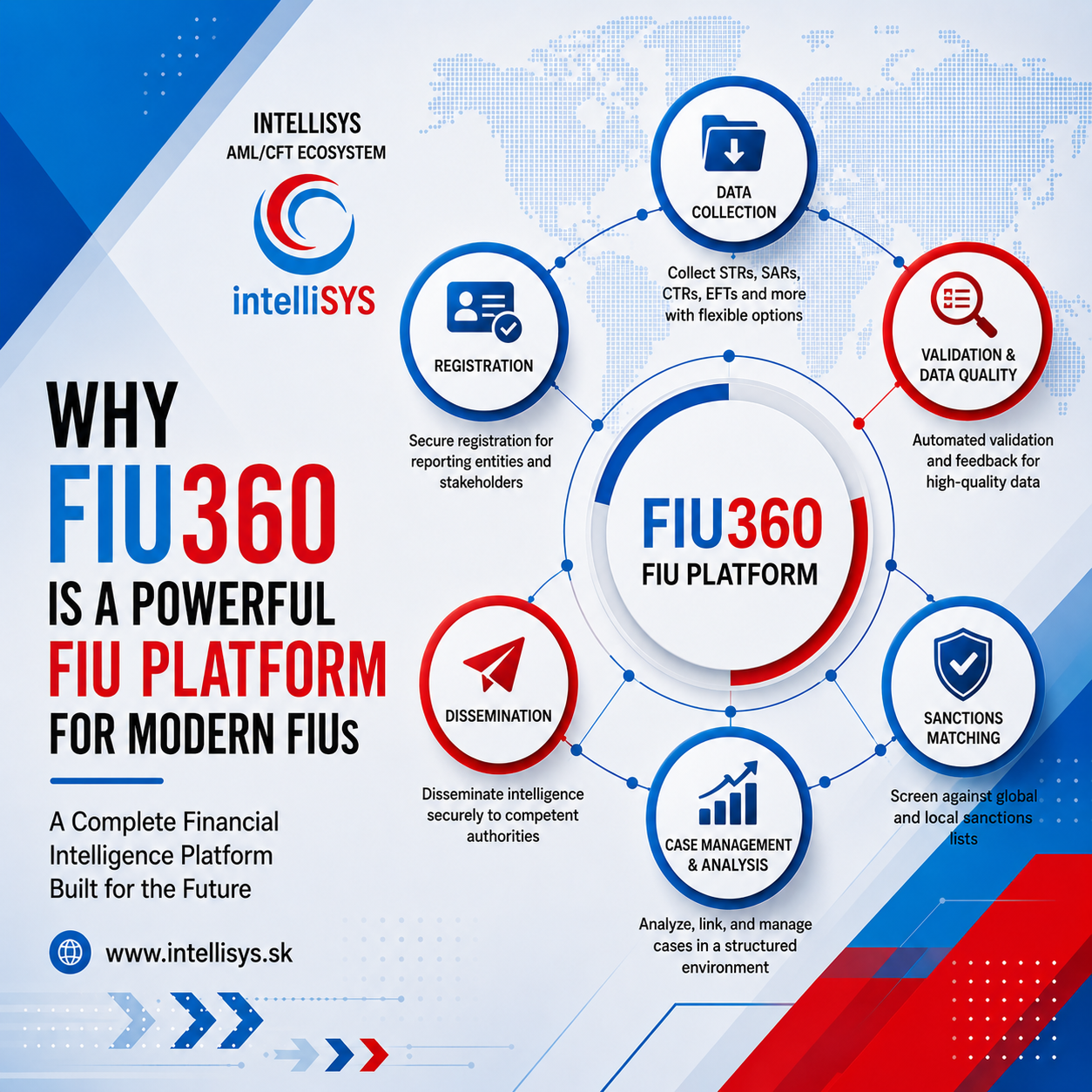
The work of an FIU does not stop when a suspicious transaction report is received. The real value begins when that report is validated, enriched, analyzed, connected to other data, and transformed into intelligence that can support action.
FIU360 is designed around this complete lifecycle:
Collect → Enrich → Analyze → Manage → Disseminate
This makes FIU360 different from basic submission portals or generic case management tools. It supports the FIU’s operational, analytical, governance, and reporting needs in one modular environment.
For modern FIUs, this integrated approach is essential. Financial crime is becoming more complex, and analysts need systems that help them see the full picture faster.
Many FIU systems focus primarily on receiving reports. While report collection is important, it is only one part of financial intelligence work.
A powerful financial intelligence system must also help the FIU validate data, identify errors, enrich reports, find links between subjects, manage workflows, protect sensitive cases, generate statistics, and disseminate intelligence securely.
FIU360 is designed to support all these functions.
It gives FIUs a platform that connects reporting, analysis, case management, dashboards, document handling, dissemination, feedback, and auditability. This reduces the need for disconnected tools and helps analysts work from a more complete intelligence environment.
A strong FIU ecosystem starts with knowing who is connected to the FIU.
FIU360 includes a registration module that allows accountable institutions, law enforcement agencies, regulators, and other stakeholders to register securely online. This creates a verified registry of FIU counterparts and supports controlled access rights for different institutions and users.
This matters because reporting entities are not all the same. A large bank may need several users with different permissions. A smaller reporting entity may need a simpler access model. Regulators and law enforcement agencies may need different interaction rights.
FIU360 supports this flexibility through role-based access and hierarchical permissions.
The result is a more secure and organized relationship between the FIU and its national AML/CFT stakeholders.
Data collection is one of the most important functions of any FIU platform. Poor-quality data at intake creates problems throughout the entire intelligence lifecycle.
FIU360 supports multiple report types, including suspicious transaction reports, suspicious activity reports, currency transaction reports, electronic funds transfer reports, terrorist financing reports, politically exposed person-related reports, and account information files.
The system supports both XML file uploads and web form submissions. This gives reporting entities flexibility while allowing the FIU to maintain structured reporting standards.
FIU360’s flexible schema design enables the FIU to define what data is required for each report type. This improves consistency, reduces errors, and makes downstream analysis more effective.
Financial intelligence depends on data quality. If reports are incomplete, inconsistent, or incorrectly formatted, analysts spend time fixing avoidable issues instead of focusing on risk.
FIU360 supports automated validation at submission. The system can check whether required fields are complete, whether the report follows the expected schema, and whether business rules are satisfied.
This helps prevent weak or incomplete reports from entering the FIU workflow without correction.
The platform can also generate confirmation or correction feedback to the reporting institution. This improves communication between the FIU and accountable institutions and supports continuous improvement in reporting quality.
Sanctions exposure is a major risk area for FIUs and national AML/CFT systems. FIU360 includes sanctions list matching capabilities that allow incoming data to be screened against relevant international and country-specific sanctions lists.
When a possible match is identified, the system can generate an alert for analyst review. If confirmed, the alert can be escalated into an intelligence case.
This capability helps FIUs identify potential sanctions risks earlier and manage screening results inside the same intelligence environment.
Instead of treating sanctions screening as a separate manual process, FIU360 integrates it into the broader reporting and analysis workflow.
Financial reports from accountable institutions rarely provide the full picture. A report may contain transaction details, customer information, and a suspicion narrative, but analysts often need additional context from national databases, registries, open sources, and other authorized systems.
FIU360’s data enrichment capability helps connect financial reports with external information sources.
This may include company registries, population registries, tax data, customs data, vehicle registries, immigration data, criminal intelligence sources, law enforcement information, sanctions databases, and open-source information.
The value of enrichment is clear. Analysts no longer need to rely only on what is inside the original report. They can review a broader intelligence picture that helps identify relationships, ownership structures, historical activity, and possible links to other cases.
FIU analysts work with many types of subjects. These may include persons, legal entities, bank accounts, transactions, addresses, phone numbers, documents, vehicles, and related identifiers.
FIU360 provides subject data management capabilities that allow analysts to search, view, update, and connect these subjects inside the intelligence database.
This is important because financial crime investigations depend heavily on relationships. A person may be linked to multiple accounts. A company may share an address with other entities. A transaction may connect to another case. A phone number may appear across several reports.
FIU360 helps analysts identify and manage these relationships more efficiently.
FIUs produce different types of intelligence. Some cases require operational intelligence to support a specific investigation. Other work requires strategic intelligence to identify trends, typologies, sector risks, or emerging threats.
FIU360 supports both.
The platform allows analysts to explore large datasets, filter information, identify patterns, and examine subjects or thematic areas. This helps the FIU move beyond single-report analysis and develop a broader understanding of financial crime risks.
Operational intelligence helps support immediate action. Strategic intelligence helps guide policy, supervision, outreach, and national risk understanding.
A strong FIU platform must support both.
Financial crime is often networked. It may involve multiple people, companies, accounts, jurisdictions, intermediaries, assets, and transactions.
These relationships are difficult to explain through tables alone.
FIU360 includes data visualization capabilities that help analysts create visual representations of money flows, commodity flows, entity networks, and social relationships. This helps analysts identify patterns more quickly and communicate findings more clearly.
Visualization is especially useful when intelligence must be shared with law enforcement officers who may not specialize in financial analysis.
A clear diagram can help explain a complex intelligence hypothesis faster than a long narrative alone.
FIU operations need consistency. Reports, cases, requests, approvals, escalations, and disseminations should follow clear processes.
FIU360 includes a process manager that allows FIUs to define workflows for different report types, case types, and operational procedures.
When a report is received, the system can assign the correct workflow step to the relevant user and track the time taken to complete each task. This supports better management oversight and performance measurement.
The process manager can also support automated actions such as notifications, reminders, status updates, and risk classification changes.
This helps FIUs move from informal task handling to measurable and standardized operations.
A strong FIU platform must protect the intelligence assets created during analysis.
FIU360 includes case management capabilities that allow the FIU to create different case types, assign case officers, link related subjects, attach documents, define security levels, and restrict access to sensitive cases.
This is critical because not every case should be visible to every user.
Some cases may involve corruption, organized crime, terrorism financing, politically exposed persons, sanctions exposure, or highly sensitive law enforcement cooperation. FIU360 allows access to be controlled according to role, sensitivity, and operational need.
This helps protect confidentiality while still allowing authorized users to work effectively.
FIUs do not work only with structured data. Analysts also handle scanned documents, Word files, Excel sheets, PowerPoint files, correspondence, intelligence notes, legal documents, and supporting attachments.
FIU360 includes document management capabilities to handle this unstructured information inside the intelligence environment.
The platform can attach documents to the intelligence database, support text extraction for search, apply meta-tags, preserve versions, and support collaborative editing of office documents.
This is important because documents often contain critical context that structured fields do not capture.
A proper document management function helps ensure that supporting material remains searchable, traceable, and connected to the case.
Statistics are essential for FIU management, operational oversight, annual reporting, and international evaluations.
FIU360 supports statistical analysis and reporting so that FIUs can generate information about report volumes, registered entities, case activity, performance, workload, trends, and operational outputs.
This helps management understand how the FIU is performing and where resources may be needed.
Statistics also support strategic planning and institutional accountability. A modern FIU should not rely on manual spreadsheet preparation for core management information.
FIU360 helps transform operational data into usable performance and intelligence insights.
Managing an FIU requires visibility. Leadership needs to understand workloads, pending cases, analyst performance, report volumes, risk trends, and operational bottlenecks.
FIU360 includes BI dashboards and reporting services that help managers monitor critical information.
Dashboards can support key performance indicators, drill-down views, automated reports, and scheduled reporting. This gives FIU leadership a stronger basis for decision-making.
The benefit is not only convenience. Better visibility helps management identify operational pressure points, improve resource allocation, and support long-term modernization planning.
The final product of an FIU is often an intelligence package shared with law enforcement, counterpart FIUs, regulators, or other competent authorities.
FIU360 supports secure dissemination of intelligence packages. These packages may include narrative reports, charts, visualizations, subject profiles, attachments, and structured case data.
The dissemination process must be secure, controlled, and auditable. FIU360 helps manage this by supporting encrypted transmission, controlled recipient access, and feedback tracking.
Feedback is important because it helps the FIU understand whether disseminated intelligence was useful, whether it supported an active investigation, and how the quality of future intelligence can be improved.
FIU data is highly sensitive. It may include personal data, financial records, suspicious activity reports, intelligence assessments, law enforcement referrals, and confidential communications.
FIU360 is designed with security as a core principle.
The platform supports role-based access control, granular permissions, audit logging, encryption, security classifications, and segregation of duties. It also records user actions and system activity to support transparency and accountability.
This level of control is essential for FIUs.
Institutions must know who accessed information, what actions were taken, when changes occurred, and how sensitive intelligence was handled. Security and auditability are not optional features. They are core requirements for a modern FIU platform.
Reporting volumes continue to increase in many jurisdictions. FIUs need platforms that can scale as the number of reports, transactions, users, cases, data sources, and analytical requirements grows.
FIU360 is designed as a modular and scalable platform.
Its architecture supports growth over time, allowing FIUs to start with the functionality they need and expand as operational requirements mature.
This is important because FIU modernization is rarely a one-time project. Needs evolve as legislation changes, reporting sectors expand, new typologies emerge, and technology expectations increase.
A scalable platform helps the FIU grow without constantly rebuilding its core environment.
FIUs operate within national laws and international expectations. They must support AML/CFT obligations, protect sensitive information, cooperate with domestic and international partners, and demonstrate operational effectiveness.
FIU360 is designed to support this environment.
The platform helps strengthen the collection, enrichment, analysis, case management, dissemination, auditability, and governance of financial intelligence. These capabilities are important for FIUs seeking to improve operational maturity and align with international standards and best practices.
Technology alone does not guarantee effectiveness. However, the right platform gives FIUs a stronger foundation for achieving it.
Consider a suspicious transaction report submitted by a financial institution.
In a limited system, the FIU may receive the report, manually validate the data, request additional information by email, search external sources separately, prepare notes in documents, create diagrams manually, and send intelligence to law enforcement through separate channels.
This process can be slow and difficult to audit.
With FIU360, the process becomes more structured. The report is submitted through a secure channel. Validation checks improve data quality. Data enrichment connects the report to external sources. Subject data management helps identify related persons, accounts, and entities. Visualization helps analysts explain relationships. Case management protects sensitive material. Dissemination creates a secure intelligence package and tracks feedback.
The result is a more complete and controlled intelligence workflow.
FIU360 is powerful because it supports the FIU as an intelligence organization, not only as a report receiver.
It connects the key elements of FIU work: data intake, validation, enrichment, analysis, workflow, case management, documents, statistics, dashboards, dissemination, feedback, security, and auditability.
This integrated model helps reduce fragmentation, improve visibility, protect sensitive information, and support better intelligence production.
For FIUs facing growing reporting volumes, complex financial crime threats, and increasing expectations from national and international stakeholders, this type of platform can provide a strong foundation for modernization.
IntelliSYS supports FIU360 not only as a product, but also through consulting, implementation, integration, migration, training, and operational support.
This matters because FIU modernization requires more than software deployment.
An FIU may need to configure reporting schemas, define workflows, migrate legacy data, integrate national databases, train analysts, onboard reporting entities, configure dashboards, and align the platform with internal procedures.
IntelliSYS helps support this full implementation journey so that FIU360 can be adapted to the institution’s operating model and national requirements.
Modern Financial Intelligence Units need more than digital report submission. They need secure, integrated, scalable, and intelligence-led platforms that support the full lifecycle of financial intelligence.
FIU360 provides this foundation. It helps FIUs collect reports, enrich data, analyze relationships, manage cases, protect documents, generate statistics, disseminate intelligence, track feedback, and maintain strong governance.
For institutions planning FIU modernization, AML/CFT technology upgrades, or a move toward more intelligence-led operations, FIU360 offers a comprehensive platform designed specifically for the realities of FIU work.
Contact IntelliSYS to explore how FIU360 can support your FIU modernization strategy or request a tailored demonstration.