
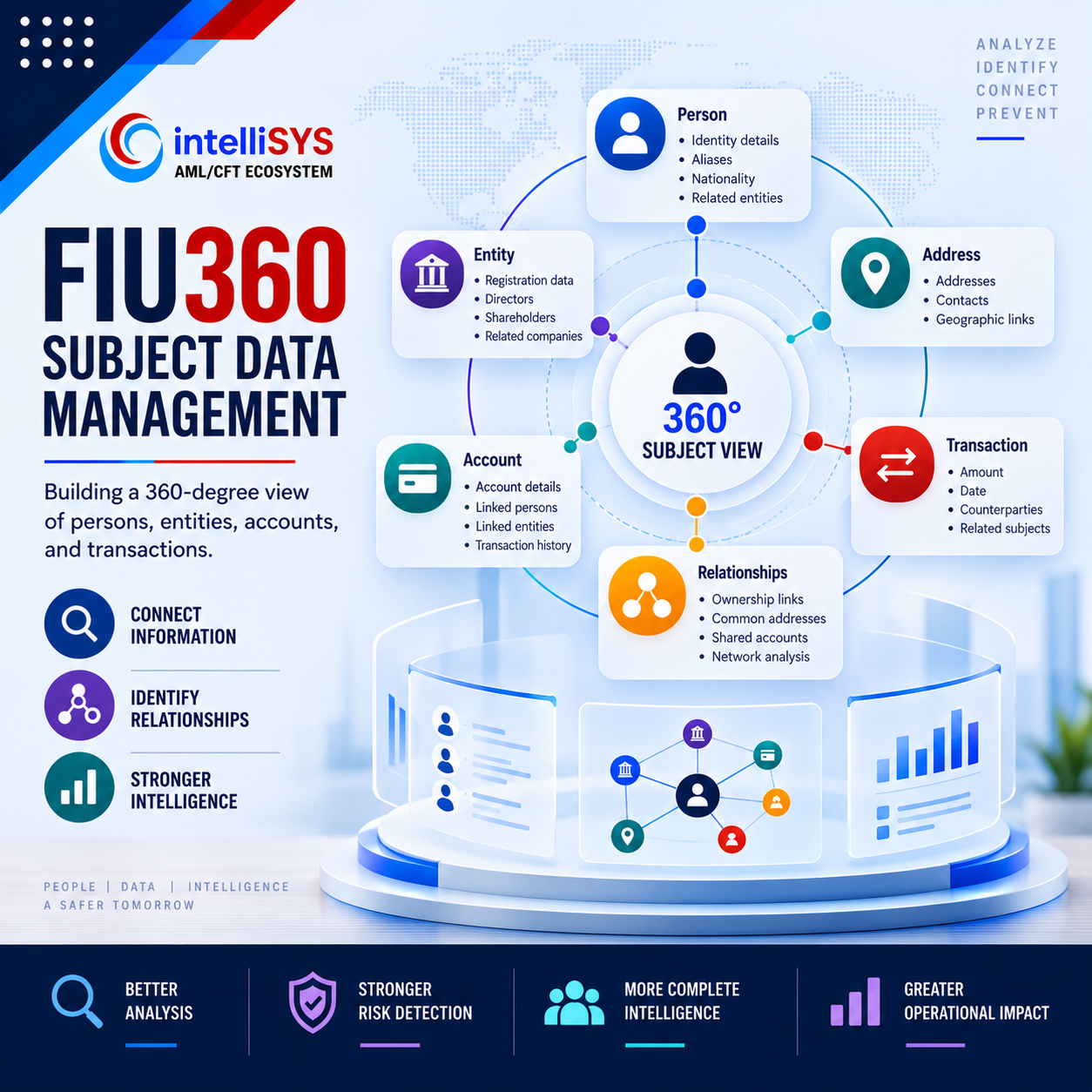
Financial intelligence depends on understanding subjects. A suspicious report may mention a person, company, account, transaction, address, phone number, director, shareholder, or counterparty. On its own, each record may appear limited. The value appears when the FIU connects these records. A person may appear in several reports. A company may share an address with other legal entities. An account may be linked to multiple subjects. A phone number may connect cases that initially looked unrelated. FIU360 subject data management helps FIUs build a clearer 360-degree view of persons, entities, accounts, transactions, and relationships across the financial intelligence environment.
FIUs receive large volumes of information from reporting entities and other sources.
This information often contains repeated subjects, inconsistent identifiers, spelling variations, incomplete records, and fragmented details.
If subjects are not managed properly, analysts may miss important connections.
The same person may appear under different names. The same company may be reported with different registration details. The same address may link several legal entities. The same account may appear across multiple suspicious reports.
Subject data management helps the FIU organize this information into a more reliable intelligence structure.
A suspicious transaction report is only one view of a subject.
The reporting institution may know about a customer, account, or transaction, but the FIU may have access to wider information.
That subject may appear in previous reports, external databases, company registries, sanctions lists, tax records, customs data, law enforcement sources, or open-source material.
FIU360 helps analysts move beyond the individual report and examine the subject across the wider intelligence environment.
This gives the FIU a stronger basis for analysis.
Financial crime cases usually involve several types of subjects.
A person may control a company.
A company may operate several accounts.
An account may send funds to multiple counterparties.
A transaction may connect several jurisdictions.
An address may link unrelated-looking entities.
FIU360 helps manage these different subject types inside one environment.
This allows analysts to understand how persons, legal entities, accounts, transactions, addresses, phone numbers, and documents connect to each other.
The result is a fuller intelligence picture.
Subject data is often inconsistent.
Names may be spelled differently. Dates may be missing. Company names may be abbreviated. Identification numbers may be incomplete. Addresses may be written in different formats. Phone numbers may use different country codes.
These inconsistencies make analysis harder.
If the system treats each variation as a separate subject, analysts may not see the full network.
FIU360 helps analysts compare, manage, and connect subject information more effectively.
Better subject management improves search, enrichment, visualization, risk scoring, and case development.
Entity resolution is the process of determining whether different records refer to the same person, company, account, or object.
This is essential for FIUs.
For example, one report may mention “ABC Trading Ltd.” Another may mention “A.B.C. Trading Limited.” A company registry may show the official name as “ABC Trading Company Ltd.”
Without entity resolution, these records may remain disconnected.
FIU360 supports the analytical process of identifying and linking related records so analysts can see the full subject history.
This helps reduce fragmentation inside the FIU database.
A subject profile should bring together the information known about a person or entity.
For a person, this may include names, aliases, identifiers, nationality, addresses, phone numbers, accounts, related companies, previous reports, documents, cases, sanctions indicators, and linked subjects.
For a company, it may include registration data, directors, shareholders, addresses, accounts, transactions, beneficial owners, related companies, documents, reports, and risk indicators.
FIU360 helps analysts build and review these subject profiles inside the intelligence environment.
This gives analysts a more complete view before making decisions.
A subject may appear across multiple reports from different reporting entities.
One bank may report suspicious transfers. Another institution may report cash activity. A money service business may report foreign remittances. A real estate professional may report a suspicious purchase.
Individually, each report may seem limited.
Together, they may show a wider pattern.
FIU360 subject data management helps connect these reports through shared persons, entities, accounts, addresses, phone numbers, or transaction counterparties.
This allows the FIU to detect patterns that individual reporting entities may not see.
Subject profiles become stronger when enriched with external data.
Company registry data can show directors and shareholders. Population records can help verify identity. Tax records can provide financial context. Customs data can support trade analysis. Sanctions lists can identify exposure. Law enforcement sources can indicate criminal intelligence links.
FIU360 allows analysts to connect authorized external data to the relevant subject records.
This creates a more complete intelligence profile.
The analyst can then assess risk with better context.
Data enrichment and subject management work together.
Enrichment provides additional information. Subject management organizes that information and connects it to the correct person, entity, account, or case.
Without subject management, enrichment results may remain as separate documents or lookup responses.
FIU360 helps bring enrichment results into the analytical structure.
A director retrieved from a company registry can become linked to a company. A phone number found in one source can connect to another report. An address can reveal related entities.
This is how enrichment becomes intelligence.
Financial crime networks often rely on hidden relationships.
A beneficial owner may use nominee directors. Several companies may share the same address. Multiple accounts may be controlled by related persons. Transactions may move through intermediaries to disguise the final beneficiary.
FIU360 subject data management helps analysts identify these relationships.
By connecting subjects, identifiers, documents, reports, and external data, the platform helps reveal links that may not be visible in the original report.
This supports stronger network analysis and case development.
Small details can be important.
A shared address, phone number, email address, document reference, or identification number may connect subjects that appear unrelated.
For example, several companies may use the same address. Multiple individuals may share a phone number. A reported entity may have a director who appears in another suspicious case.
FIU360 helps analysts detect and review these shared identifiers.
This can turn isolated records into a connected intelligence picture.
Accounts and transactions are central to financial intelligence.
An account may be used by one subject but benefit another. A company account may receive funds from several individuals. A personal account may support business activity. Transactions may connect subjects across jurisdictions.
FIU360 subject data management helps analysts link accounts and transactions to persons, entities, reports, and cases.
This supports clearer analysis of money movement.
It also helps analysts identify central accounts, repeated counterparties, circular flows, and suspicious transaction structures.
eneficial ownership analysis depends on connecting legal and natural persons.
A company may be owned by another company. That company may be controlled by nominees. Directors may appear across several entities. A beneficial owner may be hidden behind layers.
FIU360 helps analysts organize ownership relationships and related subject data.
When company registry information, reports, transactions, addresses, and related entities are connected, analysts can better understand who may control or benefit from activity.
This is essential for corruption, sanctions evasion, fraud, tax crime, and money laundering analysis.
Sanctions exposure may not always appear through direct name matching.
A reported company may not appear on a sanctions list, but its beneficial owner, director, shareholder, counterparty, or related entity may be linked to a designated subject.
FIU360 subject management helps analysts connect sanctions alerts to the wider subject profile.
This allows the FIU to review indirect exposure and related networks.
Sanctions analysis becomes stronger when it is connected to subject relationships, ownership data, transactions, and case history.
Subject data should support case development.
When a report is escalated into a case, analysts need to understand which subjects are involved and how they connect.
This creates continuity between subject review and case management.
The case does not begin from zero.
It begins with the full subject context already available inside the platform.
Visualization depends on good subject data.
A network diagram is only useful if persons, entities, accounts, transactions, and relationships are structured properly.
FIU360 subject management supports visual analysis by organizing relationships between subjects.
Analysts can map money flows, ownership links, shared addresses, transaction paths, and related reports.
This helps them see patterns that may be difficult to understand through tables alone.
Visualization turns subject data into a clearer analytical picture.
Risk-based analysis depends on subject context.
A report may appear low risk until the subject profile shows previous reports, sanctions exposure, criminal intelligence links, high-risk jurisdictions, related companies, or unusual transaction history.
FIU360 helps analysts consider subject history and related indicators during prioritization.
This supports more informed triage.
Instead of reviewing each report in isolation, the FIU can assess the subject’s wider risk profile.
This helps allocate analytical resources more effectively.
Subject data also supports strategic intelligence.
Over time, FIUs can identify recurring entities, sectors, addresses, intermediaries, corridors, transaction patterns, and typologies.
FIU360 helps preserve structured subject data that can support trend analysis.
For example, strategic analysts may identify repeated use of certain company structures, shared addresses, or professional intermediaries across multiple cases.
This can support typology development, reporting entity guidance, supervision, and national risk assessment.
Subject management therefore supports both operational and strategic intelligence.
Duplicate subject records create analytical risk.
If the same person or entity appears in multiple forms, the FIU may miss connections.
Duplicate records also weaken dashboards, risk scoring, statistics, and search results.
FIU360 helps analysts identify and manage related subject records more effectively.
This improves data quality over time.
A cleaner subject database supports stronger analysis, faster search, and more reliable intelligence products.
Historical records are valuable.
A subject reported today may have appeared in earlier cases, disseminations, documents, enrichment results, or feedback records.
FIU360 subject management helps preserve this history.
Analysts can review previous activity and understand whether the new report is isolated or part of a repeated pattern.
This supports institutional memory.
It also helps the FIU avoid treating recurring subjects as new or disconnected records.
Subjects often cross borders.
A person may use foreign companies. A company may receive funds from another jurisdiction. A beneficial owner may reside abroad. A transaction may involve several countries.
FIU360 subject profiles can support international cooperation by organizing relevant subject information before sharing or requesting intelligence.
When the FIU communicates with counterpart FIUs, structured subject data helps make requests clearer and responses more useful.
Good subject management improves the quality of cross-border cooperation.
FIUs also cooperate with domestic authorities such as law enforcement, regulators, tax authorities, customs, anti-corruption bodies, and prosecutors.
A well-structured subject profile helps the FIU prepare clearer dissemination packages.
The recipient authority can understand who is involved, how subjects connect, what evidence supports the assessment, and what follow-up may be required.
FIU360 subject management therefore improves the practical usefulness of FIU intelligence.
It helps recipients act on the information more effectively.
An FIU receives three reports from different institutions.
The first report involves a personal account. The second involves a company account. The third involves an international transfer.
At first, the reports appear unrelated.
FIU360 subject management shows that the individual in the first report is also a director of the company in the second report and a beneficiary connected to the third transaction.
The FIU can now analyze the reports as part of one wider pattern.
Several companies are reported separately by different financial institutions.
Each company appears to have different owners and accounts.
FIU360 subject data management identifies that they share the same registered address and one common phone number.
The analyst reviews company registry data and finds additional links between directors.
This creates a new network lead.
What looked like separate companies may be part of a coordinated structure.
An account appears in several reports.
In one report, it is shown as a receiving account. In another, it appears as a sending account. In a third, it is linked to a company director.
FIU360 helps connect the account to the related persons, entities, and transactions.
The analyst can now examine whether the account is functioning as a central point in a wider scheme.
This supports stronger money flow analysis.
An analyst reviews a new report involving a person with limited information.
FIU360 shows that the person appeared in an old case involving a different company and a previous dissemination to law enforcement.
The analyst can review the historical context and assess whether the new report changes the risk profile.
This prevents important institutional knowledge from being lost.
Subject history becomes part of current analysis.
A 360-degree subject view should be useful, not overwhelming.
If every possible detail is shown without structure, analysts may struggle to identify what matters.
FIU360 helps organize subject data through profiles, links, cases, documents, workflows, visualizations, and dashboards.
The analyst still needs judgment.
The goal is not to collect unlimited information.
The goal is to present relevant subject context in a way that supports better intelligence decisions.
Subject data is sensitive.
It may include personal identifiers, financial records, case history, external source information, sanctions indicators, and criminal intelligence links.
FIU360 supports controlled access, auditability, and security measures around subject data.
This helps ensure that users access subject information according to role, case need, and institutional rules.
Good subject management requires both analytical capability and strong governance.
Data must be useful, but it must also be protected.
FIU360 subject data management is powerful because it connects the core building blocks of financial intelligence.
Persons, entities, accounts, transactions, addresses, phone numbers, documents, reports, cases, enrichment results, and disseminations can be linked inside one environment.
This helps analysts build a 360-degree intelligence view.
It supports operational analysis, strategic intelligence, risk prioritization, visualization, case management, dissemination, and cooperation.
Subject management is not a secondary feature.
It is the foundation for connected financial intelligence.
Effective subject data management requires configuration, data modeling, integration, governance, and analyst training.
The FIU must define subject types, identifiers, matching rules, enrichment sources, access controls, case links, visualization needs, and data quality procedures.
IntelliSYS supports FIUs through FIU360 configuration, data integration, workflow design, migration, training, and operational consulting.
This helps ensure that subject management supports real FIU analysis rather than becoming a passive database.
The objective is to help analysts understand subjects faster, connect records more accurately, and produce stronger intelligence.
Financial intelligence depends on knowing who and what is involved.
Persons, companies, accounts, transactions, addresses, documents, phone numbers, and related records must be connected before analysts can understand the full risk picture.
FIU360 helps FIUs manage subject data in a structured, secure, and intelligence-led way.
By supporting subject profiles, entity resolution, enrichment links, relationship discovery, visualization, case management, risk prioritization, and historical review, FIU360 helps analysts move from fragmented records to a 360-degree intelligence view.
For FIUs seeking to improve analytical quality, network discovery, risk prioritization, and dissemination value, subject data management should be treated as a core modernization capability.
Contact IntelliSYS to discuss how FIU360 can support subject data management, entity resolution, and 360-degree intelligence profiles in your FIU environment.