
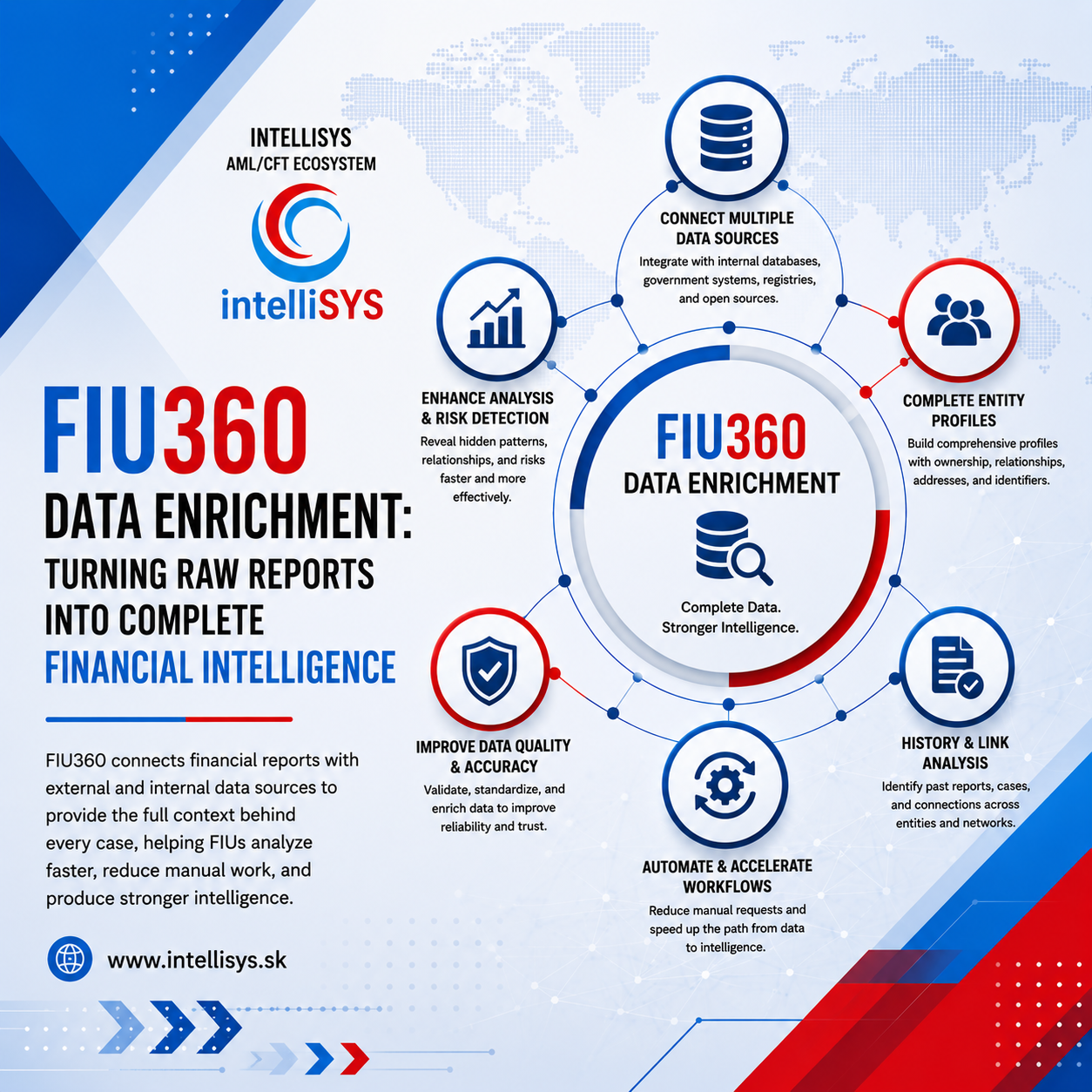
Financial Intelligence Units receive large volumes of suspicious transaction reports, suspicious activity reports, currency transaction reports, electronic funds transfer reports, and other disclosures from accountable institutions. These reports are essential, but they rarely provide the full intelligence picture on their own. To understand the real risk behind a report, FIU analysts often need additional context from company registries, population databases, tax systems, customs records, border control systems, law enforcement sources, sanctions lists, open sources, and other authorized data repositories. This is where FIU360 data enrichment becomes a powerful capability. It helps FIUs transform raw reports into complete financial intelligence by connecting reported financial data with relevant non-financial and contextual information.
A suspicious transaction report may tell the FIU what happened financially. It may show a transaction amount, date, sender, receiver, account number, customer details, and a suspicion narrative.
However, the report may not answer the deeper intelligence questions.
Who owns the company?
Is the person linked to other entities?
Does the address appear in previous cases?
Are there links to customs records, immigration data, criminal intelligence, or public sources?
Has the same subject appeared in older reports?
Are there hidden relationships between counterparties?
Without enrichment, analysts may need to collect this information manually. That creates delays and limits how quickly the FIU can move from report intake to intelligence analysis.
Data enrichment helps close this gap.
In many FIUs, analysts still request additional information through letters, emails, manual database searches, or separate communication channels. This may involve contacting government agencies, regulators, registries, law enforcement bodies, or other national stakeholders.
This process can take days or even weeks.
It also creates operational risks. Requests may be delayed, responses may be incomplete, sensitive information may be exposed through uncontrolled channels, and analysts may spend too much time collecting data instead of analyzing it.
Manual collection also makes repeatability difficult. If each analyst collects information differently, the FIU may struggle to maintain consistency across cases.
A modern financial intelligence platform should reduce these manual steps and bring relevant data into the analytical workflow more quickly.
FIU360 data enrichment means connecting the FIU’s financial intelligence platform to authorized external and internal data sources so that relevant information can be retrieved, integrated, linked, and used during analysis.
The objective is not simply to collect more data. The objective is to add meaningful context to financial reports.
For example, a suspicious transaction report may include a company name. FIU360 enrichment can help connect that company to registration details, directors, shareholders, addresses, related entities, previous reports, sanctions exposure, or other available information.
This gives analysts a richer view of the subject under review.
Instead of seeing only the original report, the analyst can review a more complete intelligence profile.
Financial data from reporting entities forms one side of the intelligence picture. The other side comes from non-financial data sources that explain who is involved, what relationships exist, and how the reported activity fits into a broader context.
Examples of useful enrichment sources may include:
Company registries, population registries, tax records, customs data, immigration records, vehicle registries, criminal intelligence systems, public servant declarations, court records, sanctions lists, phone records, professional association data, and open-source information.
When these sources are connected into the FIU workflow, analysts can move faster from isolated data points to meaningful intelligence.
This is especially important in complex cases involving shell companies, beneficial ownership structures, corruption indicators, trade-based money laundering, terrorist financing risks, sanctions exposure, or organized crime networks.
The strongest value of enrichment is that it changes the analyst’s role.
Without enrichment, analysts may spend much of their time searching for additional records, requesting information, waiting for responses, and manually copying details into case files.
With automated enrichment, the system can retrieve and link relevant information more efficiently. Analysts can then spend more time interpreting the data, identifying patterns, forming hypotheses, and preparing intelligence products.
This shift is important.
The FIU’s value is not in manually collecting information. Its value is in analyzing information and producing actionable intelligence.
A flexible enrichment model should support different operational needs.
In some cases, enrichment should happen automatically when a report is received. This gives the analyst a broader picture immediately when opening the report.
In other cases, enrichment should be triggered by the analyst. The analyst may decide to query specific sources for a particular person, company, account, phone number, address, or other subject of interest.
A mixed model is often the most practical. The system can automatically collect core information at intake, while analysts can request additional enrichment during deeper analysis.
This gives the FIU both speed and control.
Data enrichment becomes more powerful when retrieved information is not simply displayed as separate results.
The real value comes when the system links enriched data to existing FIU records.
For example, if a company registry response identifies shareholders, directors, or related companies, those subjects should be connected to existing persons or entities inside the FIU database where possible.
This allows the FIU to identify relationships between new reports and historical records.
A subject in a new report may already appear in an older case. A director may be linked to several companies. An address may connect multiple unrelated-looking entities. A phone number may appear across different reports.
These connections may not be visible without automated linking and subject data management.
Financial crime often depends on hidden relationships.
A suspicious company may be connected to other legal entities through shareholders, directors, addresses, phone numbers, intermediaries, or transaction counterparties. These links may span multiple data sources and jurisdictions.
FIU360 data enrichment helps analysts uncover these relationships by bringing external information into the same intelligence environment.
In some cases, enrichment can support multi-layer discovery. A company registry query may reveal shareholders. Those shareholders may then be queried to identify other companies they own or control. Those companies may connect to other reports, accounts, or suspicious activity.
This recursive approach helps analysts move beyond the first layer of information and detect broader networks.
Timeliness is critical in financial intelligence.
If analysts wait days or weeks for additional information, important opportunities may be missed. Funds may move, companies may close, suspects may change behavior, or law enforcement action may be delayed.
Automated enrichment can reduce turnaround time significantly by retrieving data from connected sources when needed.
This does not mean every case becomes simple. Analysts still need to assess relevance, reliability, and context. However, faster access to data gives them a stronger starting point.
For FIUs handling growing report volumes, this speed can make a major operational difference.
Manual information requests can create security risks. Sensitive details may be transmitted through email, letters, or uncontrolled communication channels. Multiple people may become aware of an FIU’s interest in a subject before the information reaches the analyst.
Automated enrichment can reduce this exposure.
When requests and responses are handled through secure system-to-system channels, the FIU can limit unnecessary human involvement and improve confidentiality.
This is especially important for sensitive cases involving corruption, organized crime, terrorist financing, politically exposed persons, sanctions exposure, or active law enforcement investigations.
Security is not only about protecting stored data. It is also about protecting the process of collecting and exchanging intelligence.
AML/CFT data integration is one of the foundations of modern financial intelligence. FIUs cannot rely only on the data submitted by reporting entities.
They need controlled access to relevant national and external sources.
However, integration must be carefully designed. FIU data is sensitive, and external systems may have their own legal, technical, and security requirements.
A strong enrichment model should define which sources are connected, what data can be requested, who can trigger requests, how responses are stored, how access is controlled, and how all actions are logged.
This ensures that enrichment improves intelligence capability without weakening governance.
Consider an FIU receiving an STR involving a legal entity that received multiple incoming transfers from foreign counterparties.
The original report includes the company name, account number, transaction dates, and a short suspicion narrative. On its own, the report may not provide enough context to determine whether the activity is part of a larger risk pattern.
With FIU360 data enrichment, the analyst can review additional information from connected sources.
The system may retrieve company registration details, beneficial ownership information, related directors, other companies sharing the same address, tax or customs indicators, previous FIU reports involving the same entity, sanctions exposure, or open-source references.
The analyst can then identify whether the company appears to be active, whether its ownership structure is unusual, whether it connects to known subjects, and whether the transaction pattern aligns with a known typology.
The report becomes more than a transaction record. It becomes part of a broader intelligence picture
Data enrichment supports both operational and strategic intelligence.
For operational intelligence, enrichment helps analysts understand a specific report, subject, or case. It provides context that can support prioritization, case development, dissemination, or referral to law enforcement.
For strategic intelligence, enriched data can help the FIU identify wider trends. For example, analysts may detect repeated use of certain company structures, recurring geographic corridors, common addresses, risky sectors, or patterns linked to specific typologies.
This means enrichment does not only improve individual cases. It also strengthens the FIU’s ability to understand national financial crime risks.
The final value of FIU analysis is often seen in the intelligence package disseminated to law enforcement or another competent authority.
A stronger intelligence package includes more than reported transactions. It includes context, relationships, supporting documents, visualizations, subject profiles, and analytical findings.
Data enrichment helps analysts build richer and more actionable intelligence packages.
When law enforcement receives a package that explains ownership links, related entities, historical activity, and supporting context, it becomes easier to understand the intelligence and decide on the next investigative step.
This improves the practical value of the FIU’s output.
Data enrichment must be auditable.
The FIU should know which data sources were queried, who triggered the request, when it happened, what response was received, and how the response was used in analysis.
This is important for governance and accountability.
A controlled enrichment process helps ensure that data collection is lawful, purposeful, and properly documented. It also helps supervisors review analytical work and confirm that sensitive information was handled correctly.
In modern FIU operations, enrichment should not happen outside the platform in informal notes or personal files. It should be part of the controlled intelligence environment.
Data enrichment should be targeted and useful. Connecting many sources does not automatically create better intelligence.
If analysts receive too much irrelevant information, the system may create noise instead of clarity.
A good enrichment model should prioritize relevance. It should help analysts understand which information matters, how it connects to the case, and whether it supports the intelligence hypothesis.
This requires a balance between automation and analyst judgment.
FIU360 supports this balance by enabling enrichment to be integrated into the analytical workflow, while analysts remain responsible for interpretation and decision-making.
FIU360 data enrichment is powerful because it directly addresses one of the biggest challenges in FIU work: the gap between raw reports and complete intelligence.
It reduces manual data collection, improves access to relevant context, helps identify hidden relationships, supports network discovery, strengthens case analysis, and improves the quality of intelligence products.
It also helps FIUs operate more efficiently. Analysts can spend less time requesting information and more time analyzing risk.
For FIUs handling high volumes of reports and complex financial crime threats, this capability is essential for modernization.
Data enrichment is not only a software feature. It is also an integration and governance project.
Each connected source may require technical interfaces, legal approvals, security controls, data mapping, transformation rules, access permissions, and operational procedures.
IntelliSYS supports this process through its experience in FIU technology, secure system integration, data migration, workflow configuration, and AML/CFT consulting.
This helps FIUs design enrichment models that are practical, secure, and aligned with national requirements.
The objective is not to connect systems randomly. The objective is to build a controlled enrichment environment that improves financial intelligence analysis.
FIUs cannot produce strong intelligence from incomplete context. Suspicious transaction reports are important, but they must be enriched with relevant information from trusted and authorized sources.
FIU360 data enrichment helps FIUs connect financial reports with the broader intelligence picture. It supports faster analysis, stronger relationship discovery, better case development, more useful dissemination, and improved operational efficiency.
For FIUs planning modernization, data enrichment should be treated as a strategic capability, not a secondary add-on.
If your organization is looking to strengthen FIU analysis, automate information collection, or connect national data sources into a secure financial intelligence platform, IntelliSYS can help design and implement the right enrichment model.
Contact IntelliSYS to discuss how FIU360 data enrichment can support your financial intelligence modernization strategy or request a tailored demonstration.