A suspicious transaction report is not just a regulatory submission.
It is a source of intelligence.
Analysts may use the report to identify a subject, connect accounts, examine transaction patterns, enrich companies, link previous cases, assess risk, or prepare intelligence for dissemination.
If the underlying data is weak, every later analytical step becomes more difficult.
For example, an incomplete identification number may prevent subject matching.
A missing account number may break a transaction link.
An unclear narrative may prevent the analyst from understanding why the institution considered the activity suspicious.
Good data quality therefore directly supports good intelligence.
Unstructured reporting creates inconsistency.
Different institutions may describe similar information in different ways. One reporting entity may provide a complete customer profile, while another may submit only a name and transaction amount.
Structured reporting helps reduce this variation.
FIU360 can support defined report types, fields, schemas, required information, and validation rules.
This allows the FIU to establish clearer reporting expectations.
When reporting entities submit information within a structured framework, the resulting data becomes easier to search, compare, validate, and analyze.
Some information is essential for analysis.
Depending on the report type and national requirements, the FIU may need customer identifiers, account numbers, transaction dates, transaction amounts, currencies, counterparties, addresses, identification documents, or suspicion indicators.
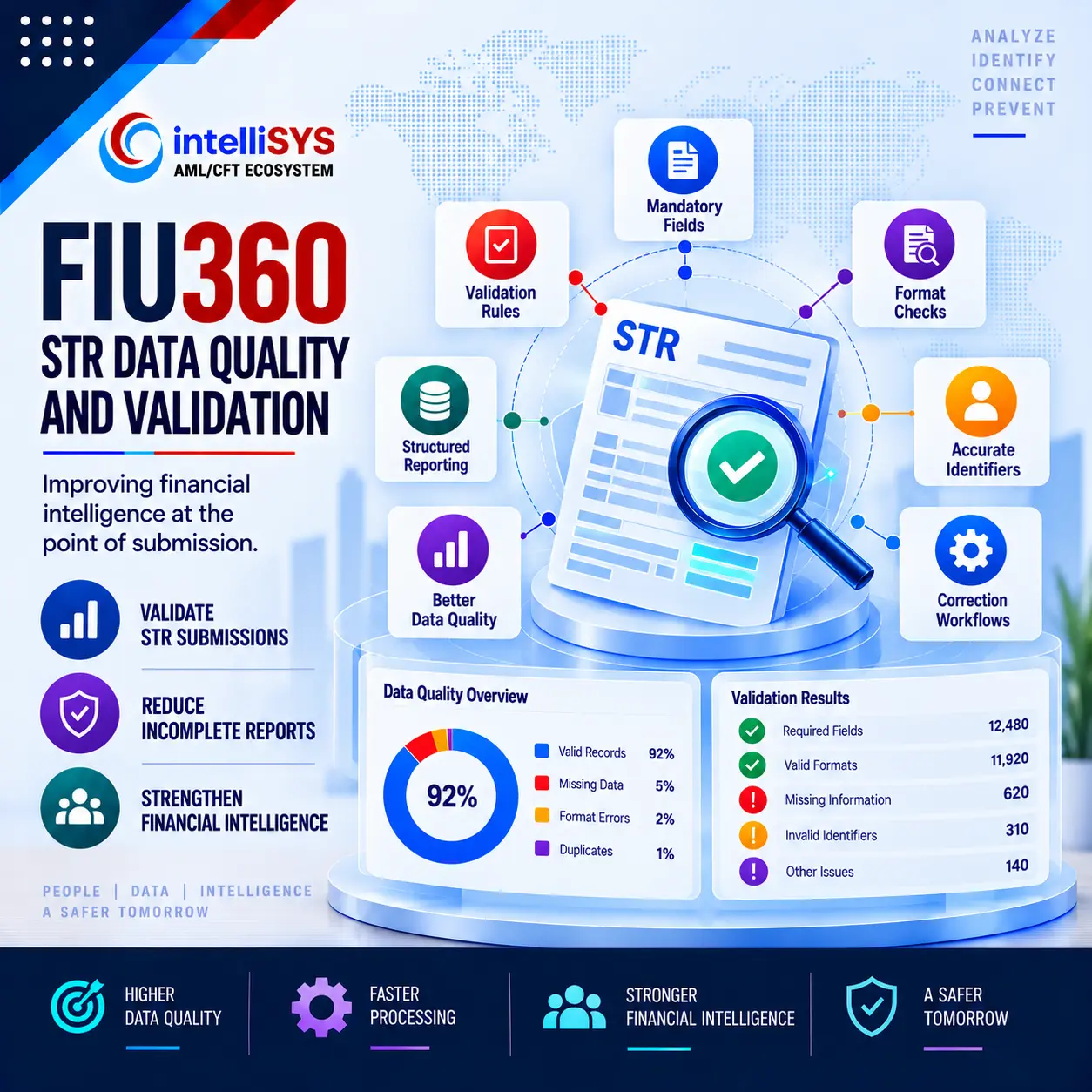
FIU360 validation rules can help ensure that required information is present before a report is accepted or moved forward.
This reduces the number of incomplete reports reaching analysts.
Validation does not guarantee that the report is analytically strong.
But it helps ensure that the basic data needed for intelligence work is available.
Missing information creates delays.
If an analyst receives a report with incomplete customer details, they may need to request clarification before analysis can continue.
This creates additional work for both the FIU and the reporting entity.
FIU360 can help detect missing required information earlier in the reporting process.
The reporting entity can then correct the submission before the report reaches the analytical queue.
This shifts quality control closer to the source.
That is usually more efficient than repairing poor data later.
Data may exist but still be unusable if the format is wrong.
Dates may use inconsistent structures.
Currencies may be entered incorrectly.
Account identifiers may contain invalid characters.
Identification numbers may have the wrong length or structure.
Transaction values may be placed in text fields.
FIU360 can support technical validation rules that identify these problems.
This helps create more consistent data across reporting entities and report types.
Identifiers are critical for financial intelligence.
They help the FIU determine whether two records refer to the same person, company, account, or transaction.
Useful identifiers may include national ID numbers, passports, company registration numbers, account numbers, phone numbers, addresses, tax numbers, or other legally permitted identifiers.
If identifiers are incomplete or inconsistently formatted, entity resolution becomes more difficult.
FIU360 Subject Data Management becomes more effective when incoming reports contain reliable identifiers from the beginning.
Better source data improves subject matching later.
Transaction information is one of the most important parts of many suspicious reports.
The FIU may need to understand:
Who sent the funds?
Who received them?
Which accounts were involved?
What was the amount?
Which currency was used?
When did the transaction occur?
Which jurisdiction was involved?
What reference or purpose was provided?
If these elements are missing or inconsistent, transaction analysis becomes weaker.
FIU360 validation can help ensure that core transaction fields are complete and structured before deeper analysis begins.
Transaction analytics depend on consistent data.
Analysts cannot reliably compare patterns if one institution records currencies one way, another uses incomplete timestamps, and another omits counterparties.
Structured and validated reporting creates a stronger analytical foundation.
FIU360 Transaction Analysis can then connect transactions, subjects, accounts, counterparties, and historical records more effectively.
Data quality therefore influences the value of advanced analytics.
Structured fields are important, but they do not replace the narrative.
The narrative should explain why the reporting entity considered the activity suspicious.
A weak narrative may simply state:
“Unusual transactions detected.”
That tells the analyst very little.
A stronger narrative may explain the customer profile, transaction pattern, change in behavior, relevant counterparties, attempted explanation, and specific reason for suspicion.
FIU360 can help the FIU monitor narrative quality and identify recurring weaknesses in submitted reports.
A report may pass every technical validation rule and still be weak.
All mandatory fields may be complete.
The XML or form structure may be correct.
But the report may still lack useful context.
This is why FIUs need both technical validation and analytical quality monitoring.
Technical validation asks:
Is the data complete and correctly formatted?
Analytical quality asks:
Does the report help the FIU understand the suspicious activity?
Both matter.
Not every report will be correct on the first submission.
A structured correction workflow allows the FIU to return problematic reports to the reporting entity.
FIU360 can help manage this process.
The FIU can identify the issue, request correction, track the report status, and receive an updated submission.
This creates a more controlled process than relying on informal emails or phone calls.
It also creates a record of repeated reporting problems.
One reporting error may be accidental.
Repeated errors may reveal a wider problem.
For example, an institution may repeatedly omit beneficial ownership information.
Another may frequently submit invalid transaction identifiers.
A sector may struggle with narrative quality.
FIU360 can help track these patterns over time.
This allows the FIU to distinguish isolated mistakes from recurring reporting weaknesses.
The information can then support training, guidance, or supervisory engagement.
Data quality improves when reporting entities understand what they are doing wrong.
Simply rejecting a report may not solve the underlying problem.
The FIU needs a feedback mechanism.
Feedback may explain:
Which fields were incomplete.
Why the information matters.
How the report should be corrected.
What recurring quality issues have been identified.
FIU360 can help structure this interaction so reporting entities receive clearer and more consistent guidance.
A mature FIU should not spend years correcting the same reporting problems.
If the same issue appears repeatedly, the FIU should ask why.
The problem may involve reporting guidance.
It may involve user training.
It may involve poor internal systems at the reporting entity.
It may involve unclear report schemas.
FIU360 quality statistics can help identify recurring issues and support targeted improvement.
This moves the FIU from reactive correction to proactive reporting quality management.
Institutions do not all have the same reporting maturity.
Some may consistently submit complete, high-quality reports.
Others may generate frequent validation failures.
FIU360 can help analyze validation errors by reporting entity.
This allows the FIU to identify which institutions may need additional support.
It can also help management assess whether reporting quality is improving over time.
Quality patterns may also appear at sector level.
Banks may have different challenges from money service businesses.
Real estate professionals may struggle with different fields than insurance companies.
DNFBPs may require different reporting guidance from financial institutions.
FIU360 can help aggregate validation and correction data by sector.
This supports more targeted outreach and training.
The FIU can focus on the specific weaknesses affecting each reporting community.
Repeated reporting problems may be relevant to supervisory authorities.
Frequent missing data, repeated correction requests, weak narratives, or inconsistent reporting may indicate weaknesses in AML/CFT controls.
Reporting Entity Supervision Support in FIU360 explains how FIU data can support evidence-based oversight.
The FIU does not replace the supervisor.
But reporting quality can provide useful supervisory signals.
A sector may submit very few reports.
Another sector may submit many reports of poor quality.
These are different problems.
Under-reporting may indicate weak detection or limited awareness.
Poor-quality reporting may indicate weak internal controls, poor data capture, or misunderstanding of reporting requirements.
FIU360 helps the FIU distinguish these patterns.
That distinction matters because the response should be different.
One problem may require awareness and outreach.
The other may require technical guidance or stronger reporting controls.
Entity resolution depends heavily on source quality.
If names are incomplete, dates of birth are missing, company numbers are incorrect, or addresses are inconsistent, the FIU may fail to connect related records.
Good validation reduces this risk.
FIU360 subject management can then compare stronger identifiers across reports.
This improves the probability that analysts identify repeated persons, entities, accounts, and relationships.
Data quality therefore has a direct impact on network discovery.
Ownership analysis also depends on accurate reporting.
If a company report does not include registration information, directors, shareholders, or other relevant identifiers, the FIU may struggle to connect the company with external registry information.
Beneficial Ownership Analysis in FIU360 becomes stronger when the starting report contains reliable corporate data.
Better reporting helps analysts move more quickly from the legal entity to the persons controlling it.
External enrichment cannot fully compensate for poor incoming data.
If the FIU receives the wrong company number, the registry lookup may return nothing.
If the subject name is incomplete, matching may be unreliable.
If the account number is wrong, transaction links may be missed.
FIU360 National Data Integration becomes more effective when the initial report contains accurate identifiers.
High-quality reporting therefore improves enrichment efficiency.
FIUs depend on institutional memory.
A subject reported today may have appeared several years earlier.
But historical matching works only if the data can be connected.
If the earlier report used incomplete identifiers and the new report uses different information, the relationship may be missed.
Structured reporting and consistent validation improve long-term intelligence value.
Good data quality is not only useful for today’s case.
It improves the FIU’s intelligence database over time.
Once an STR becomes part of a case, the analyst may need to rely on the original data repeatedly.
Subject profiles, transactions, company records, documents, and analytical notes all build on the report.
Poor source data creates uncertainty throughout the case.
FIU360 case management benefits from strong intake quality.
The better the report, the less time analysts need to spend repairing basic information before developing intelligence.
Intelligence disseminated to law enforcement or another competent authority must be clear and reliable.
If the source report contains incomplete information, the weakness may carry forward into the dissemination.
Analysts may need to spend additional time verifying basic details.
Strong validation at intake reduces this burden.
It supports better case development and more reliable intelligence outputs.
The quality chain begins at submission.
Poor reporting quality affects strategic analysis too.
If sector data is incomplete or inconsistent, dashboards may produce misleading results.
If duplicate subjects are not resolved, counts may be inflated.
If transaction fields are inconsistent, trend analysis becomes weaker.
FIU360 strategic intelligence depends on reliable operational data.
This is why reporting validation is not merely an administrative function.
It supports the credibility of national-level analysis.
National Risk Assessment relies on evidence.
STR volumes, sectors, suspicious activity patterns, transaction values, reporting quality, and intelligence outcomes may all contribute to the national risk picture.
FATF guidance notes that STR data should be interpreted in the context of sector risk and reporting behavior rather than as raw volume alone.
FIU360 and National Risk Assessment becomes more reliable when the underlying reporting data is complete and consistent.
Good national risk analysis begins with good operational data.
Suspicious transaction reporting is a core part of the AML/CFT framework.
FATF guidance on suspicious transaction reporting recognizes the importance of reporting suspicious transactions and activity so authorities can use financial information to combat money laundering, terrorist financing, and other financial crime.
For FIUs, the practical challenge is not only receiving the reports.
It is receiving information that can be used effectively.
Validation and quality management help close that gap.
AML/CFT effectiveness also depends on reliable data.
FATF Guidance on AML/CFT-Related Data and Statistics highlights STR-related statistics, including reporting volumes, sectors, and transaction values, as useful evidence for assessing effectiveness.
This reinforces the need for consistent underlying data.
If the information is incomplete or poorly structured, aggregate statistics become less reliable.
A bank submits an STR involving several unusual transfers.
The transaction information is complete, but the customer identification number is missing.
Without that identifier, the FIU may struggle to connect the customer to previous reports.
FIU360 validation identifies the missing field before the report enters the analytical queue.
The institution corrects the report.
When the updated report is processed, the subject is linked to an earlier case.
A simple validation rule prevents an important connection from being lost.
A reporting entity submits an STR with the narrative:
“Transactions appear unusual.”
All mandatory fields are technically complete.
But the analyst does not know why the activity was considered suspicious.
The FIU identifies narrative quality as a recurring issue for the institution.
Guidance is provided explaining that future narratives should describe the customer profile, transaction behavior, counterparties, and specific reason for concern.
The quality of future reports improves.
This shows why technical validation alone is not enough.
A bank submits an STR involving several unusual transfers.
The transaction information is complete, but the customer identification number is missing.
Without that identifier, the FIU may struggle to connect the customer to previous reports.
FIU360 validation identifies the missing field before the report enters the analytical queue.
The institution corrects the report.
When the updated report is processed, the subject is linked to an earlier case.
A simple validation rule prevents an important connection from being lost.
A money service business repeatedly submits transactions using inconsistent date and currency formats.
FIU360 validation identifies the failures and returns the submissions for correction.
Reporting quality statistics show that the issue is recurring.
The FIU provides targeted technical guidance.
The reporting entity adjusts its internal reporting process.
Validation errors then fall significantly.
The FIU reduces rework while the reporting entity improves compliance efficiency.
The FIU notices that reports from a particular sector frequently lack complete beneficial ownership data.
FIU360 reporting statistics show that the issue affects multiple institutions, not one company.
The FIU works with the relevant supervisor to provide sector guidance and training.
Subsequent reports include stronger corporate identifiers.
This improves both reporting quality and beneficial ownership analysis.
A large institution submits a high number of STRs.
At first, the volume appears positive.
However, FIU360 quality analysis shows frequent correction requests, weak narratives, and incomplete counterparties.
Few reports develop into useful intelligence.
The FIU can now assess reporting performance more accurately.
High volume alone does not equal high quality.
Two banks submit reports involving customers with slightly different names.
One report includes a complete national ID number and date of birth.
The other includes the same identifier.
FIU360 subject management identifies that both records refer to the same person.
Without consistent identifiers, the relationship might have been missed.
Good source data directly improves intelligence connectivity.
FIU management needs visibility over reporting quality.
Dashboards can help monitor:
Validation failures.
Correction volumes.
Common missing fields.
Narrative quality issues.
Reporting entities with repeated problems.
Sector-level quality trends.
Changes over time.
FIU360 can help management move beyond individual error handling and monitor the reporting ecosystem more strategically.
Quality initiatives should produce measurable results.
If an FIU introduces new guidance, training, or technical validation rules, it should be able to evaluate whether reporting improves.
FIU360 statistics can help compare quality indicators over time.
The FIU may see fewer validation failures.
Correction requests may decrease.
Narratives may improve.
Identifiers may become more complete.
Measurement helps determine whether the intervention worked.
Training is more effective when it addresses real problems.
Generic AML/CFT training may not solve technical reporting issues.
FIU360 quality data can help identify specific weaknesses.
For example:
A sector may need guidance on beneficial ownership fields.
Another may need training on transaction identifiers.
A third may need support writing clearer STR narratives.
This allows the FIU to provide targeted training based on actual reporting behavior.
Large reporting institutions may submit reports through automated system interfaces.
This increases efficiency but also makes technical validation important.
A mapping error in one system could affect many reports.
FIU360 reporting interfaces can apply validation rules to incoming structured data.
Problems can be detected before large volumes of incorrect information enter the FIU environment.
This helps protect data quality at scale.
Validation needs balance.
If reporting rules are too weak, the FIU receives incomplete information.
If rules are too rigid, legitimate reports may be rejected unnecessarily.
Not every field can always be completed in every situation.
The FIU should distinguish between mandatory information, conditional requirements, optional fields, and analytical guidance.
FIU360 configuration should reflect the FIU’s reporting framework and legal requirements.
Validation should improve intelligence, not create unnecessary reporting barriers.
Financial crime changes.
Reporting requirements may change.
New sectors may become reporting entities.
New transaction channels may emerge.
New identifiers may become important.
Validation rules should therefore evolve.
The FIU should periodically review which fields generate value, which errors recur, and where the reporting model needs improvement.
FIU360 can support configurable reporting structures and workflows that adapt over time.
Reporting data is highly sensitive.
STRs may contain personal data, account information, transaction details, corporate records, and allegations of suspicious activity.
Access must be controlled.
FIU360 supports secure handling, access control, auditability, and workflow management.
Improving data quality should never weaken confidentiality.
Both objectives must be designed together.
FIU360 is powerful for reporting quality because validation is connected to the wider FIU lifecycle.
The report does not end at intake.
Its data later supports subject management, transaction analysis, enrichment, case management, dissemination, strategic intelligence, supervision, and National Risk Assessment.
Improving the report at the beginning improves every step that follows.
This creates a direct relationship between intake quality and intelligence quality.
Improving STR quality requires technology, reporting standards, workflow design, training, and cooperation with reporting entities.
The FIU needs to define report schemas, validation rules, required fields, correction processes, quality indicators, dashboards, reporting guidance, and escalation procedures.
IntelliSYS supports FIUs through FIU360 configuration, reporting entity onboarding, validation design, workflow setup, dashboard configuration, training, data migration, and operational consulting.
This helps FIUs build a reporting environment focused not only on receiving more information, but on receiving better information.
Financial intelligence systems cannot produce strong results from consistently poor input.
STR quality affects subject matching, transaction analysis, data enrichment, case development, dissemination, strategic intelligence, supervision, and national risk assessment.
FIU360 helps FIUs strengthen the beginning of this intelligence chain.
Through structured reporting, validation rules, correction workflows, reporting entity feedback, quality monitoring, and controlled data management, FIU360 helps improve the information analysts receive before analysis begins.
For FIUs seeking to reduce rework, improve analytical quality, strengthen reporting entity engagement, and build more reliable intelligence databases, STR data quality should be treated as a core operational capability.
Contact IntelliSYS to discuss how FIU360 can support STR validation, reporting quality management, reporting entity onboarding, and financial intelligence modernization.