
Financial Intelligence Units receive reports from accountable institutions. But those reports do more than support case analysis. They also reveal how well reporting entities understand their AML/CFT obligations, how consistently they submit information, whether report quality is improving, and which sectors may need additional guidance or supervisory attention. FIU360 helps FIUs use reporting data, validation results, dashboards, statistics, and feedback to support stronger AML/CFT supervision and reporting ecosystem improvement.
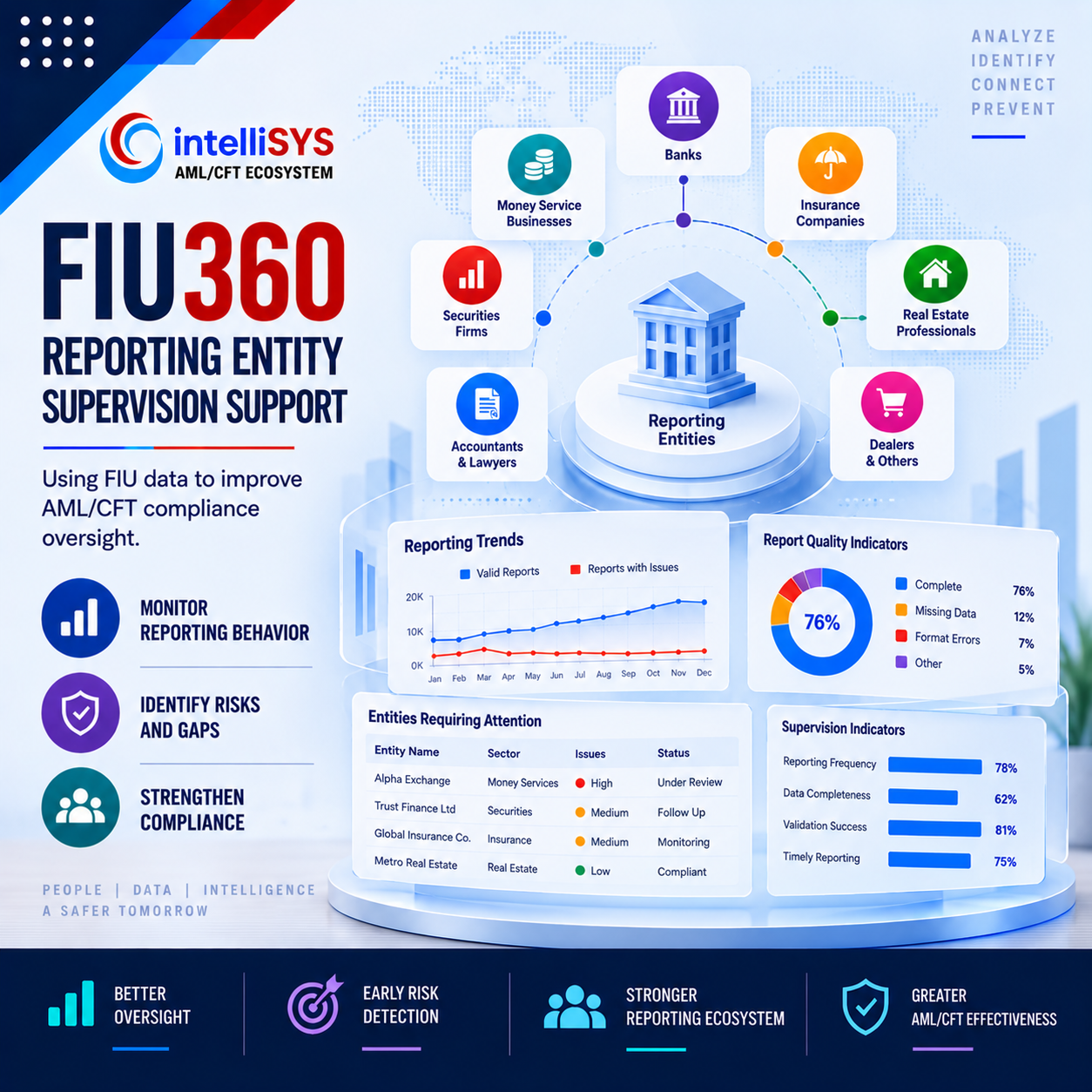
A national AML/CFT system depends on the quality of information submitted by reporting entities.
Banks, money service businesses, insurance companies, securities firms, real estate professionals, accountants, lawyers, dealers, and other accountable institutions may all have reporting duties under national law.
If reporting entities submit high-quality reports, the FIU can analyze risk more effectively.
If reports are incomplete, inconsistent, late, defensive, or poorly structured, the FIU’s work becomes slower and less effective.
Supervision support helps identify where reporting behavior needs improvement.
FIUs hold valuable data about reporting behavior.
They can see which institutions submit reports, how often they report, what types of reports they submit, whether reports pass validation, whether corrections are required, and whether reports lead to useful intelligence.
This data can support supervisors.
For example, low reporting from a high-risk sector may indicate weak detection or under-reporting. High reporting volume with poor quality may indicate defensive reporting or weak internal controls.
FIU360 helps organize these signals so they can be reviewed, measured, and acted upon.
Supervision support begins with knowing who is reporting.
FIU360 supports reporting entity registration and user access management.
This helps the FIU maintain a controlled registry of reporting institutions and authorized users.
A structured registry supports better communication, monitoring, and accountability.
The FIU can understand which institutions are active, which users are authorized, and how reporting access is being managed.
This creates a stronger foundation for reporting sector oversight.
Report volume is one of the most basic indicators of reporting behavior.
FIU360 statistics and dashboards can help the FIU review report volumes by institution, sector, report type, time period, and risk category.
This can reveal useful trends.
A sudden increase in reports may indicate emerging risk, improved detection, regulatory change, or defensive reporting.
A sudden decrease may indicate operational disruption, weak controls, or under-reporting.
Volume alone does not prove effectiveness, but it gives supervisors an important starting point.
Under-reporting is a serious AML/CFT weakness.
A sector may have significant exposure to money laundering or terrorist financing risk but submit very few suspicious reports.
This may indicate lack of awareness, weak controls, poor monitoring systems, limited compliance capacity, or insufficient sector engagement.
FIU360 can help identify under-reporting patterns by comparing reporting behavior across sectors and institutions.
The FIU can then share insights with supervisors or target outreach and training.
This helps strengthen the reporting ecosystem before problems reach the FIU.
High report volume is not always positive.
Some reporting entities may submit large numbers of low-value reports to protect themselves from criticism rather than to provide meaningful intelligence.
This creates unnecessary workload for the FIU.
FIU360 can help monitor report quality indicators such as validation errors, missing fields, weak narratives, incomplete identifiers, repeated correction requests, and low conversion into useful cases.
These indicators can help supervisors distinguish active reporting from effective reporting.
The goal is not only more reports.
The goal is better reports.
Validation errors can reveal weaknesses in reporting entity processes.
If an institution repeatedly submits reports with missing mandatory fields, incorrect formats, inconsistent identifiers, or incomplete transaction information, this may indicate a training or compliance control issue.
FIU360 validation rules and correction workflows help capture these issues.
Over time, the FIU can identify institutions or sectors with repeated problems.
This information can support supervisory engagement, reporting guidance, or targeted training.
Validation data becomes a practical compliance signal.
Correction requests create work for both the FIU and reporting entities.
If reports are frequently returned for correction, analysts lose time and reporting entities face repeated operational friction.
FIU360 can help track correction patterns.
Management can see which institutions require repeated corrections and what types of errors occur most often.
This helps the FIU move from reactive correction to proactive improvement.
Instead of fixing the same problem repeatedly, the FIU can support better reporting practices through guidance, system rules, or supervisory communication.
A report may be technically valid but still analytically weak.
For example, a suspicious transaction report may include all mandatory fields but provide a vague narrative that does not explain the suspicious activity clearly.
FIUs need reports that are both structured and meaningful.
FIU360 can support review of report quality by helping analysts assess whether submitted reports provide useful subject details, transaction context, suspicion indicators, and supporting documents.
This type of quality review can help identify where reporting entities need better guidance.
Different sectors have different risk profiles and reporting maturity.
Banks may submit frequent reports, while smaller DNFBP sectors may submit fewer reports. Money service businesses may show different transaction patterns from insurance firms or real estate professionals.
FIU360 dashboards and statistics can help analyze reporting behavior at sector level.
This supports more targeted supervision.
Instead of issuing generic guidance to all reporting entities, authorities can focus on the sectors where reporting quality, volume, or risk indicators show concern.
Sector-level analysis supports a risk-based supervisory approach.
Supervisors may also need institution-level insight.
One bank may submit strong reports with complete transaction details and useful narratives. Another may submit reports with repeated errors. A money service business may stop reporting entirely. A real estate firm may submit reports only after regulatory pressure.
FIU360 can help show these patterns.
This information can support supervisory inspections, compliance reviews, outreach, or follow-up.
The FIU does not replace the supervisor.
But FIU data can provide supervisors with valuable evidence about reporting behavior.
The usefulness of a report can be measured partly by what happens after submission.
Did the report support enrichment?
Was it linked to other reports?
Did it become a case?
Was intelligence disseminated?
Did feedback show that the intelligence was useful?
FIU360 can connect report intake, case management, dissemination, and feedback data.
This helps the FIU understand which reporting entities or sectors produce reports that lead to meaningful intelligence outcomes.
This is a more advanced view of reporting quality.
It looks beyond volume and validation.
Risk-based supervision requires evidence.
Supervisory authorities need to know which sectors, institutions, products, channels, and behaviors create higher AML/CFT risk.
FIU360 reporting data can support this evidence base.
For example, repeated suspicious activity involving a sector may suggest higher exposure. Repeated poor-quality reports from an institution may suggest weak internal controls. Repeated links to certain typologies may require targeted supervisory action.
FIU360 helps transform FIU reporting data into actionable supervisory insight.
Not every reporting problem requires enforcement.
Some issues can be addressed through guidance, outreach, training, or improved communication.
FIU360 can help identify common errors and reporting weaknesses.
The FIU can then provide targeted outreach to reporting entities.
For example, if many reports lack beneficial ownership details, the FIU can issue guidance on ownership information. If narratives are weak, the FIU can provide examples of useful suspicion descriptions.
This improves reporting quality over time.
Training is a practical way to improve reporting behavior.
FIU360 data can help determine what training is needed.
If reports show repeated XML errors, technical training may be required. If reports lack suspicion indicators, compliance teams may need typology training. If a sector is under-reporting, awareness training may be needed.
IntelliSYS supports FIUs and reporting ecosystems through training and operational support.
When training is informed by FIU data, it becomes more targeted and useful.
FIUs and supervisors have different mandates, but they share an interest in AML/CFT effectiveness.
The FIU can provide supervisors with strategic feedback on reporting trends, sector weaknesses, report quality, typologies, and compliance gaps.
FIU360 helps organize the underlying data.
This supports stronger cooperation between the FIU and supervisory authorities.
A supervisor can use FIU insights to plan inspections, update guidance, review institutional controls, or assess sector risk.
Dashboards help management monitor reporting quality over time.
FIU360 can support dashboards showing report volumes, validation errors, correction requests, sector activity, institution activity, report types, case conversion, dissemination outcomes, and feedback.
These dashboards help identify improvement areas.
They also help leadership track whether outreach and supervision efforts are working.
If a sector receives training, the FIU can monitor whether report quality improves afterward.
This turns improvement into a measurable process.
Reporting entity behavior is relevant to national risk assessment.
Low reporting from a high-risk sector may indicate vulnerability. Frequent suspicious activity involving certain products or channels may indicate emerging threats. Poor report quality may indicate weaknesses in preventive measures.
FIU360 can help provide data for national risk assessment work.
This may include sector reporting trends, typologies, geographic exposure, report quality indicators, and intelligence outcomes.
The FIU’s data becomes part of the national evidence base.
FATF effectiveness depends partly on whether reporting entities detect and report suspicious activity, and whether FIUs use that information effectively.
FIU360 helps support this by improving reporting intake, validation, monitoring, analysis, dissemination, feedback, and statistics.
The FIU can demonstrate that it is not only receiving reports.
It is monitoring report quality, identifying weaknesses, improving engagement, and supporting competent authorities with useful intelligence.
This strengthens the evidence of a functioning AML/CFT system.
An FIU notices that a high-risk DNFBP sector submits very few reports.
FIU360 dashboards show low report volume despite the sector’s exposure in national risk assessment findings.
The FIU shares this insight with the relevant supervisor and supports targeted outreach.
Training is delivered to the sector, and reporting behavior is monitored over the following months.
This is how FIU data can support supervisory action.
A reporting institution repeatedly submits reports with missing customer identifiers and incomplete transaction fields.
FIU360 tracks the validation errors and correction requests.
The FIU identifies the repeated issue and provides targeted guidance to the institution.
If the problem continues, the information may support supervisory follow-up.
This helps move reporting quality improvement from manual complaint to evidence-based oversight.
A financial institution submits a large number of reports.
However, few reports lead to cases, enrichment value, dissemination, or useful feedback from recipients.
FIU360 analysis shows that many reports contain generic narratives and limited suspicion indicators.
The FIU can work with the institution and supervisor to improve report quality.
This reduces unnecessary workload and supports more meaningful intelligence.
FIU360 strategic analysis shows an increase in suspicious activity involving real estate transactions and complex ownership structures.
The FIU prepares sector guidance using anonymized typology indicators.
Supervisors share the guidance with relevant reporting entities.
Future reports from the sector become more focused and include better ownership information.
This shows how reporting data can improve sector awareness.
Reporting metrics must be interpreted carefully.
Low report volume does not automatically prove non-compliance. High report volume does not automatically prove strong compliance. A low case conversion rate does not always mean reports are useless.
Context matters.
FIU360 provides data, but FIU and supervisory professionals must interpret that data using sector risk, institutional size, business model, legal obligations, and typology context.
Metrics should support judgment, not replace it.
Reporting entity supervision support must respect confidentiality.
FIU data is sensitive, and information shared with supervisors should follow legal authority, institutional protocols, and security controls.
FIU360 supports controlled access, auditability, and secure information handling.
This helps ensure that reporting quality insights are used appropriately.
The objective is to improve the AML/CFT system while protecting sensitive financial intelligence.
FIU360 is powerful because it connects report intake, validation, correction, analysis, case outcomes, dissemination, feedback, dashboards, and statistics.
This gives the FIU a complete view of reporting behavior.
It helps identify under-reporting, low-quality reporting, repeated errors, useful reporting patterns, sector risks, and training needs.
Supervision support becomes evidence-based.
The FIU can help improve the reporting ecosystem instead of only reacting to poor reports after they arrive.
Improving reporting quality requires technology, process, and training.
The FIU must define report types, validation rules, correction workflows, dashboards, sector indicators, feedback mechanisms, and reporting entity communication processes.
IntelliSYS supports FIUs through FIU360 configuration, reporting entity onboarding, AML/CFT consulting, training, dashboard setup, workflow design, and operational support.
This helps FIUs improve reporting quality and support supervisory cooperation in a practical way.
The objective is to strengthen the full AML/CFT chain from reporting entity to FIU to competent authority.
Reporting entities are the first line of AML/CFT detection.
The quality of their reports directly affects the FIU’s ability to produce useful intelligence.
FIU360 helps FIUs use reporting data to support better supervision, stronger sector engagement, improved reporting quality, and evidence-based AML/CFT oversight.
By monitoring report volumes, validation errors, correction requests, sector behavior, institution-level patterns, case outcomes, dissemination, and feedback, FIU360 helps turn reporting data into supervisory insight.
For FIUs and supervisors seeking to improve reporting quality and AML/CFT effectiveness, reporting entity supervision support should be treated as a core modernization capability.
Contact IntelliSYS to discuss how FIU360 can support reporting entity supervision, reporting quality analytics, and AML/CFT oversight improvement.