Suspicious activity is rarely defined by transaction value alone.
A large payment may be legitimate.
A small payment may be part of a wider laundering network.
What matters is context.
Analysts need to understand who is sending the money, who receives it, how frequently transactions occur, which accounts are involved, whether the behavior fits the known profile, and whether the same subjects appear elsewhere in FIU intelligence.
This is why transaction analysis is a central financial intelligence capability.
It transforms transaction records into analytical evidence.
Financial crime is often visible as behavior rather than as one isolated transaction.
An analyst may identify:
Repeated transfers just below internal thresholds.
Rapid movement of funds through several accounts.
High-value transactions inconsistent with known activity.
Multiple unrelated customers transferring funds to the same beneficiary.
Circular movement of funds between related companies.
Unexpected cross-border payments.
Sudden changes in an account’s normal transaction behavior.
The importance of these indicators depends on the wider circumstances.
FATF’s risk-based approach emphasizes identifying and understanding risk so resources can be concentrated where exposure is higher.
For an FIU, transaction analysis helps provide the evidence needed to make those risk-based decisions.
Modern financial systems generate enormous amounts of transactional data.
Banks, money service businesses, payment providers, securities firms, reporting entities, and other institutions may submit reports containing numerous transactions.
Manual analysis becomes difficult as volumes increase.
An analyst cannot realistically examine every transaction independently and still identify the relationships hidden across the wider dataset.
FIU360 helps structure transaction information so analysts can search, filter, compare, group, visualize, and connect financial activity.
The objective is not merely to store more transactions.
The objective is to make the data analytically usable.
Transactions become more meaningful when connected to the people and entities behind them.
A transfer may involve:
A natural person.
A legal entity.
A bank account.
A beneficiary.
An intermediary.
A shareholder.
A director.
A related company.
A previously reported subject.
FIU360 subject data management helps connect accounts and transactions with persons, entities, addresses, phone numbers, reports, and cases.
This gives analysts context that is not available from transaction data alone.
One transfer creates a relationship between two points.
Hundreds of connected transfers can create a network.
The analyst needs to understand which accounts are central, which counterparties repeatedly appear, where money enters the network, where it leaves, and whether several apparently independent subjects are financially connected.
FIU360 can help analysts examine these relationships through link analysis and visualization.
Instead of reviewing transaction tables line by line, analysts can explore how money and subjects are connected.
This is especially valuable in complex cases involving multiple accounts, companies, or jurisdictions.
A common financial intelligence question is simple:
Where did the money go?
The answer may be complicated.
Funds may enter one account, be divided into smaller transfers, move through several intermediaries, pass through corporate accounts, cross borders, and eventually reach another beneficiary.
The intermediate steps may be designed to make the final destination difficult to identify.
FIU360 supports money-flow analysis by connecting transaction records across subjects and accounts.
This helps analysts reconstruct the movement of funds and identify important points in the financial chain.
Speed can be an important analytical indicator.
Funds that enter an account and leave almost immediately may indicate pass-through activity.
The significance depends on the account type, customer profile, business model, transaction purpose, and wider context.
FIU360 helps analysts compare timestamps, counterparties, accounts, and related transactions.
This can reveal sequences where funds are received and quickly transferred elsewhere.
The system provides the structure for analysis, while the analyst determines whether the behavior is relevant to the case.
Repeated counterparties can reveal hidden relationships.
Several individuals may transfer money to the same company.
Several companies may send funds to the same beneficiary.
An account may repeatedly interact with a counterparty already present in other suspicious reports.
These repeated connections may be difficult to detect when each report is reviewed independently.
FIU360 can help analysts identify recurring transaction relationships across reports and cases.
A counterparty that appears insignificant in one report may become important when seen across the FIU’s wider intelligence environment.
Some financial structures move funds through several accounts before returning money to the original subject or a related entity.
This may create the appearance of commercial activity while obscuring the underlying movement of funds.
Circular patterns can be difficult to identify manually, especially when several companies and accounts are involved.
FIU360 relationship analysis can help analysts examine transaction paths and related subjects.
If funds repeatedly circulate among connected entities, the analyst can investigate the commercial explanation and determine whether the pattern requires deeper review.
Companies add another layer of complexity.
An account may belong to a legal entity, but the people controlling the company may also control other businesses or accounts.
This means transaction analysis often needs corporate intelligence.
A payment between two companies may appear to be an ordinary business transaction.
However, ownership analysis may reveal that both entities are controlled by the same individual.
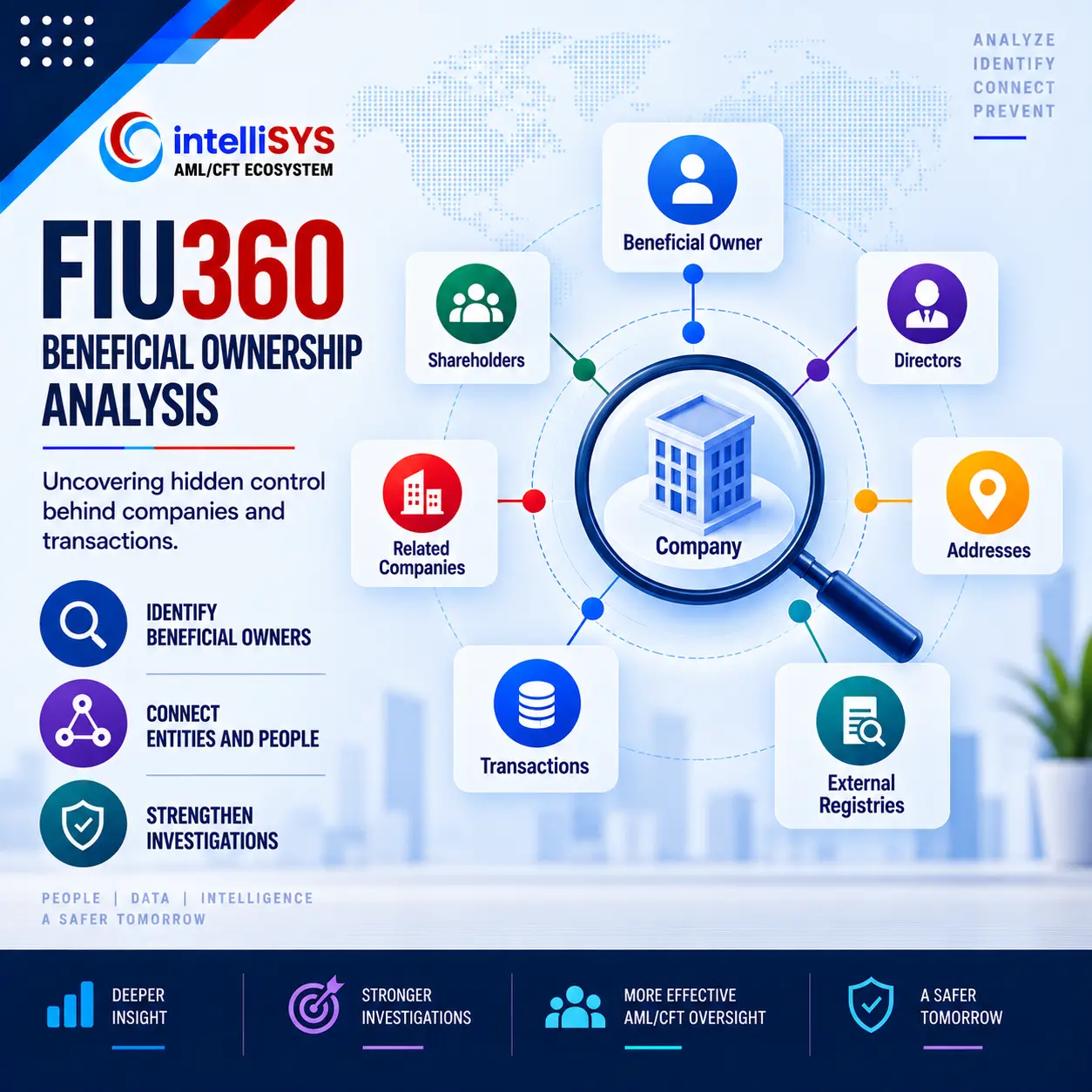
FIU360 allows analysts to connect transaction relationships with company, director, shareholder, and beneficial ownership data.
This changes how the financial activity can be interpreted.
The party named on an account is not always the person who ultimately benefits from the transaction.
Corporate layers, nominees, intermediaries, relatives, or connected entities may separate the formal account holder from the actual beneficiary.
Transaction analysis therefore becomes stronger when combined with ownership analysis.
A flow of funds between apparently independent companies may look very different once the underlying ownership structure is known.
This is where FIU360’s connected intelligence model becomes valuable.
Financial flows and ownership relationships can be examined together rather than as separate analytical exercises.
A transaction record provides financial information.
It may not explain the people or entities involved.
Analysts may need company registry information, identity records, sanctions data, customs information, tax data, criminal intelligence, immigration data, or previous FIU records.
FIU360 National Data Integration helps connect authorized external information to the financial intelligence environment.
Enrichment can change the interpretation of a transaction.
A counterparty may turn out to be connected to another suspicious company, previous case, sanctioned subject, or law enforcement record.
Cross-border transfers are an important area of FIU analysis.
International payments may involve several jurisdictions, banks, currencies, intermediaries, and legal entities.
The risk does not come from international activity itself.
Most international transactions are legitimate.
The analytical question is whether the cross-border behavior is consistent with the subjects, business activities, transaction purposes, and wider intelligence picture.
FIU360 helps analysts organize cross-border transaction information and connect it with subjects, jurisdictions, cases, and enrichment results.
Patterns may emerge across many international transactions.
An FIU may observe repeated movement between the same jurisdictions or through the same intermediaries.
These transaction corridors may be relevant to particular sectors, typologies, criminal networks, or legitimate business activity.
Strategic analysis can help distinguish normal patterns from those requiring attention.
FIU360 allows transaction data to contribute not only to individual investigations but also to broader risk understanding.
Over time, recurring corridors can become useful strategic intelligence indicators.
Location can provide important context.
Transactions may involve jurisdictions, cities, border areas, financial centers, or trade routes that have different risk characteristics.
However, geography should never be treated as proof of suspicious activity.
It is one factor among many.
FIU360 can help analysts combine geographic information with transaction behavior, subjects, reporting sectors, cases, and external intelligence.
This supports more balanced and evidence-based analysis.
Financial activity can occur through different products and channels.
These may include bank transfers, cash deposits, remittances, trade finance, cards, electronic payments, correspondent banking, business accounts, or other services.
Different channels may generate different analytical patterns.
FIU360 can help structure transaction data according to relevant products and channels.
This allows analysts to examine whether particular methods appear repeatedly across suspicious reports or cases.
At strategic level, this can also support understanding of how financial crime methods are changing.
The quality of transaction data submitted by reporting entities directly affects FIU analysis.
Missing account numbers, incomplete counterparties, inconsistent currencies, poor transaction descriptions, or incorrect dates can weaken intelligence.
FIU360 validation and reporting workflows help improve the structure of incoming information.
Better data supports better transaction analysis.
If repeated data-quality problems are identified, the FIU can provide feedback or guidance to the reporting institution.
This creates a connection between analytical needs and reporting quality improvement.
An individual STR provides the reporting institution’s view.
An FIU sees information from many reporting entities.
This creates an important analytical advantage.
One bank may report Account A.
Another institution may report Company B.
A money service business may report Person C.
FIU360 may reveal that Account A transferred funds to Company B and that Person C controls or receives funds from the same company.
The reports become part of one intelligence picture.
Historical intelligence can significantly change the interpretation of current transactions.
A subject may have appeared in an earlier STR.
An account may have been linked to a previous case.
A company may have been included in an earlier dissemination.
A counterparty may appear repeatedly across several years of FIU records.
FIU360 helps preserve this history so analysts can compare new financial activity with earlier intelligence.
Institutional memory becomes part of transaction analysis.
Some accounts become important because of their position within the transaction network.
They may receive money from many parties, distribute funds to multiple beneficiaries, or act as an intermediary between separate groups.
The account balance alone may not reveal this importance.
Network position can.
FIU360 transaction and link analysis can help analysts identify accounts that appear repeatedly across transaction relationships.
These central points may deserve additional analytical attention.
Financial activity may sometimes be broken into smaller transactions.
This may have a legitimate explanation.
It may also warrant review when the pattern appears designed to avoid controls, reporting requirements, or attention.
Analysts need to examine timing, amounts, counterparties, account behavior, customer profiles, and jurisdictional context.
FIU360 helps group and compare related financial activity.
The analyst then determines whether the transaction pattern is relevant and whether further enrichment or case development is justified.
Historical behavior provides context.
An account that normally receives regular domestic business payments may suddenly begin receiving large international transfers.
A customer may move from low transaction activity to rapid, high-value movement across several jurisdictions.
A company may begin interacting with new counterparties outside its apparent business profile.
These changes can be analytically relevant.
FIU360 helps analysts review transaction history alongside current activity and subject information.
This makes behavioral changes easier to identify.
Sanctions exposure may appear inside transaction networks.
A direct participant may match a designated subject.
A counterparty may be owned or controlled by another entity.
Funds may pass through intermediaries before reaching a connected party.
Sanctions Screening in FIU360 connects screening with enrichment, subject relationships, cases, and wider financial intelligence.
This helps analysts assess sanctions-related risk within the full transaction context rather than through name matching alone.
Trade transactions can be particularly complex.
Financial payments need to be compared with the underlying commercial activity.
Analysts may need customs declarations, invoices, company information, goods descriptions, values, counterparties, and shipment information.
A financial transfer may appear reasonable until the trade data is considered.
FIU360 data integration can help connect transaction information with authorized customs or trade-related sources.
This can support analysis of inconsistencies between financial flows and declared trade activity.
Fraud proceeds may move quickly.
Funds can be received into one account and redistributed across several beneficiaries.
Multiple victim payments may converge into the same account.
Different fraud cases may use common intermediaries.
Transaction analysis can help identify these relationships.
FIU360 allows analysts to connect accounts, counterparties, reports, subjects, and cases.
This can reveal a wider network where each individual report initially showed only one part of the activity.
Corruption-related financial flows may involve companies, intermediaries, family members, associates, procurement payments, or asset purchases.
The financial activity may appear legitimate when reviewed without context.
Analysts therefore need to connect transactions with ownership information, subjects, contracts, external records, and historical intelligence where legally authorized.
FIU360 helps bring these pieces together.
This supports deeper review of relationships between money movement and the people or entities involved.
Complex financial activity can be difficult to explain using spreadsheets.
A money-flow diagram may communicate the intelligence more clearly.
It can show which account received funds, how the money was divided, which entities received subsequent transfers, and where funds eventually moved.
FIU360 visualization supports this analytical process.
Visual representations help analysts explore transaction structures and can also improve supervisory review and intelligence dissemination.
The visualization should support the evidence, not replace it.
An FIU receives several STRs from different reporting institutions.
Each report involves a different customer.
At first, there is no obvious relationship.
Transaction analysis shows that all of the customers transfer funds to the same beneficiary account.
FIU360 subject analysis then reveals that the beneficiary is connected to a company appearing in another FIU case.
The analyst can now examine whether the reports form part of one wider network.
A company account receives a large transfer.
Within hours, most of the money is divided among several other accounts.
Those accounts then send funds onward to foreign beneficiaries.
FIU360 helps the analyst reconstruct the transaction sequence, review the connected subjects, and enrich the counterparties.
The analyst can then determine whether there is a legitimate commercial explanation or whether the pattern requires escalation.
The intelligence comes from the sequence, not one individual payment.
Several companies repeatedly transfer funds to each other.
The transaction descriptions suggest ordinary commercial activity.
However, FIU360 subject analysis identifies shared directors and related beneficial owners.
The funds eventually return to an account connected to the original group.
The analyst can visualize the transaction path and corporate relationships together.
This gives the FIU a stronger basis for assessing the activity.
FIU strategic analysis identifies repeated suspicious transactions moving through the same group of jurisdictions.
Different reporting entities and customers are involved, but several counterparties and transaction routes repeatedly appear.
FIU360 helps compare the cases and identify common elements.
The pattern may become a strategic intelligence lead.
This can support reporting guidance, risk assessment, supervisory engagement, or international cooperation.
A new STR identifies unusual transfers from a company account.
FIU360 shows that one of the counterparties appeared in a case several years earlier.
The analyst reviews the historical information and discovers connections to other subjects already known to the FIU.
The current report can now be analyzed with the benefit of institutional history.
A transaction that initially appeared isolated becomes part of a wider intelligence picture.
Important transaction findings need to become part of the case record.
FIU360 can connect relevant transactions with subjects, documents, analyst notes, enrichment results, visualizations, workflow decisions, and supporting evidence.
This gives analysts and supervisors one controlled case environment.
Transaction analysis does not remain in a separate spreadsheet.
It becomes part of the intelligence case.
This supports continuity, review, and auditability.
Complex cases often require review.
A supervisor may need to understand why certain transactions were considered important, which relationships were identified, which sources were used, and how the analyst reached the assessment.
FIU360 helps preserve the supporting data and analytical context.
Visualizations, transaction records, subject links, enrichment results, and analyst notes can be reviewed together.
This strengthens analytical quality assurance.
Law enforcement and other competent authorities need intelligence they can understand and use.
Sending a large transaction spreadsheet may not be enough.
The FIU may need to explain the key transaction sequence, subjects, counterparties, money flows, ownership relationships, and supporting evidence.
FIU360 helps organize this information into a structured intelligence package.
Transaction summaries and visualizations can help recipients understand complex financial activity more quickly.
This strengthens the connection between analysis and operational action.
Transaction analysis has value beyond individual cases.
Across thousands of reports and cases, transaction data can reveal broader patterns.
The FIU may identify:
Recurring corridors.
Repeated counterparties.
Emerging payment channels.
High-risk products.
Common transaction structures.
Sector-specific behaviors.
Changing financial crime methods.
These patterns contribute to strategic intelligence.
FIU360 helps connect operational transaction data with wider trend analysis.
Transaction patterns can also support national risk understanding.
Repeated use of certain products, jurisdictions, company structures, sectors, or transaction channels may indicate vulnerabilities or emerging threats.
FIU transaction data should not be interpreted alone.
It should be combined with reporting behavior, cases, law enforcement information, supervision data, and wider national evidence.
money laundering and terrorist financing risk analysis is central to the FATF risk-based framework.
FIU360 can help provide structured operational evidence for that wider assessment.
FIUs can use transaction intelligence to improve reporting.
If analysts repeatedly identify certain patterns in useful STRs, those patterns may inform typology guidance and reporting entity awareness.
For example, the FIU may identify recurring use of intermediary accounts, unusual transaction sequences, related corporate counterparties, or emerging cross-border behaviors.
Appropriately anonymized strategic findings can be shared with reporting entities.
This helps institutions improve their ability to detect suspicious activity.
The intelligence cycle therefore feeds back into prevention.
Transaction intelligence can also help supervisors understand sector risk.
Patterns may show that particular products, institutions, or channels are repeatedly involved in suspicious activity.
This does not automatically mean that an institution has weak controls.
However, aggregated FIU intelligence can provide useful supervisory indicators.
Supervisors can combine these indicators with their own examinations, risk assessments, and compliance data.
This supports more evidence-based AML/CFT oversight.
Strong analytics depend on strong data.
Incorrect dates, duplicate transactions, inconsistent account identifiers, missing currency information, and incomplete counterparty records can distort analysis.
FIU360 reporting validation, structured data collection, and subject management help strengthen the underlying information.
Data quality should therefore be considered part of analytical capability.
Sophisticated tools cannot compensate for consistently poor source data.
The FIU needs both reliable information and effective analytical processes.
A transaction pattern is an analytical indicator, not proof of criminal activity.
Rapid transfers, international payments, shared counterparties, complex company structures, or high-value transactions may all have legitimate explanations.
Context is essential.
Analysts should consider customer profiles, business models, documentation, ownership, transaction purpose, historical activity, and external intelligence.
FIU360 helps organize the evidence.
Professional analytical judgment determines what the evidence means.
Transaction information is highly sensitive.
FIUs must protect financial records, subjects, account information, cases, and analytical findings.
FIU360 supports role-based security, controlled case access, auditability, and structured workflows.
This helps protect sensitive financial intelligence while allowing authorized analysts to perform their work.
The system should also preserve who accessed information, what actions occurred, and how the intelligence was developed.
Analytical capability and security must advance together.
FIU360 is powerful for transaction analysis because financial movements are not analyzed in isolation.
Transactions can be connected with persons, companies, accounts, beneficial owners, reports, external data, historical intelligence, documents, sanctions information, cases, and visual relationships.
This allows analysts to move from raw financial records to connected intelligence.
The value is not only finding unusual transactions.
It is understanding what those transactions mean within the wider financial intelligence picture.
Effective transaction analysis requires more than analytical software.
FIUs need structured reporting data, good data quality, integration with relevant sources, trained analysts, case workflows, visualization capability, security controls, and clear analytical methodologies.
IntelliSYS supports FIUs through FIU360 configuration, data integration, subject management, visualization, workflow design, migration, training, and operational consulting.
This helps ensure that transaction data becomes useful intelligence rather than another large dataset.
The objective is to help analysts identify relevant patterns faster, understand financial networks more clearly, and produce stronger intelligence products.
Individual transactions rarely tell the whole story.
Financial intelligence comes from connecting transactions with subjects, accounts, companies, counterparties, ownership relationships, jurisdictions, historical records, and external intelligence.
FIU360 helps FIUs build this connected view.
By combining structured transaction data, subject management, data enrichment, network analysis, visualization, case management, historical intelligence, and risk-based analysis, FIU360 helps analysts move from financial records to actionable intelligence.
For FIUs handling growing data volumes and increasingly complex financial networks, transaction analysis should be treated as a core intelligence capability.
Contact IntelliSYS to discuss how FIU360 can support transaction analysis, money-flow visualization, network detection, and financial intelligence modernization.