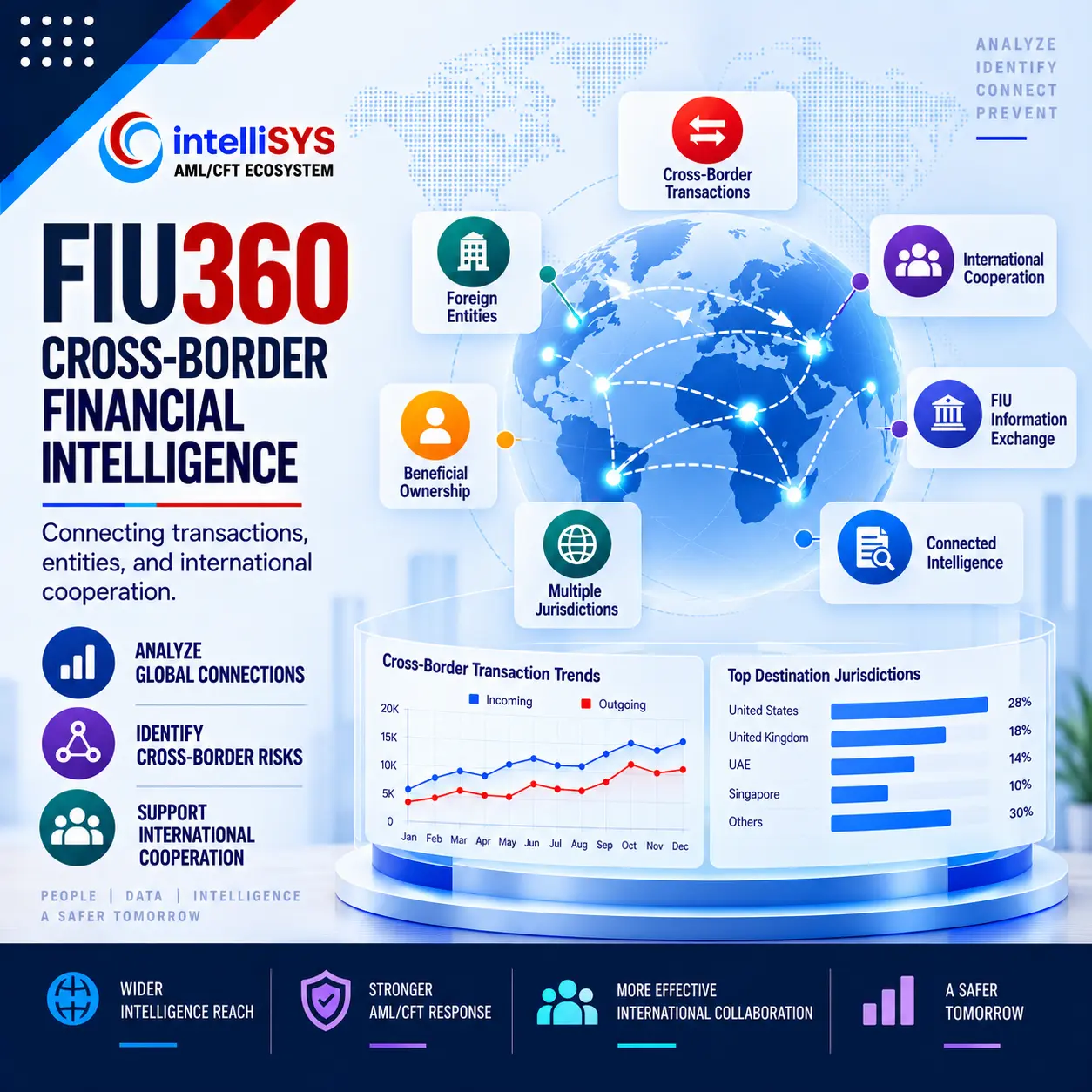
Money laundering networks can use international financial systems to create distance between criminal activity and the proceeds generated from it.
Funds may cross borders several times.
Companies may be registered in different jurisdictions.
Directors, shareholders, and beneficial owners may live in different countries.
Assets may be held outside the jurisdiction where the underlying offence occurred.
This means an FIU cannot always understand suspicious financial activity using domestic information alone.
International cooperation becomes an essential part of the analytical process.
FATF international cooperation standards recognize international cooperation as a fundamental element of an effective AML/CFT framework.
Consider an STR involving a company that sends repeated payments to several foreign beneficiaries.
The domestic reporting institution can identify the customer and its transactions.
But it may not know who controls the receiving companies, whether those counterparties have appeared in foreign FIU intelligence, or whether the funds are linked to investigations in another jurisdiction.
The FIU can examine the activity more broadly.
FIU360 helps connect the domestic STR with related subjects, accounts, entities, historical records, enrichment information, and case intelligence.
If international information later becomes available through authorized cooperation channels, it can become part of the analytical picture.
International transactions contain multiple analytical dimensions.
Analysts may need to examine origin jurisdictions, destination jurisdictions, intermediary institutions, currencies, counterparties, transaction values, timing, payment references, and account relationships.
One international transfer may be entirely legitimate.
A repeated pattern may be more significant.
FIU360 helps analysts connect transaction records and understand how money moves across subjects and jurisdictions.
This provides a foundation for deeper cross-border analysis.
Patterns can emerge when transactions are analyzed over time.
Several subjects may repeatedly send funds through the same jurisdictions.
Different companies may use the same foreign beneficiaries.
Multiple cases may involve the same financial corridor.
These recurring relationships may be relevant to specific typologies, sectors, criminal networks, or legitimate commercial activity.
FIU360 allows analysts to connect operational transaction information with broader strategic analysis.
A corridor that appears repeatedly across separate cases may deserve closer attention.
Financial networks become more complex when several jurisdictions are involved.
Money may move from Country A to Country B, pass through a company in Country C, and eventually reach a beneficiary in Country D.
Each institution or jurisdiction may see only part of the transaction chain.
The FIU needs to reconstruct the wider flow.
FIU360 transaction analysis helps analysts connect transactions, counterparties, accounts, and subjects so that international money flows can be examined as a network rather than as isolated transfers.
Cross-border cases frequently involve legal entities.
A domestic company may transfer funds to a foreign company.
That company may itself be owned by another entity.
Its director may be connected to additional companies or individuals in other jurisdictions.
Understanding these structures requires more than transaction data.
Analysts also need corporate context.
Company registration details, ownership structures, directors, shareholders, addresses, and beneficial owners can all help explain the financial relationship.
International ownership structures can make it difficult to determine who ultimately controls a company.
A corporate chain may span several jurisdictions.
Different registries may record different parts of the ownership structure.
Nominees or intermediary companies may create additional layers.
Beneficial Ownership Analysis in FIU360 helps connect legal entities with persons, shareholders, directors, accounts, addresses, transactions, and related companies.
This becomes especially important when the formal corporate structure crosses borders.
Cross-border analysis also creates data-matching challenges.
The same individual may appear under different spellings or transliterations.
Companies may use abbreviated names.
Addresses can be represented differently.
Identification formats vary between countries.
These differences can make related records appear unrelated.
FIU360 subject data management helps analysts compare identifiers and connect records across reports and intelligence sources.
Good entity resolution can prevent important international relationships from remaining hidden.
A cross-border subject should not be analyzed only through one transaction.
The FIU may have previous reports, related companies, domestic accounts, foreign counterparties, addresses, phone numbers, documents, sanctions indicators, historical cases, and enrichment results.
FIU360 Subject Data Management helps consolidate this information into a connected intelligence profile.
This provides analysts with a stronger foundation before requesting or evaluating foreign information.
Some questions cannot be answered using domestic sources.
An analyst may need to know:
Who owns a foreign company?
Does a person hold accounts in another jurisdiction?
Has the foreign FIU received related suspicious reports?
Is a company already associated with an investigation abroad?
Does the foreign jurisdiction hold additional identity or transaction information?
At this point, FIU-to-FIU cooperation may become important.
The analyst must follow the FIU’s legal authority, cooperation procedures, confidentiality requirements, and applicable international information-exchange mechanisms.
International FIU cooperation allows financial intelligence to extend beyond national boundaries.
The Egmont Group provides a global framework supporting secure information exchange and cooperation among member FIUs.
Requests between FIUs can help analysts obtain information that may not be available domestically.
This can strengthen subject identification, ownership analysis, transaction reconstruction, case development, and understanding of international networks.
FIU360 can help organize the domestic case context and preserve the information relevant to the analytical process.
A foreign FIU needs enough context to understand the request.
A vague request may create delay or produce limited results.
Analysts should provide relevant facts, subjects, identifiers, transaction information, the potential connection to the requested jurisdiction, and the analytical reason for the request, subject to applicable rules.
The Egmont Group Principles for Information Exchange emphasize effective, lawful, protected information exchange between FIUs.
A well-organized FIU case environment can help analysts prepare clearer requests.
Receiving foreign information is only one part of the process.
The analyst must connect the response to the existing intelligence.
A foreign company may link to a domestic subject.
A foreign account may appear in several local STRs.
A director identified by another FIU may already appear in the FIU’s historical records.
A foreign transaction may complete a previously unexplained money-flow sequence.
FIU360 helps analysts incorporate authorized information into the case environment and connect it to relevant subjects, documents, transactions, and analytical findings.
Not every cross-border analytical question requires a formal FIU request.
Some information may already be accessible through authorized domestic or external data sources.
Company registries, sanctions data, customs records, open-source material, and other legally accessible information may provide useful initial context.
FIU360 National Data Integration helps FIUs connect authorized data sources with reports and cases.
This can help analysts determine what information is already known and what still requires international cooperation.
Sanctions-related networks can span several jurisdictions.
A domestic company may transact with a foreign entity that does not directly appear on a sanctions list.
Further analysis may reveal ownership or control links to another person or company.
Intermediaries may also create distance between the transaction and the designated subject.
Sanctions Screening in FIU360 helps analysts connect screening results with ownership, transactions, subject relationships, enrichment, and case intelligence.
Cross-border context can be critical when reviewing indirect exposure.
Trade-based money laundering is inherently international in many cases.
Payments may move between importers and exporters while goods cross borders through separate channels.
Analysts may need to compare financial transactions with invoices, customs declarations, shipment data, company relationships, and ownership information.
A payment may appear commercially reasonable until the broader trade relationship is examined.
FIU360 data integration and transaction analysis can help connect the financial and corporate components of the case.
This supports deeper investigation of cross-border trade patterns.
Fraud schemes can operate internationally.
Victims may be in one jurisdiction while receiving accounts are located in another.
Funds may then move through several intermediaries before being withdrawn or transferred again.
Separate FIUs may each receive reports involving only one part of the network.
International cooperation can help connect these fragments.
FIU360 can support the domestic analysis by linking accounts, subjects, transaction flows, reports, and case history before and after foreign intelligence is obtained.
Corruption proceeds may be moved outside the jurisdiction where the underlying conduct occurred.
Funds may be transferred to foreign companies, property, investment structures, or accounts.
Associates, family members, intermediaries, or corporate vehicles may appear in the transaction chain.
Cross-border financial intelligence can help identify these relationships.
Ownership analysis, transaction reconstruction, enrichment, and FIU cooperation may all contribute to understanding where funds moved and who controls them.
Terrorist financing cases can involve international financial relationships, remittances, intermediaries, charities, businesses, cash movement, or other channels.
Individual transactions may be small and appear ordinary.
Context becomes critical.
FIU analysts may need to connect domestic information with foreign subjects, counterparties, previous cases, and international intelligence.
Cross-border cooperation can help reveal relationships that are not visible through domestic data alone.
Proliferation financing can also involve complex cross-border commercial and financial structures.
Companies, intermediaries, trade routes, ownership arrangements, and transactions may span multiple jurisdictions.
The analytical challenge often involves understanding relationships between legal entities, beneficial owners, transactions, goods, and counterparties.
FIU360’s connected analytical environment can help organize these relationships.
International cooperation may then provide additional context where legally authorized and necessary.
Three domestic banks submit STRs involving unrelated customers.
All three customers transfer funds to the same foreign beneficiary.
FIU360 transaction analysis identifies the repeated counterparty.
Subject analysis shows that one domestic customer is also connected to a company that has previously sent money to the same jurisdiction.
The analyst now has a stronger basis to examine the foreign beneficiary and determine whether international cooperation is appropriate.
What appeared to be three separate STRs becomes one connected intelligence lead.
An FIU receives an STR involving payments to a foreign company.
The domestic customer states that the company is an independent supplier.
Initial research shows limited information about the foreign entity.
Additional authorized information reveals an ownership link between the foreign company and an individual connected to the domestic customer.
The transaction relationship now looks different.
FIU360 helps the analyst connect the corporate relationship with the financial activity and wider case record.
A domestic company receives a large incoming payment.
The money is rapidly divided and transferred to companies in several countries.
Some of those companies then send funds to another common beneficiary.
FIU360 helps reconstruct the transaction sequence and identify the repeated relationships.
Foreign information later adds context about some of the receiving companies.
The analyst can connect the international response with the original transaction network and develop a clearer view of the financial chain.
A new STR involves a foreign counterparty.
FIU360 shows that the same counterparty appeared in an older case several years earlier.
The historical case included information received through international cooperation.
The analyst can now compare the new activity with the previous intelligence.
This preserves institutional memory and helps the FIU identify recurring cross-border relationships.
Several domestic companies appear in different STRs.
The cases initially look unrelated.
Company information reveals that each business is connected to foreign entities sharing the same director.
FIU360 subject and relationship analysis exposes the common link.
The analyst can investigate whether the foreign director is simply a legitimate corporate service provider or whether the pattern has analytical significance.
The important point is that the relationship becomes visible.
International intelligence should not disappear into individual email accounts or disconnected documents.
The FIU needs institutional memory.
Future analysts may need to know whether a subject was previously discussed with another FIU, what information was received, what restrictions applied, and how the information affected the analysis.
FIU360 case and document management can help preserve relevant cooperation records according to the FIU’s legal and security procedures.
This makes previous international work available to authorized users when new cases emerge.
International financial intelligence is highly sensitive.
Information received from another FIU may be subject to restrictions on use, dissemination, retention, or onward sharing.
These conditions must be respected.
The Egmont principles emphasize protection and appropriate use of exchanged information.
FIU360’s security, access controls, workflow management, and auditability can support controlled handling within the FIU environment.
Technology must reinforce cooperation safeguards, not weaken them.
Information exchanged between FIUs cannot simply be treated as unrestricted domestic data.
Depending on the applicable framework, prior consent may be required before information is disseminated to another authority or used for another purpose.
Analysts and supervisors need to understand these restrictions.
Case records should clearly preserve the provenance and handling conditions of international intelligence.
This protects both the providing FIU and the receiving FIU.
It also supports trust between international partners.
Sensitive international cooperation should be traceable.
The FIU should be able to understand who accessed the information, where it was used, what actions followed, and whether it was included in subsequent analytical products.
FIU360 supports structured workflows and auditability around intelligence handling.
This is particularly important where information has additional confidentiality restrictions.
Strong international cooperation depends on strong inform
Cross-border intelligence may eventually support dissemination to domestic law enforcement or another competent authority.
The FIU needs to distinguish between its own information and intelligence received from foreign partners.
Relevant restrictions and permissions must be respected.
Structured case management helps analysts and supervisors prepare dissemination packages that reflect these conditions.
The intelligence product should remain clear, useful, secure, and compliant with applicable information-sharing requirements.
Cross-border cases can generate large amounts of material.
There may be domestic STRs, foreign responses, company records, transaction data, diagrams, supporting documents, analyst notes, follow-up requests, and correspondence.
FIU360 case management helps organize these elements in one controlled environment.
This gives analysts and supervisors a clearer view of the case.
It also reduces the risk that critical international information becomes separated from the analysis it supports.
International cases can quickly become difficult to understand.
A network may contain people, companies, accounts, jurisdictions, transactions, addresses, directors, and beneficial owners across several countries.
Visualization helps simplify this complexity.
FIU360 can support relationship and money-flow visualization so analysts can see how domestic and foreign elements connect.
A well-designed network diagram can also help supervisors and competent authorities understand the intelligence more quickly.
International cooperation is not useful only for individual cases.
Patterns across multiple cross-border cases can support strategic intelligence.
FIUs may identify recurring jurisdictions, transaction corridors, company structures, intermediary types, foreign counterparties, or criminal typologies.
These patterns can improve understanding of national exposure to international financial crime.
They may also support typology development, reporting entity guidance, supervisory priorities, and National Risk Assessment.
Operational cooperation can therefore generate strategic value.
Cross-border exposure is an important part of national AML/CFT risk understanding.
A jurisdiction may have particular exposure through trade, remittances, financial centers, neighboring countries, offshore structures, or international payment corridors.
FIU data can help identify how these risks appear in real financial intelligence.
FIU360 and National Risk Assessment connects reports, cases, transactions, subjects, sectors, and intelligence outcomes with broader risk analysis.
Cross-border intelligence can add an important international dimension to that evidence.
International case patterns can also help reporting entities.
If the FIU repeatedly observes specific transaction corridors, corporate structures, intermediary arrangements, or cross-border typologies, appropriately anonymized findings can support guidance.
Banks and other reporting entities may then improve their understanding of relevant risk indicators.
This strengthens detection before information reaches the FIU.
The intelligence cycle moves from reporting to analysis and back into prevention.
Supervisors may benefit from aggregated cross-border intelligence.
Repeated exposure to particular products, jurisdictions, customer types, or transaction structures may indicate areas requiring additional supervisory attention.
FIU intelligence does not replace supervisory analysis.
However, it can provide important evidence.
FIU360 helps structure operational data so relevant trends can be identified and communicated appropriately.
This supports a more connected national AML/CFT framework.
International cooperation is not simply a procedural requirement.
It affects whether countries can follow financial activity beyond their own borders.
FATF standards recognize the importance of effective cooperation between competent authorities.
The FATF, Egmont Group, INTERPOL and UNODC international cooperation handbook provides practical guidance aimed at strengthening cooperation in money-laundering detection, investigation, and prosecution.
For FIUs, effective information exchange can directly improve analytical reach.
International cooperation is valuable, but it should be purposeful.
An FIU should not request foreign information simply because a transaction crossed a border.
Analysts should first understand what is already known, why the foreign information is relevant, and how it could affect the analysis.
Domestic enrichment, previous intelligence, transaction analysis, and subject management may answer part of the question.
A focused request is more useful than a broad fishing exercise.
FIU360 helps analysts organize the known facts before deciding what additional information is needed.
FIU360 is valuable for cross-border intelligence because it connects the different parts of the analytical problem.
Transactions can be linked to persons.
Persons can be linked to companies.
Companies can be connected to ownership structures.
Accounts can be connected across reports.
Foreign information can be related to existing case intelligence.
Historical records can reveal previous international relationships.
Visualization can then help analysts understand how the entire network fits together.
The result is a more connected view of cross-border financial activity.
Effective international financial intelligence requires more than communication between FIUs.
It requires strong domestic analytical capability, structured case management, good subject data, transaction analysis, integration, information security, clear workflows, and trained analysts.
IntelliSYS supports FIUs through FIU360 configuration, subject management, transaction analysis, data integration, visualization, case management, security design, training, and operational consulting.
This helps FIUs prepare, organize, analyze, and protect the intelligence needed for complex cross-border cases.
The objective is not to replace international cooperation mechanisms.
It is to strengthen the FIU environment in which international intelligence is requested, analyzed, connected, governed, and used.
A domestic suspicious transaction report may represent only one part of an international financial network.
To understand the wider picture, FIUs need to connect transactions, subjects, foreign companies, beneficial ownership, accounts, historical intelligence, domestic enrichment, and information obtained through authorized international cooperation.
FIU360 helps bring these components together.
By supporting transaction analysis, subject management, ownership analysis, enrichment, case management, visualization, auditability, and secure intelligence handling, FIU360 helps analysts understand cross-border activity more clearly.
For FIUs confronting international money laundering, corruption, fraud, sanctions evasion, terrorist financing, proliferation financing, or other transnational financial crime, connected cross-border analysis should be treated as a core financial intelligence capability.
Contact IntelliSYS to discuss how FIU360 can support cross-border transaction analysis, international case management, financial intelligence integration, and FIU modernization.