Legal entities are used throughout legitimate business activity.
But they can also be misused to conceal criminal proceeds or distance individuals from assets and transactions.
A company may appear legitimate while the true controller remains hidden behind other companies, nominees, relatives, professional intermediaries, or foreign entities.
This creates a major challenge for FIU analysts.
A suspicious transaction involving a company cannot always be understood by reviewing the company record alone.
Analysts need to examine ownership, control, relationships, transaction flows, and associated subjects.
Beneficial ownership analysis helps reveal the person behind the structure.
The shareholder listed in a registry may not always be the individual exercising actual control.
A company may be owned by another company.
That company may itself be owned by another entity in a different jurisdiction.
Directors may act on behalf of someone else. Shares may be held through nominees. Family members or associates may appear as formal owners while another person exercises control.
For FIU analysts, this means legal ownership is only one layer of the analysis.
The broader objective is to understand who ultimately benefits from or controls the structure.
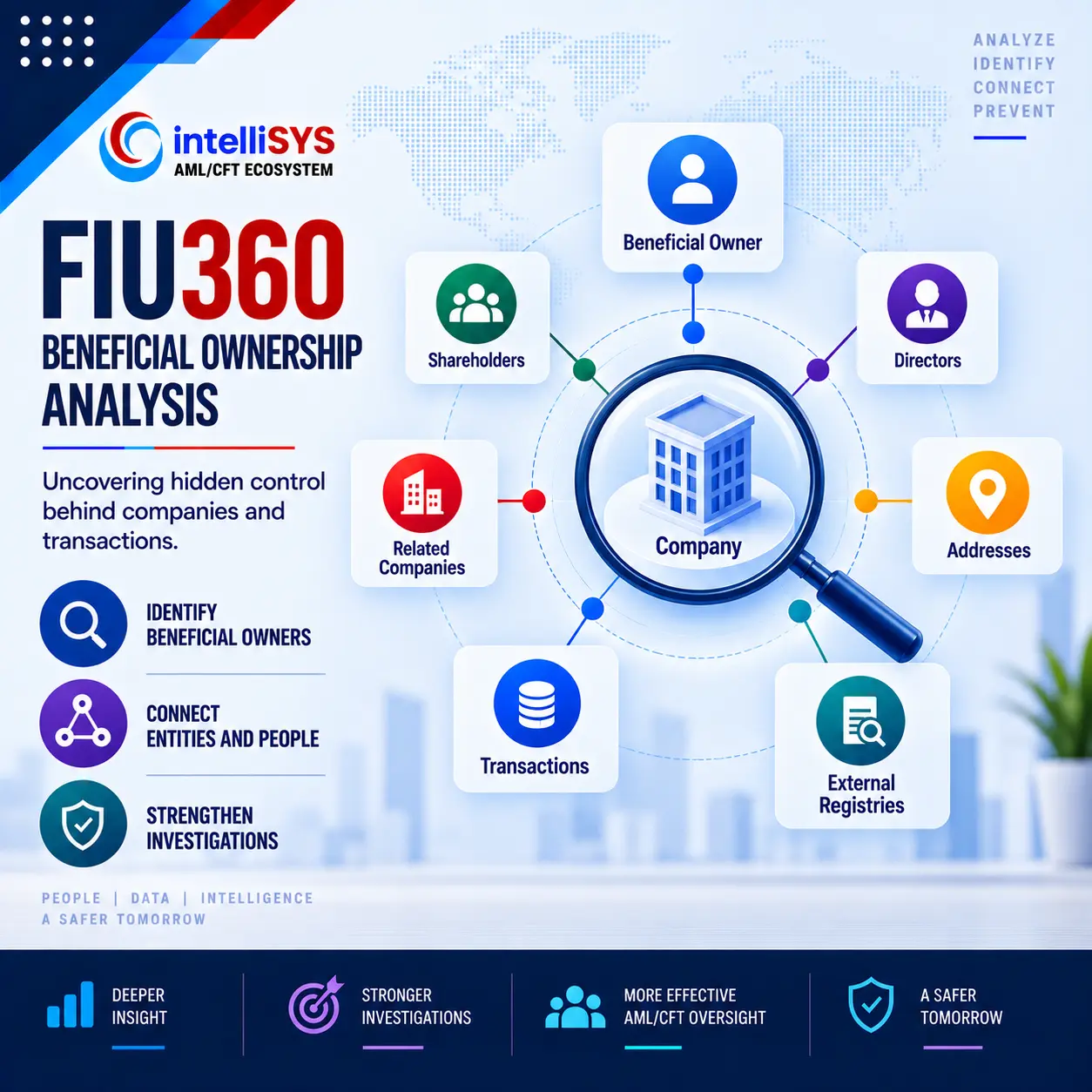
FIU360 helps analysts connect multiple layers of information rather than viewing each company separately.
Company registry information is one of the most important sources for ownership analysis.
It may contain registration numbers, shareholders, directors, registered addresses, incorporation dates, company status, related entities, and other corporate information.
FIU360 can support integration with authorized company registries so analysts can bring this information into the intelligence environment.
This makes it easier to compare corporate records with STR data, transactions, previous cases, sanctions information, and other sources.
Registry data becomes more valuable when it is connected to the wider intelligence picture.
Complex ownership structures are difficult to understand through tables alone.
A company may have several shareholders. One shareholder may be another company. That company may have different directors. Some of those directors may appear in additional entities.
FIU360 visualization can help analysts turn these relationships into a network.
A visual ownership map can show companies, shareholders, directors, beneficial owners, addresses, transactions, and related accounts.
This can make hidden structures easier to understand.
Instead of reading dozens of records separately, the analyst can see how the corporate network fits together.
Nominee arrangements may be legitimate in some circumstances, but they can also be used to hide real control.
An FIU analyst may notice that the same person serves as director or shareholder for many unrelated companies.
That pattern may require closer review.
FIU360 subject data management can help identify repeated directors, shareholders, addresses, phone numbers, and other identifiers across multiple entities.
This does not automatically prove wrongdoing.
But it provides a useful analytical lead.
The analyst can then review whether the relationship is consistent with legitimate business activity or whether it may indicate a concealed ownership structure.
Addresses can reveal important relationships.
Several companies may use the same registered address. A director may share an address with another shareholder. Multiple legal entities may operate from a location connected to a professional intermediary.
These connections may not appear suspicious individually.
But when combined with transaction patterns and ownership records, they can become significant.
FIU360 helps analysts identify shared addresses across subject records.
This can support deeper review of corporate networks and possible nominee arrangements.
Beneficial ownership analysis should not stop at corporate records.
The FIU also needs to understand how the entities move money.
A company may be formally owned by one person but consistently send funds to another individual or related company.
A shareholder may receive transfers unrelated to declared business activity.
Multiple companies may transfer money between themselves before funds reach a final beneficiary.
FIU360 helps connect ownership relationships with financial transactions.
This allows analysts to examine whether the movement of funds supports or contradicts the formal ownership structure.
Layered ownership structures can be combined with layered transaction flows.
Funds may move through several companies, accounts, or jurisdictions before reaching the actual beneficiary.
The corporate structure and transaction structure may be designed together.
FIU360 supports money-flow visualization and relationship analysis so analysts can examine both.
For example, an analyst may identify that Company A is owned by Company B, which is controlled by an individual who also receives payments from Company C.
When ownership and transaction relationships are analyzed together, hidden control can become easier to detect.
Ownership analysis often requires information beyond the original STR.
The analyst may need company registries, population records, tax information, sanctions data, customs records, law enforcement intelligence, or open-source information.
FIU360 data enrichment can help connect authorized external data to company and person profiles.
This gives analysts additional context.
For example, a shareholder may also appear as a director of another suspicious company. A registered address may connect several entities. A beneficial owner may appear in previous intelligence records.
Enrichment helps transform a company record into a broader intelligence profile.
Sanctions risk may be hidden behind ownership structures.
A company may not appear directly on a sanctions list.
However, its beneficial owner, controlling shareholder, director, or related entity may be associated with a designated subject.
This makes ownership analysis critical for sanctions intelligence.
FIU360 helps analysts connect sanctions alerts with company structures, persons, transactions, and related entities.
This allows the FIU to examine indirect exposure rather than relying only on direct name matching.
Corruption cases often involve the concealment of ownership or assets.
Public officials or politically exposed persons may use family members, associates, companies, or nominees to distance themselves from financial activity.
A legal entity may hold property, receive contracts, or process payments while the true controller remains hidden.
FIU360 can help analysts compare ownership data with persons, transactions, addresses, documents, and historical intelligence.
This supports analysis of possible conflicts of interest, unexplained wealth, procurement-related activity, or concealed asset ownership.
Beneficial ownership analysis can therefore be important in corruption-related financial intelligence.
Fraud schemes frequently involve multiple companies.
Some may be created specifically to receive payments, issue invoices, move funds, or conceal the final beneficiary.
Different companies may appear unrelated until shared directors, addresses, accounts, or transaction counterparties are identified.
FIU360 helps analysts connect these relationships.
A network view may reveal that several companies are controlled by the same small group of individuals.
This can help the FIU identify a wider fraud structure rather than treating each company as an isolated subject.
Trade-based money laundering may involve complex corporate relationships.
Importers, exporters, freight companies, intermediaries, and related businesses may appear across multiple jurisdictions.
Ownership relationships can help analysts determine whether supposedly independent trading parties are actually connected.
FIU360 integration with company and customs data can support this analysis.
For example, two companies on opposite sides of a trade transaction may share a beneficial owner or director.
That relationship may change the risk assessment of the transaction.
International corporate structures can make beneficial ownership analysis more difficult.
Companies may be registered in several jurisdictions.
Ownership information may be incomplete or structured differently across registries.
Different languages, identifiers, legal forms, and naming conventions can create additional complexity.
FIU360 helps analysts organize available information into connected subject profiles.
Where information can be obtained lawfully from foreign counterparts or other authorized sources, it can be linked to the wider case.
This supports cross-border ownership analysis and international cooperation.
Ownership data often contains inconsistencies.
The same person may appear under different spellings. Company names may be abbreviated. Addresses may use different formats. Identification numbers may be missing from some sources.
Entity resolution helps determine whether different records refer to the same subject.
FIU360 supports the analytical process of comparing identifiers across reports, registries, and external sources.
Better entity resolution reduces the risk that related ownership records remain separated.
This is especially important in complex corporate networks.
Ownership structures change.
Directors resign. Shares are transferred. Companies change names. Registered addresses move. New entities are created.
Historical intelligence can therefore be important.
A company that appears unrelated today may have shared directors or owners with another entity several years earlier.
FIU360 helps preserve historical subject and case information so analysts can review previous relationships.
This can reveal links that current registry records alone may not show.
Different reporting entities may submit STRs involving different companies.
At first, the reports may appear unrelated.
FIU360 may reveal that the companies share directors, beneficial owners, addresses, accounts, or transaction counterparties.
This creates a broader intelligence picture.
The FIU can then analyze the reports as a network rather than as isolated submissions.
This is one of the major advantages of centralized financial intelligence analysis.
Individual reporting entities see their customers.
The FIU can see the wider network.
An FIU receives an STR involving unusual transfers through a recently created company.
Company registry enrichment reveals that the company’s director is also a director of six other entities.
Several of those companies share the same address.
FIU360 visualization shows that the companies transfer funds between each other before sending money abroad.
The analyst also identifies a common individual connected to several of the accounts.
What initially appeared to be one suspicious company now appears to be a wider corporate network.
A bank reports activity involving a company that does not match any sanctions list.
FIU360 enrichment reveals that the company is partly owned by another legal entity.
Further ownership analysis identifies an individual connected to that entity who is associated with a designated subject.
The analyst maps the ownership structure and transaction relationships.
The case is escalated for deeper review.
This demonstrates why sanctions analysis should examine ownership relationships, not only direct company names.
An STR involves large payments to a private company.
The company’s formal shareholder is not a politically exposed person.
However, FIU360 subject analysis identifies links between the shareholder, a family member of a PEP, and another company receiving related transactions.
The analyst reviews corporate data, transaction history, addresses, and supporting documents.
The broader relationship may justify enhanced analysis.
The value comes from seeing the full network rather than one shareholder record.
Two companies appear as buyer and seller in international trade transactions.
On paper, they appear independent.
Company data shows that both have directors linked to the same beneficial owner.
Transaction analysis also shows repeated payments between related accounts.
The FIU can now review whether the commercial relationship is genuine or whether the structure may be used to move funds between connected parties.
Ownership intelligence changes the analytical context.
Complex ownership analysis generates many supporting records.
Analysts may need company documents, registry extracts, transaction histories, diagrams, notes, external-source responses, and subject records.
FIU360 case management helps organize this information in one controlled environment.
The ownership analysis can remain connected to the related case, documents, subjects, visualizations, and workflow decisions.
This improves continuity and supervisory review.
Ownership relationships can be difficult to explain in narrative form.
A law enforcement agency may need to understand several companies, shareholders, directors, accounts, and transactions quickly.
FIU360 visualization can help create clearer intelligence packages.
A corporate relationship diagram may show who owns what, how companies connect, and how funds move through the network.
This can improve the practical usefulness of FIU dissemination.
The recipient receives not only a conclusion, but also a structured explanation of the ownership network.
Beneficial ownership data also has strategic value.
Across many cases, the FIU may identify recurring patterns.
These could include repeated use of nominee directors, certain corporate structures, common professional intermediaries, specific jurisdictions, or recurring types of shell companies.
FIU360 can help preserve and analyze these patterns.
This can support typology development, reporting entity guidance, supervision, National Risk Assessment, and policy development.
Ownership intelligence therefore supports both operational and strategic FIU work.
Reporting entities may need guidance on beneficial ownership red flags.
FIU intelligence can help identify practical indicators seen in real cases.
These might include complex structures without clear commercial purpose, frequent ownership changes, common directors across unrelated entities, unusual payments to shareholders, or companies sharing addresses with multiple unrelated businesses.
FIU360 strategic analysis can help identify such recurring patterns.
The FIU can then use anonymized insights to improve reporting entity awareness.
This helps strengthen detection before reports reach the FIU.
Supervisors may also benefit from beneficial ownership intelligence.
Repeated weaknesses in how institutions identify or verify company ownership may indicate compliance gaps.
FIU reporting and case data can help identify these patterns.
FIU360 can provide aggregated intelligence that supports risk-based supervisory attention.
This helps connect FIU findings with preventive AML/CFT controls across the reporting sector.
Beneficial ownership weaknesses can create national AML/CFT vulnerabilities.
If FIU cases repeatedly involve opaque legal structures, nominee arrangements, shell companies, or hidden foreign ownership, these trends may be relevant to the National Risk Assessment.
FIU360 helps organize the underlying case and subject data.
Strategic analysts can identify recurring corporate patterns and assess their significance.
This provides an evidence-based contribution to national risk understanding.
Ownership information can be sensitive.
FIUs must ensure that registry data, personal identifiers, financial records, and related intelligence are accessed and used according to legal authority and institutional rules.
FIU360 supports role-based access, security controls, auditability, and case-level restrictions.
This helps ensure that beneficial ownership analysis remains controlled and traceable.
Strong analytical capability must always be matched by strong governance.
A complex corporate structure is not automatically criminal.
Multiple companies, foreign ownership, nominee services, shared addresses, or layered structures may have legitimate commercial explanations.
FIU analysts must assess the full context.
FIU360 helps organize relationships and evidence, but the system does not replace analyst judgment.
The purpose of beneficial ownership analysis is to identify relationships that require explanation.
Analysts must then determine whether those relationships are relevant to the financial intelligence question.
FIU360 is powerful for beneficial ownership analysis because it connects corporate information with the wider financial intelligence environment.
Company records, persons, shareholders, directors, accounts, transactions, addresses, sanctions indicators, documents, historical reports, enrichment results, and cases can be analyzed together.
This helps analysts move beyond simple company searches.
They can build a wider intelligence picture of ownership, control, and financial relationships.
For modern FIUs, this is essential for investigating complex financial crime structures.
Effective beneficial ownership analysis requires technology, data integration, analytical methodology, and trained users.
The FIU must define relevant data sources, identifiers, matching procedures, visualization needs, case workflows, security controls, and information-sharing arrangements.
IntelliSYS supports FIUs through FIU360 configuration, company-registry integration, subject data management, enrichment, visualization, workflow design, training, and operational consulting.
This helps turn fragmented corporate information into usable financial intelligence.
The objective is to help analysts identify hidden control faster and understand complex corporate networks more clearly.
A company record is only part of the intelligence picture.
To understand financial crime risk, FIUs often need to identify the persons behind the company, the entities around it, the accounts connected to it, and the transactions flowing through it.
FIU360 helps analysts build that wider view.
By connecting company registries, subject data, ownership relationships, transactions, enrichment sources, visualization, sanctions information, case management, and historical intelligence, FIU360 supports deeper beneficial ownership analysis.
For FIUs investigating shell companies, corruption, sanctions evasion, fraud, trade-based money laundering, or complex corporate networks, beneficial ownership analysis should be treated as a core financial intelligence capability.
Contact IntelliSYS to discuss how FIU360 can support beneficial ownership analysis, corporate network mapping, and hidden-control detection in your FIU environment.