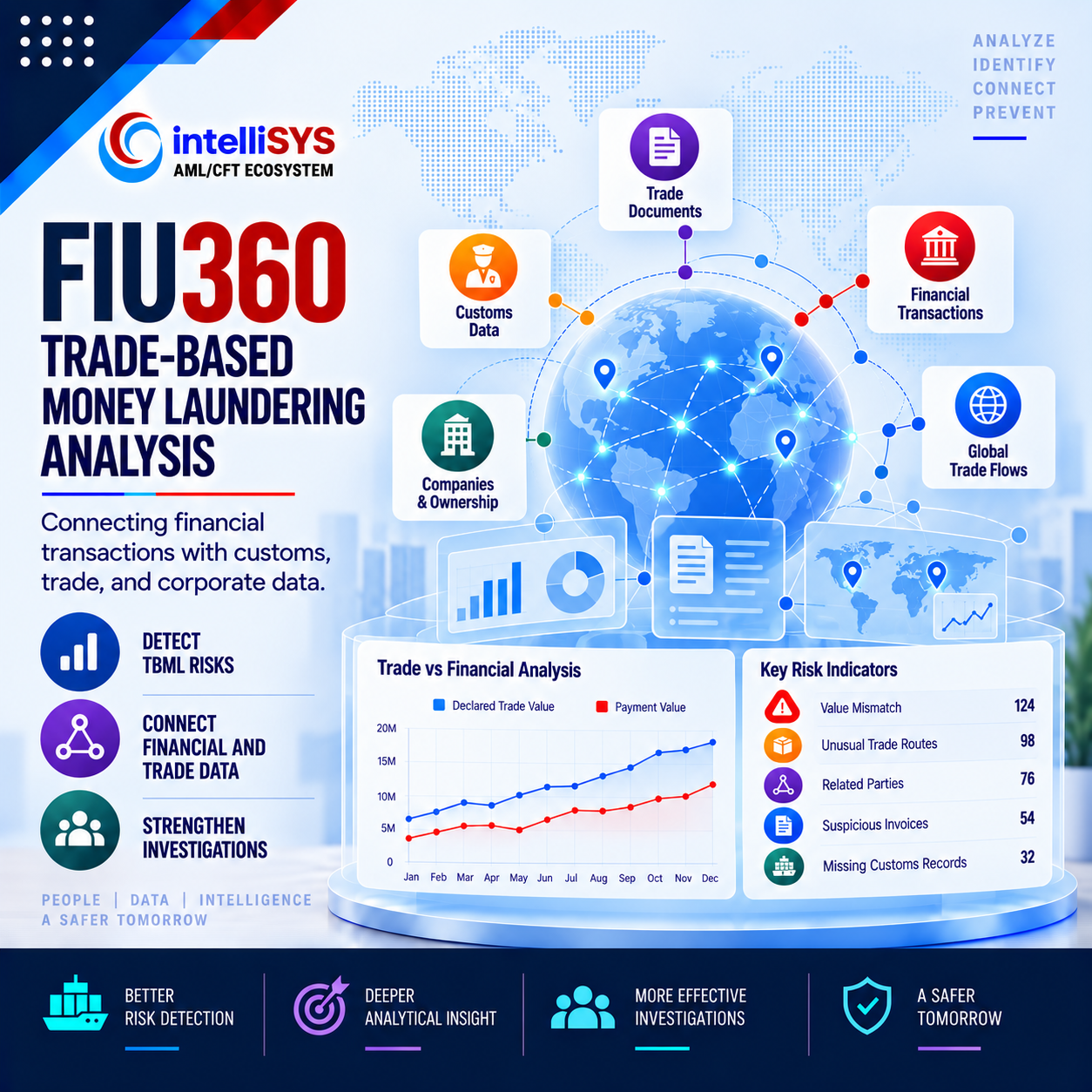
International trade is large, complex, and legitimate.
Millions of commercial transactions occur every day across different industries, currencies, products, ports, jurisdictions, and financial institutions.
This creates an environment where suspicious activity can be difficult to separate from ordinary business.
Trade-based money laundering may involve manipulating the price, quantity, quality, description, or movement of goods to transfer value or disguise criminal proceeds.
The FATF Trade-Based Money Laundering report describes how international trade can be exploited to disguise proceeds and move value through trade transactions.
For FIUs, the analytical challenge is therefore not simply identifying international payments.
It is understanding whether the financial and commercial activity make sense together.
Consider a company sending $500,000 to a foreign supplier.
The payment amount itself may not appear unusual.
But several additional questions matter.
What goods were purchased?
What quantity was declared?
What was the unit price?
What was the market value?
Did customs records show the goods entering the country?
Does the supplier exist?
Are the buyer and seller related?
Does the transaction make sense for the company’s normal business?
Transaction analysis becomes much stronger when these questions can be answered using connected data.
Customs information can provide essential context for trade-related financial activity.
It may include import and export declarations, goods descriptions, declared values, quantities, origins, destinations, shipping details, and trading counterparties.
FIU360 National Data Integration can support connections with authorized customs and other government data sources.
This helps analysts compare the financial side of a transaction with the declared movement of goods.
A mismatch does not automatically indicate money laundering.
But it may identify activity requiring closer examination.
One of the central TBML analytical questions is whether the financial value matches the commercial activity.
A company may pay significantly more for goods than their apparent value.
It may receive substantially less than expected.
Export values may not match incoming foreign payments.
Import values may not correspond with outgoing transfers.
The FATF and Egmont Group TBML Risk Indicators identify discrepancies between trade documents, commodity values, import/export figures, and financial transfers as potentially relevant indicators.
FIU360 can help analysts connect these data points inside the wider intelligence environment.
Over-invoicing occurs when goods or services are invoiced at a value higher than their actual or reasonable commercial value.
For example, goods worth $100,000 may be invoiced at $300,000.
If the buyer pays the full invoice amount, additional value may effectively be transferred to the seller.
From a purely banking perspective, the transaction may appear to correspond with an invoice.
The anomaly becomes clearer only when analysts compare the invoice, goods, market information, company profiles, and transaction history.
FIU360 helps organize these different elements for analytical review.
Under-invoicing works in the opposite direction.
Goods may be shipped with a declared value significantly below their actual value.
The difference can represent value transferred outside the formal financial transaction.
This can be difficult to detect if financial and customs data remain in separate systems.
Analysts need to compare declared trade values with financial flows and wider commercial information.
FIU360 data integration can help bring these records into a connected case environment.
This allows analysts to examine discrepancies more systematically.
The same shipment or commercial activity may sometimes be supported by multiple invoices or payment requests.
This can create opportunities to justify repeated payments for the same underlying goods.
Detecting this may require comparing invoice numbers, dates, counterparties, values, shipment records, and bank transactions.
Document analysis and transaction history become especially important.
FIU360 case and document management can help analysts organize relevant invoices and supporting records around the related transaction activity.
Repeated or duplicated commercial documentation can then be examined within the broader case context.
Trade documents may describe goods inaccurately.
The declared goods may differ from what was actually shipped.
Descriptions may be vague, inconsistent, or unusually generic.
The FATF/Egmont risk indicators include discrepancies between invoices, contracts, customs information, actual commodities, and their descriptions as potentially relevant TBML indicators.
Analysts therefore need to compare documentation with other available information.
FIU360 helps organize documents, company data, transaction records, and authorized customs information inside the analytical workflow.
This makes inconsistencies easier to identify.
The declared quantity of goods can also affect the value transferred through trade.
A company may report a larger or smaller quantity than was actually shipped.
If the FIU only sees the payment, this difference may remain invisible.
Customs or shipment data can provide important context.
Analysts can compare transaction values with declared quantities and other records.
The objective is not to assume that every discrepancy is suspicious.
Commercial errors occur.
But material or repeated inconsistencies may justify further analysis.
Some trade transactions may involve documentation for goods that were never actually shipped.
Payments may nevertheless be made as though a legitimate commercial transaction occurred.
This type of activity is difficult to identify without access to multiple sources.
Analysts may need payment records, invoices, customs declarations, shipping information, company data, and potentially external intelligence.
FIU360 helps analysts connect available records to determine whether the commercial and financial information tell a consistent story.
Trade-based analysis is also corporate analysis.
The importer and exporter should be understood as subjects, not simply names on an invoice.
Analysts may need to examine company registration, directors, shareholders, beneficial owners, addresses, business activity, formation dates, related entities, and historical FIU intelligence.
A company claiming to trade industrial equipment may require additional review if corporate records suggest that its actual business activity is unrelated.
FIU360 helps connect corporate intelligence with transaction and customs information.
This strengthens the analytical picture.
Two companies may appear to be independent trading partners.
Ownership analysis may reveal something different.
The importer and exporter may share the same beneficial owner.
Their directors may be related.
They may use the same address.
They may belong to a wider corporate network.
Beneficial Ownership Analysis in FIU360 helps analysts connect companies with shareholders, directors, persons, addresses, accounts, and transactions.
These relationships may significantly change how a trade transaction is assessed.
Company age can provide useful context.
A recently incorporated company may suddenly begin processing high-value international trade.
That may be entirely legitimate.
However, when combined with other unusual characteristics, the pattern may deserve closer review.
FATF/Egmont TBML indicators identify newly formed or recently reactivated businesses conducting unusually high-volume or high-value trade as one potential risk indicator.
FIU360 can help analysts connect company history with transactions, ownership, previous reports, and trade data.
Context determines whether the activity has analytical significance.
The nature of the company’s business matters.
A company registered as a local consultancy may suddenly import agricultural equipment.
A car dealer may begin exporting clothing.
A business may trade commodities that appear unrelated to its stated commercial activity.
Such activity may have a legitimate explanation.
But it can also be analytically relevant.
FIU360 allows analysts to connect company profiles, transaction history, trade records, and external data so these inconsistencies can be reviewed in context.
Goods do not always move directly between buyer and seller.
Transshipment, logistics hubs, free zones, and intermediary countries are normal parts of global trade.
However, unusually complex routes without a clear commercial explanation may require additional analysis.
Goods may move through several jurisdictions while payments follow a different route.
Companies may use intermediaries in countries that have no obvious connection to the trade.
FIU360 can help analysts map jurisdictions, entities, transactions, and related records.
This allows the complete route to be examined instead of looking only at the final payment.
One of the most important TBML analytical concepts is comparing two flows.
The flow of goods.
And the flow of money.
These two flows should generally have a reasonable commercial relationship.
If one shipment generates multiple unexplained payments, or substantial payments appear without corresponding trade activity, the discrepancy may be relevant.
FIU360 transaction analysis can help reconstruct the financial flow while integrated customs and trade information provides the commercial context.
The analyst can then examine where the two flows diverge.
Trade-based money laundering is still financial intelligence.
Payments must be examined carefully.
Analysts may identify unusual transaction sequences, rapid pass-through activity, repeated counterparties, unexpected jurisdictions, third-party payments, or values inconsistent with the company’s profile.
FIU360 Transaction Analysis helps connect accounts, counterparties, companies, subjects, and historical activity.
This allows trade-related payments to be analyzed as part of a wider financial network.
Trade transactions may sometimes involve payments from or to parties that are not clearly connected to the underlying contract.
There may be legitimate reasons for these arrangements.
But unexplained third-party involvement can complicate the commercial picture.
The analyst needs to understand why one company is buying the goods while another entity makes the payment.
FIU360 can help identify relationships between the parties through company information, beneficial ownership, previous intelligence, accounts, addresses, and other connected records.
This helps determine whether the third-party relationship is commercially reasonable.
The payment method may also provide context.
Trade finance instruments, wire transfers, cash activity, third-party funding, or combinations of different payment mechanisms may be used in legitimate commerce.
However, unusually complex arrangements without clear commercial purpose can require further analysis.
FATF/Egmont TBML indicators include unconventional or unnecessarily complex use of financial products among potential risk indicators.
The FIU must assess these patterns together with the business profile, documentation, counterparties, and transaction history.
No single payment method proves suspicious activity.
Invoices, contracts, bills of lading, customs declarations, purchase orders, shipping records, certificates, and other documents may all provide analytical evidence.
Reviewing these files individually can become difficult in complex cases.
FIU360 document management helps analysts organize relevant documents around the case and related subjects.
Documents can then be reviewed alongside transactions and other intelligence.
This is important because inconsistencies often appear only when several records are compared.
The document should not be treated separately from the financial activity it supports.
TBML analysis depends heavily on the quality of incoming data.
Incomplete company identifiers, missing transaction details, vague goods descriptions, inconsistent currencies, inaccurate dates, and poorly structured reports make analysis more difficult.
STR Data Quality and Validation in FIU360 helps explain why stronger reporting data improves downstream entity resolution, transaction analysis, and financial intelligence.
Good TBML analysis therefore begins before the analytical stage.
It begins with reliable source information.
Customs authorities and FIUs often hold different parts of the same intelligence picture.
The FIU sees financial reports and transactions.
Customs may see declarations, goods, values, routes, traders, and border activity.
These perspectives can complement each other.
FATF/Egmont research emphasizes the importance of financial and trade data sharing in addressing TBML risks.
Where legally permitted, stronger cooperation can help authorities identify inconsistencies that neither institution would see alone.
FIU360 data integration can support the technical side of authorized information access and analytical use.
Tax information can provide additional context.
A company may report large import or export activity while its declared revenue, business size, or economic profile appears inconsistent.
This does not by itself prove wrongdoing.
But it may raise questions requiring further analysis.
Where legally authorized, FIU360 can support connections between financial intelligence and tax-related information.
This helps analysts understand whether the reported trade activity aligns with the company’s broader economic profile.
Company registry information can help verify whether the parties involved in trade exist and what they appear to do.
Analysts may examine incorporation dates, business activity, directors, shareholders, addresses, legal status, and related entities.
A company may have changed ownership shortly before suspicious activity began.
Several traders may share the same director.
A recently created company may immediately process unusually large transactions.
FIU360 can link company records with transaction and case information.
These relationships give analysts stronger context.
Public information may also support trade analysis.
Company websites, product information, public shipping records, procurement information, market pricing, court records, adverse media, and other sources may provide useful context where their use is lawful and appropriate.
Open-source information should be evaluated carefully.
Its reliability may vary.
FIU360 can help analysts incorporate relevant findings into the case alongside more authoritative sources.
Technology organizes the information, but analysts must judge its evidentiary and intelligence value.
Trade is inherently international.
Important information may therefore exist in another jurisdiction.
A foreign company may be linked to a counterpart FIU’s intelligence.
An exporter may have appeared in previous investigations abroad.
The beneficial owner may live in another country.
Cross-Border Financial Intelligence in FIU360 helps explain how domestic financial intelligence can be strengthened by authorized international cooperation.
Cross-border context can be critical in complex trade networks.
TBML cases can generate large amounts of information.
Transactions.
Invoices.
Customs declarations.
Bills of lading.
Company registry information.
Ownership relationships.
Correspondence.
Foreign intelligence.
Analyst notes.
FIU360 case management helps organize these elements inside a controlled case environment.
This allows analysts and supervisors to review the complete intelligence picture rather than relying on disconnected files.
Complex trade cases are often difficult to explain through narrative alone.
Visualization can show the relationship between companies, beneficial owners, accounts, shipments, counterparties, and payments.
A money-flow diagram can show where the funds moved.
A relationship diagram can show who controls the companies.
A jurisdiction map can show how the trade network spans countries.
FIU360 visualization can help analysts communicate this complexity more clearly.
This can support both internal review and intelligence dissemination.
Trade exposure varies significantly between jurisdictions.
Countries with major ports, free zones, commodity trading sectors, regional logistics hubs, or high levels of international commerce may face different vulnerabilities.
TBML intelligence can therefore contribute to National Risk Assessment.
FIUs can identify recurring trade typologies, sectors, routes, products, jurisdictions, and company structures appearing in their cases.
FIU360 and National Risk Assessment helps connect operational financial intelligence with wider national AML/CFT risk understanding.
Trade-based money laundering requires cooperation across both public and private sectors.
The FATF and Egmont Group Trade-Based Money Laundering: Trends and Developments report emphasizes better understanding of TBML risk, information sharing, risk assessment, and cooperation between relevant authorities and private-sector participants.
Its accompanying risk indicators provide additional examples of patterns involving businesses, trade activity, documentation, goods, accounts, and transactions.
These resources are useful references for FIUs developing their own TBML analytical capability.
They should support, not replace, domestic legal frameworks and professional analysis.
TBML cannot be understood from one dataset.
Financial transactions must be connected with companies.
Companies must be connected with ownership.
Payments may need to be compared with customs information.
Documents need to be reviewed.
Historical intelligence may reveal previous relationships.
Cross-border cooperation may provide missing context.
FIU360 brings these components into a connected analytical environment.
This helps analysts move from isolated trade records to a wider financial intelligence picture.
Effective TBML analysis requires more than transaction monitoring.
FIUs need access to relevant data, integration architecture, subject management, transaction analysis, document management, visualization, secure case workflows, and trained analysts.
IntelliSYS supports FIUs through FIU360 configuration, customs and government data integration, subject management, transaction analysis, visualization, workflow design, training, and operational consulting.
This helps ensure that trade-related information becomes usable financial intelligence.
The objective is to help analysts compare money with trade activity, identify meaningful inconsistencies, connect corporate networks, and build stronger intelligence cases.
Trade-based money laundering is difficult because the financial transaction is only part of the story.
FIUs need to understand the companies, goods, documents, customs declarations, ownership structures, counterparties, jurisdictions, and payment flows surrounding the trade.
FIU360 helps bring these elements together.
By connecting transaction analysis, customs data, corporate records, beneficial ownership, subject management, documents, historical intelligence, visualization, and case workflows, FIU360 supports a more complete approach to TBML analysis.
For FIUs working in jurisdictions with significant international trade exposure, the ability to compare financial activity with trade activity should be treated as an important financial intelligence capability.
Contact IntelliSYS to discuss how FIU360 can support trade-based money laundering analysis, customs data integration, transaction analysis, and connected financial intelligence.